Rosette Nebula: A Bloom of Stars in Monoceros
Floating in the quiet expanse of Monoceros, 5,200 light-years away, the Rosette Nebula (NGC 2237) unfolds like a cosmic bloom carved from hydrogen and starlight. Its glowing petals trace the influence of the young cluster NGC 2244, whose intense radiation hollows out the nebula’s heart and shapes its intricate structure. With a diameter of 130 light-years, the Rosette Nebula is one of the largest and most massive star-forming regions in the Milky Way.
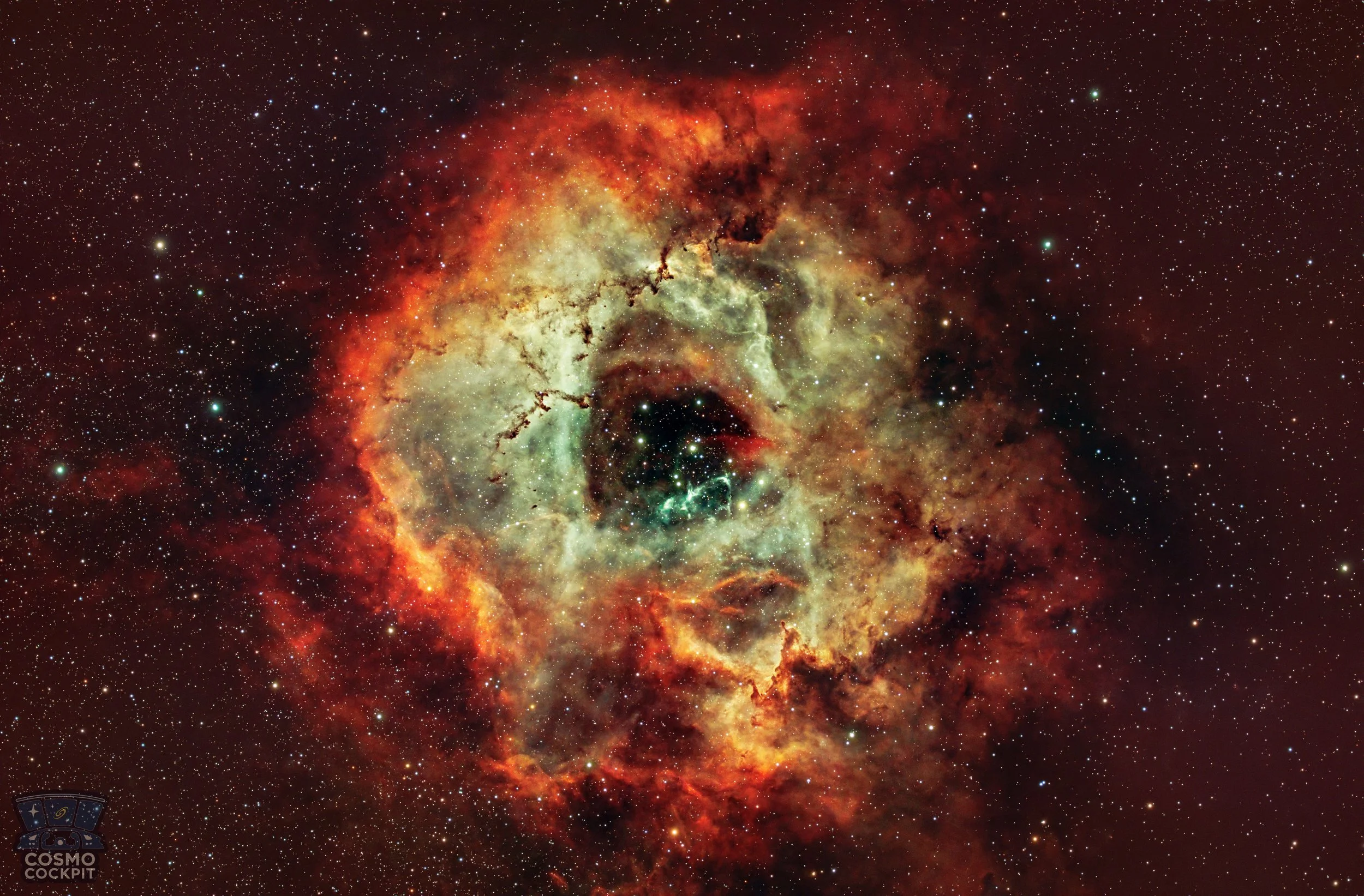
The Rosette Nebula: its hydrogen petals, sculpted by stellar winds and radiation, form one of the most iconic shapes in the night sky. 8 hours of integration (96 photos - 5 minutes each) - 6 hours narrowband (Ha + OIII) and 2 hours multiband (Optolong L-Pro) filters.
History
The open cluster at the heart of the Rosette Nebula was first documented on February 17, 1690, by British astronomer John Flamsteed. William Herschel cataloged it in 1784, describing a “beautiful cluster of scattered stars.” In the 19th century, astronomers like Albert Marth and Lewis Swift identified the surrounding nebulosity, which Dreyer later cataloged as NGC 2237, NGC 2238, and NGC 2246.
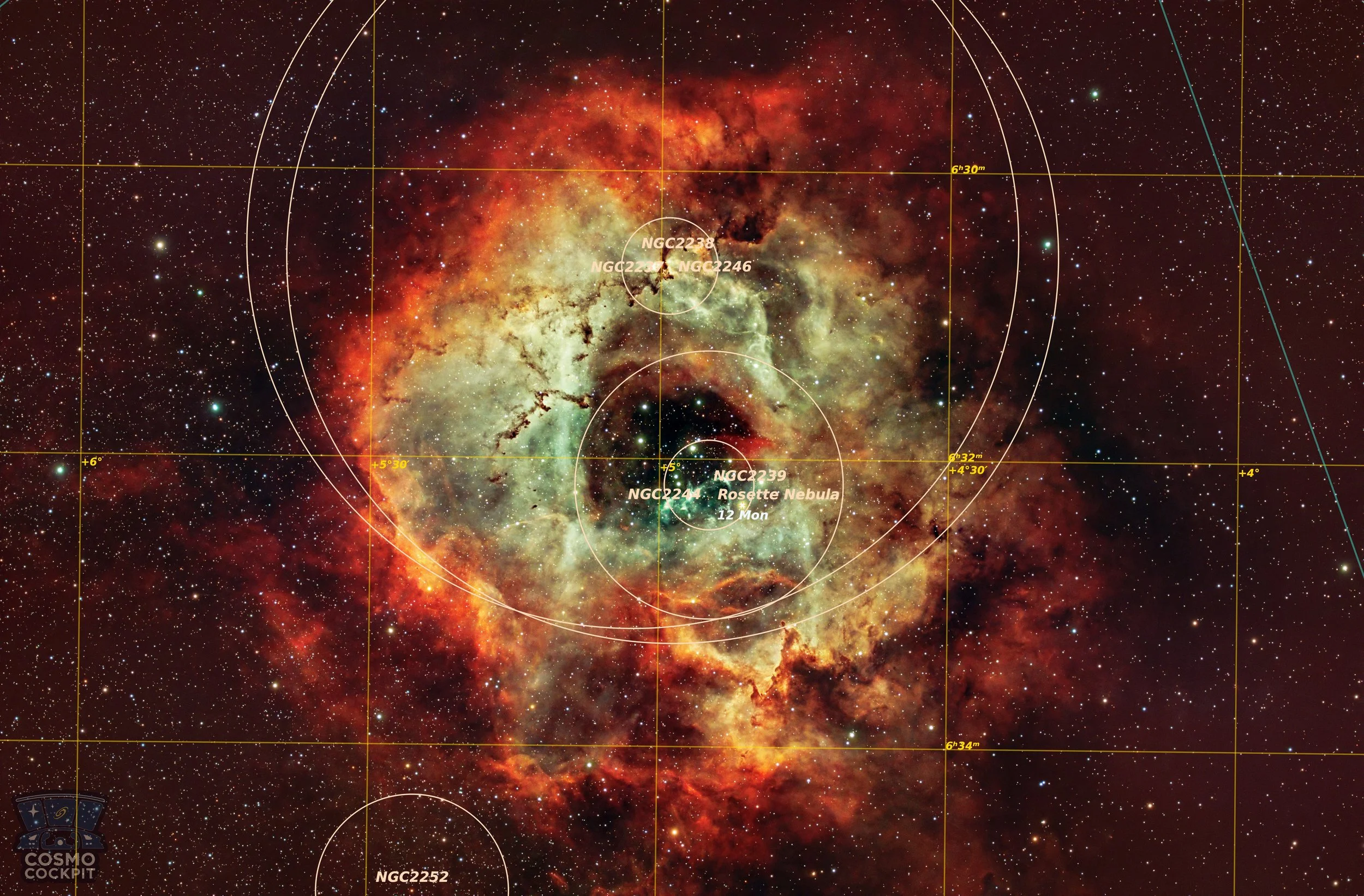
This annotated image of the Rosette Nebula reveals the full structure of this large H II region embedded in the Monoceros Molecular Cloud Complex. The plate‑solved field highlights the nebula’s circular ionized shell, carved by the young open cluster NGC 2244 at its center.
Astrophysics
The Rosette Nebula is a large H II region embedded in the Monoceros Molecular Cloud Complex, shaped primarily by the radiation field and stellar winds from the central open cluster NGC 2244. Its ionized hydrogen shell expands into the surrounding molecular material, creating the characteristic cavity and filamentary structures visible in deep exposures.
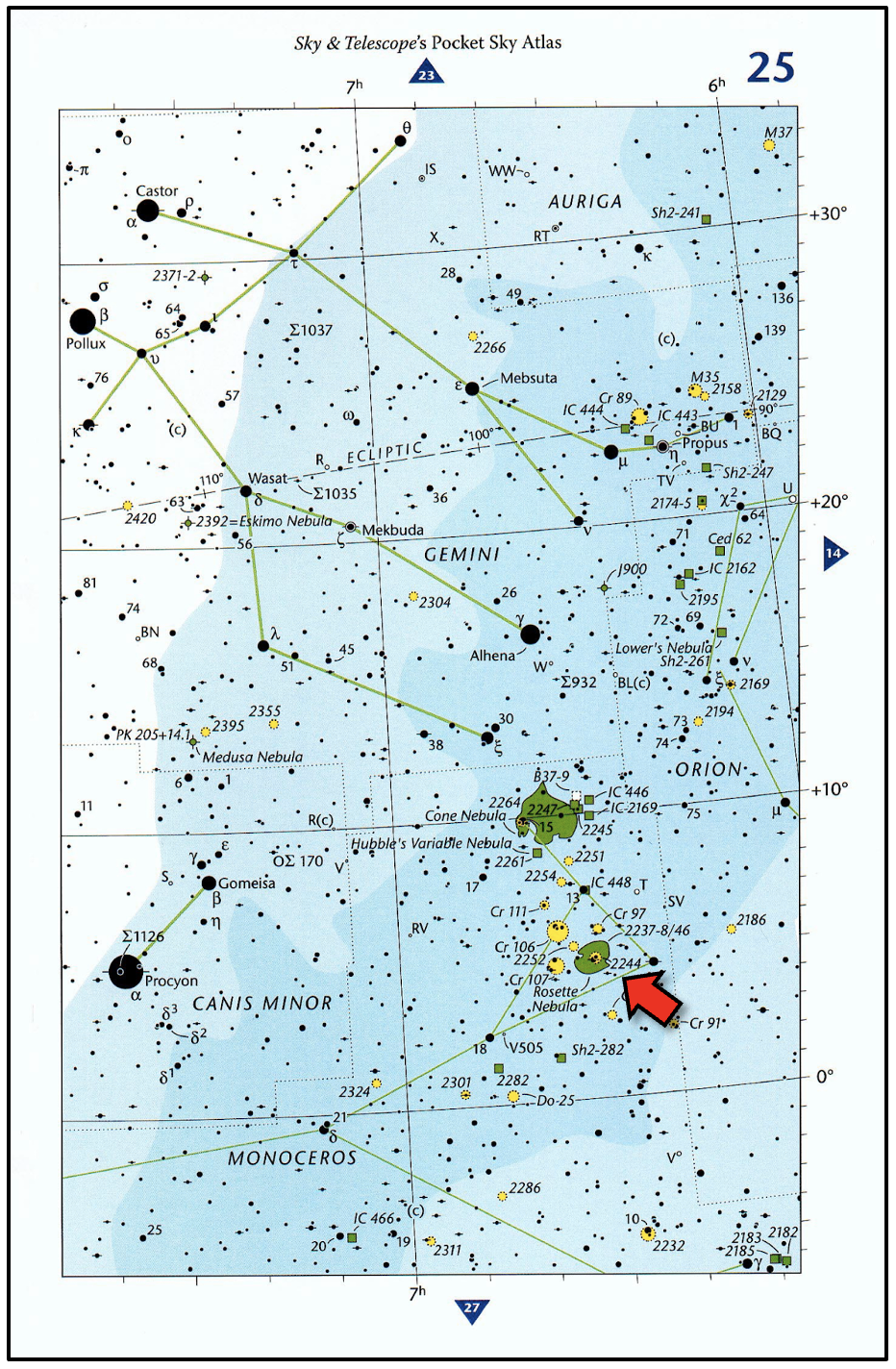
The Rosette Nebula lies in the heart of the constellation Monoceros, west of Orion’s Belt and between the bright stars Betelgeuse and Procyon, occupying a rich region of the winter Milky Way. Sky and Telescope's Pocket Sky Atlas - Roger W. Sinnott.
What makes the Rosette Nebula special:
A stellar nursery 5,000 light-years away: It contains about 10,000 solar masses of gas and dust, making it a stellar nursery (observations with the Chandra X-ray Observatory have revealed approximately 2,500 young stars within the nebula). These massive stars drive intense stellar winds that sculpt the nebula and create the ionized bubble at its center.
Powered by the open cluster NGC 2244: These young, massive stars carved out the nebula’s central cavity.
Rich in hydrogen-alpha emission: The nebula’s signature red tones come from ionized hydrogen excited by ultraviolet radiation.
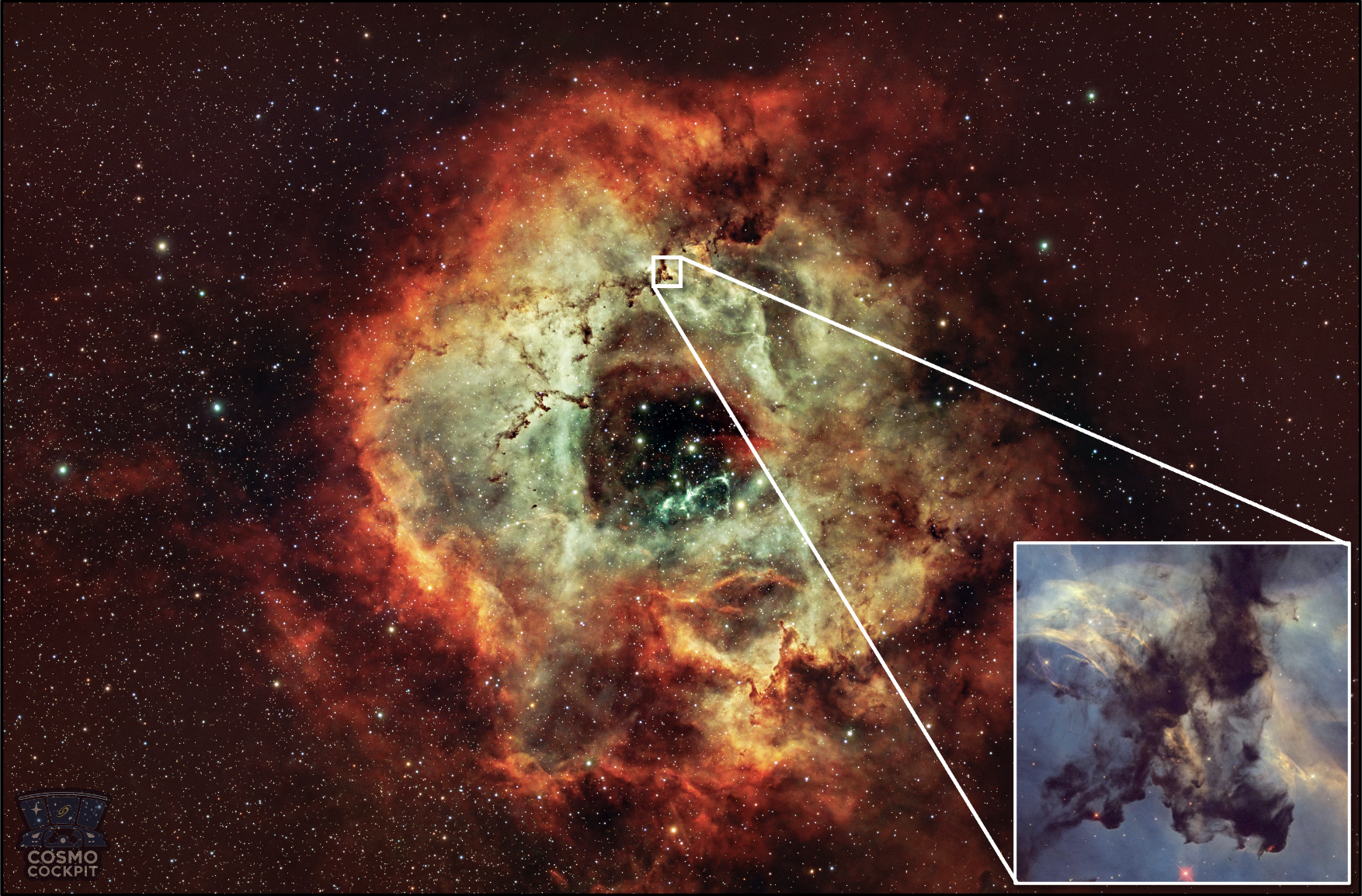
The Hubble Space Telescope zooms into a small portion of the Rosetta Nebula, only 4 light-years across (the approximate distance between our Sun and the neighbouring Alpha Centauri Star System). Dark clouds of hydrogen gas laced with dust are silhouetted across the image. The clouds are being eroded and shaped by the seething radiation from the cluster of larger stars in the center of the nebula (NGC 2440). An embedded star is seen at the tip of a dark cloud (the bottom-right portion of the image), launching jets of plasma that are crashing into the cold cloud around it. The resulting shock wave is causing a red glow. The colours are due to the presence of hydrogen, oxygen, and nitrogen. Credit: NASA, ESA, STScI.
Observation
For amateur astronomers, the Rosette Nebula is a rewarding target, especially under dark skies:
It can be glimpsed with the unaided eye using averted vision (i.e., looking slightly to the side to make it more visible);
Binoculars readily resolve the cluster, while small telescopes at low magnifications reveal the nebula’s ghostly, irregular patches. The cluster’s brightest stars are neatly arranged into two rows of three stars, with yellowish 12 Monocerotis prominently visible as a foreground star.
Astrophotography Tips
Prioritize long integration: The Rosette’s faint outer halo benefits enormously from extended exposure time. Aim for several hours to smooth noise and reveal low‑contrast structures.
Use narrowband filters for structure: Hα, O III, and S II filters isolate the nebula’s emission regions and help control light pollution, especially in urban or suburban skies.
Dial in consistent guiding: The Rosette’s fine dust lanes and filamentary edges demand tight stars. Stable guiding throughout the session preserves detail and makes processing far easier.
Watch your framing: The nebula is larger than many expect. A slightly wider field of view helps capture the whole “flower” shape without clipping the outer petals.
Check our post in AstroBin.