Horsehead and Flame Nebulae — A Fiery Duo in Orion’s Belt
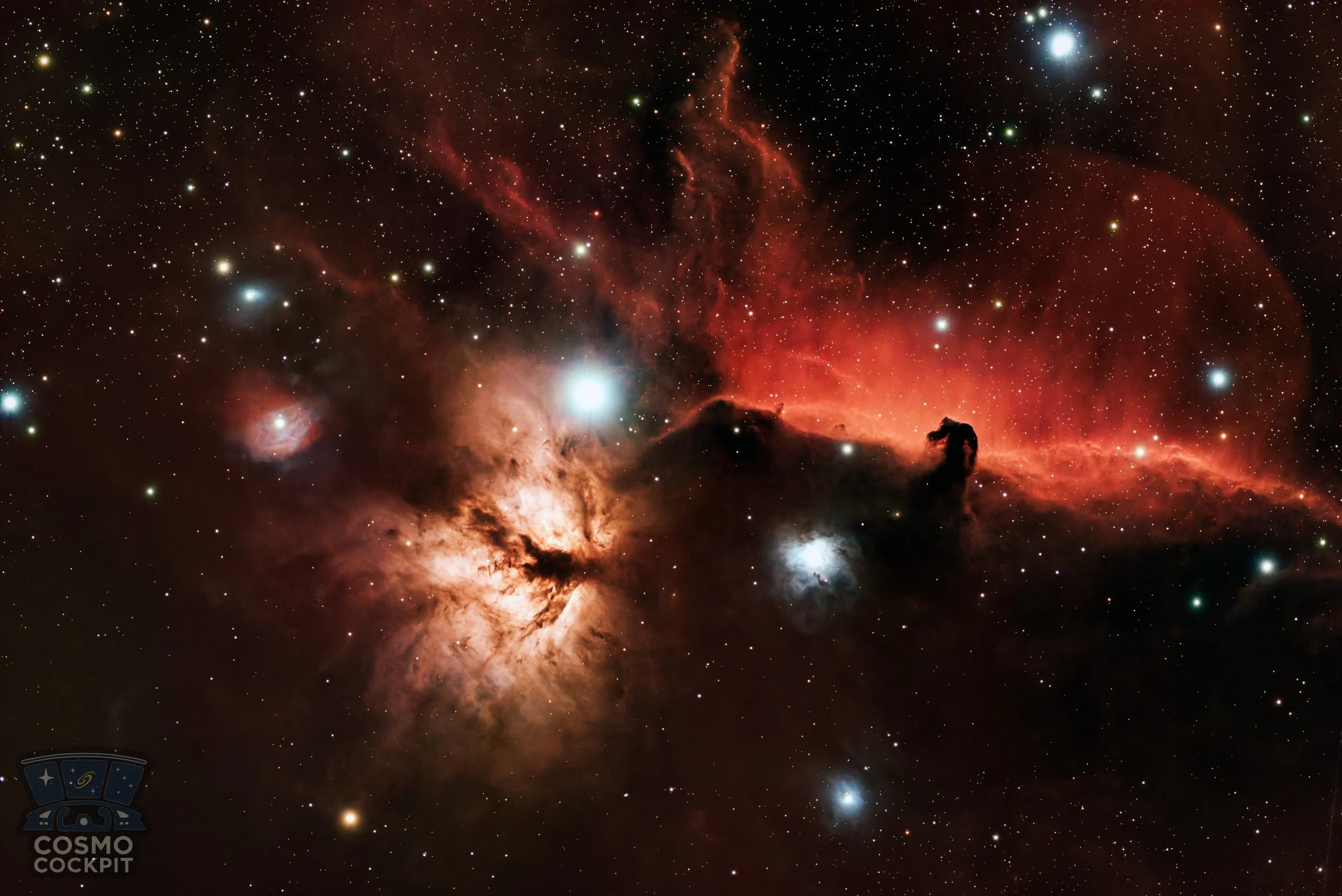
A 7 hours and 45 minutes total exposure time into Orion’s most dramatic region: The Horsehead Nebula (Barnard 33) and the Flame Nebula (NGC 2024) rise from the glowing hydrogen clouds near Alnitak, the easternmost star of Orion’s Belt. This field blends bright emission, dark dust pillars, and newborn stars into one of the sky’s most dramatic regions.
Few regions of the night sky capture the imagination quite like the area around Alnitak, the easternmost star in Orion’s Belt. Here, two iconic nebulae — the Horsehead Nebula (Barnard 33) and the Flame Nebula (NGC 2024) — sit side by side in a cosmic tableau of dust, fire‑like glow, and newborn stars. This field is a favourite among astrophotographers, not only for its beauty but also for the challenge it presents: bright stars, faint dust, and complex emission structures all compete for attention.
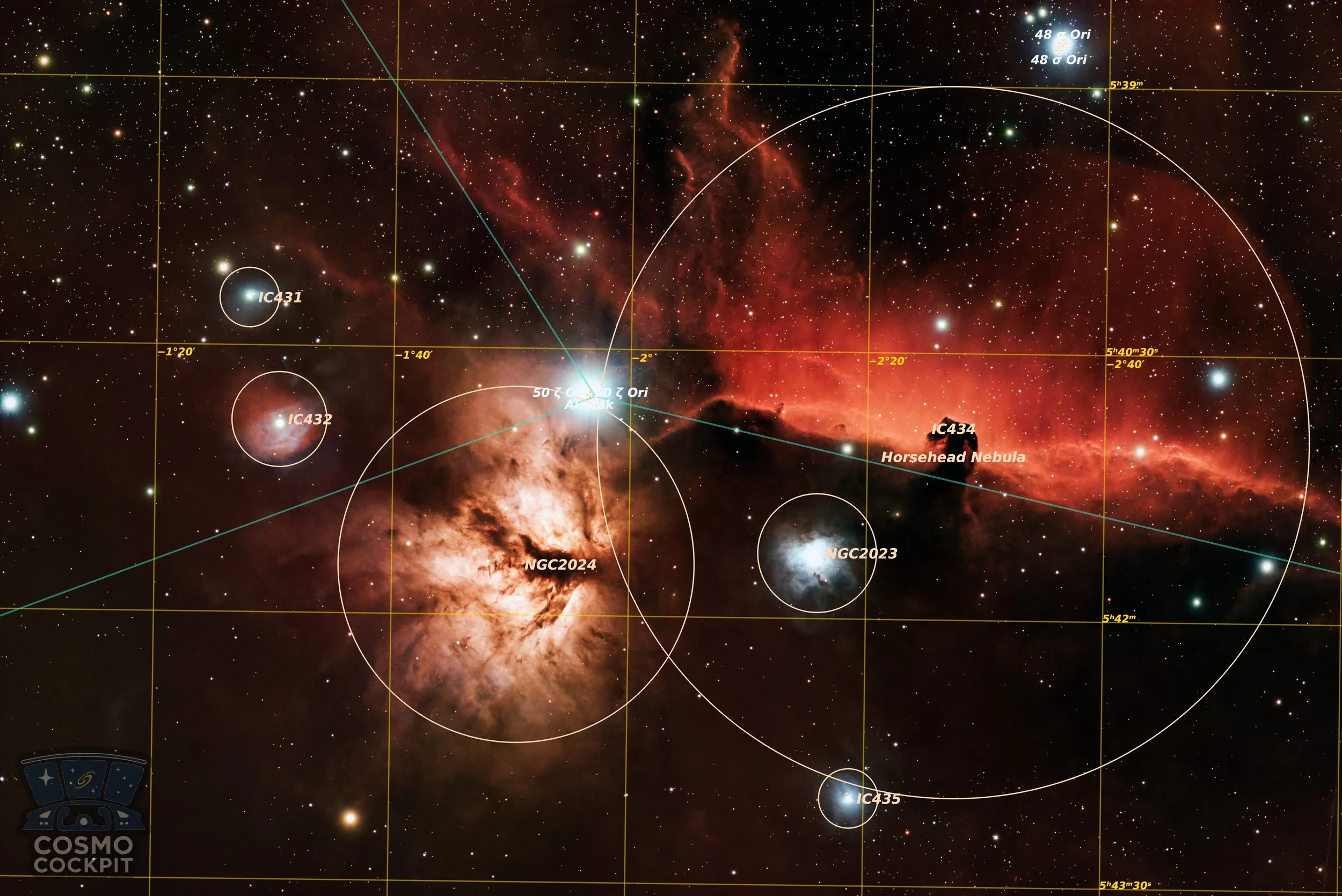
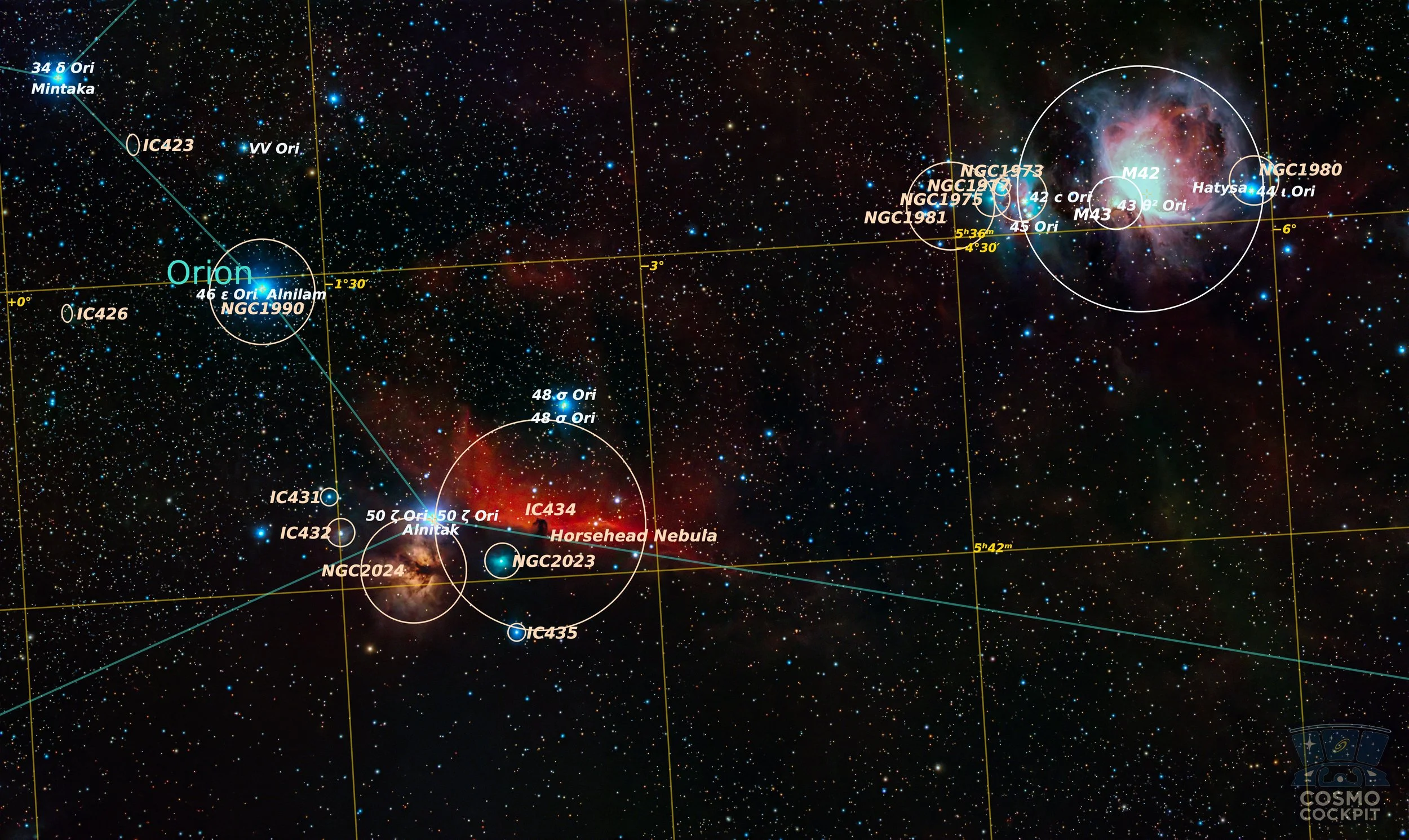
The Horsehead (Barnard 33) and the Flame (NGC2024) Nebulae. Plate solved and annotated in PixInsight.
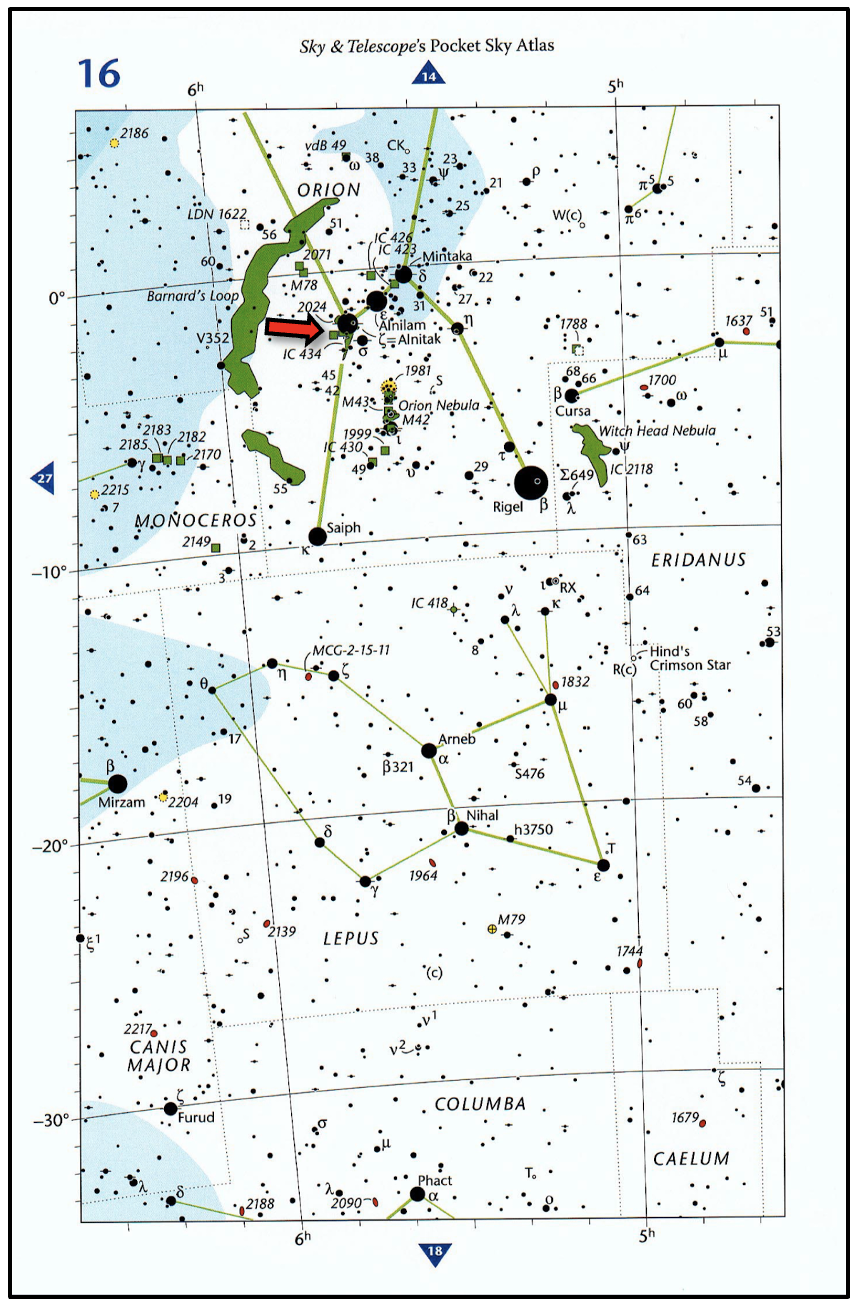
Sky and Telescope's Pocket Sky Atlas - Roger W. Sinnott.
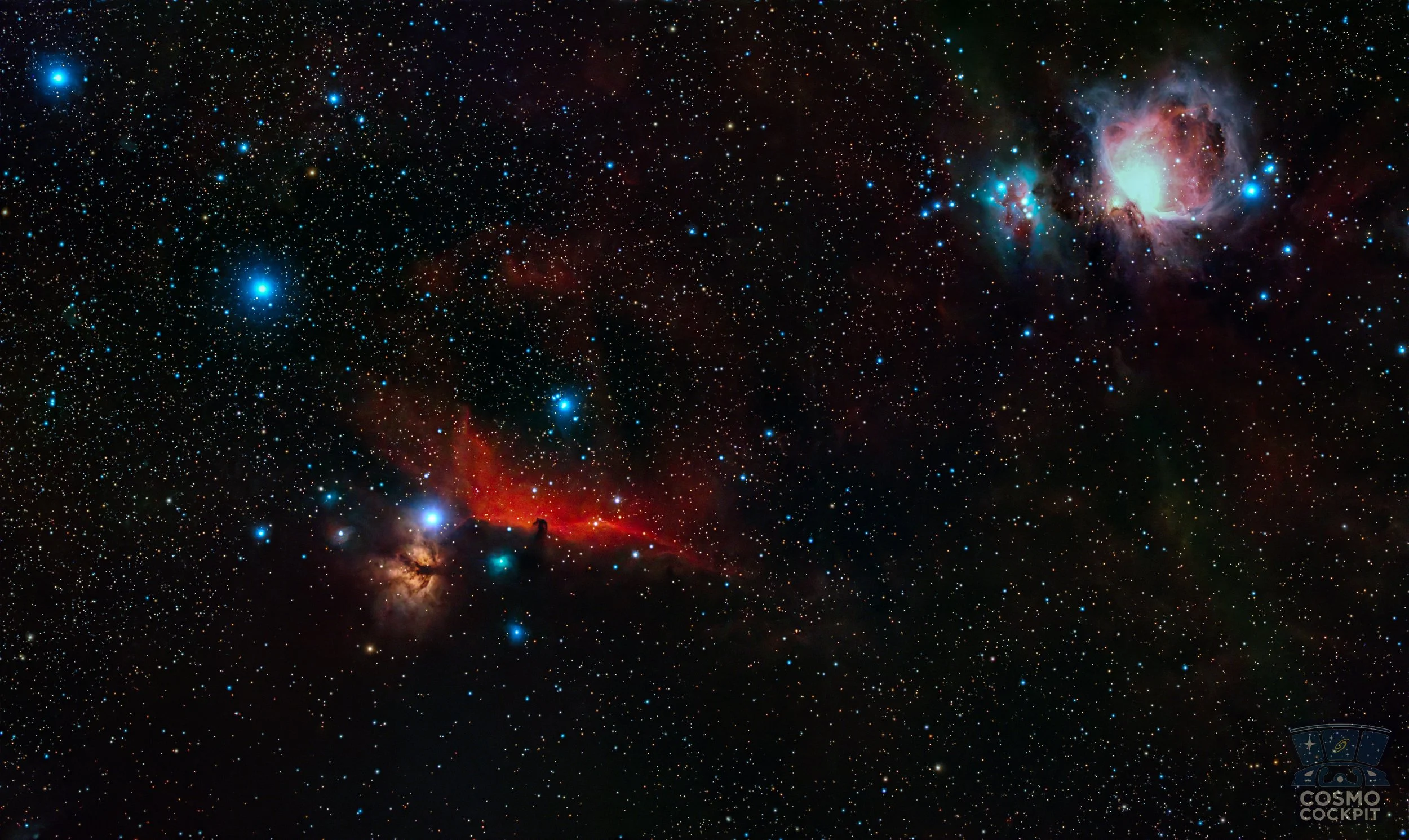
The Orion Complex from Alnitak to M42: A sweeping look across Orion’s Belt and Sword, where glowing hydrogen clouds, dark dust lanes, and newborn stars coexist in one of the night sky’s most vibrant neighborhoods. From the Horsehead and Flame to the Running Man and the Great Orion Nebula, this field captures the constellation’s most iconic structures in a single frame.
Astrophysics
Beyond its visual appeal, the Horsehead and Flame Nebulae are part of a vast star‑forming complex stretching across Orion. Studying these regions helps astronomers understand:
How massive stars shape their environments;
How radiation sculpts molecular clouds; and
How new stars emerge from collapsing gas and dust.
The Flame Nebula (NGC 2024)
The Flame Nebula earns its name from its fiery appearance — a glowing cloud of hydrogen gas illuminated by the intense ultraviolet radiation of nearby Alnitak.
Distance: around 1,350 light‑years;
Type: Emission nebula;
What’s happening: A cluster of young, massive stars is buried inside, their radiation carving out dark lanes and lighting up the surrounding gas.
Why it glows: UV light strips electrons from hydrogen atoms; when they recombine, they emit the deep red H‑alpha light.
The Horsehead Nebula (Barnard 33)
One of the most recognizable shapes in the night sky, the Horsehead is actually a dense pillar of cold molecular gas silhouetted against the bright emission nebula IC 434.
Distance: approximately 1,375 light‑years;
Type: Dark nebula;
What’s happening: Stellar winds and radiation sculpt the cloud into its iconic shape;
Why it’s dark: The dust is so thick that it blocks visible light, allowing only infrared wavelengths to pass through.
Together, these nebulae form a striking contrast: one blazing with ionized gas, the other a shadowy silhouette carved by stellar forces.
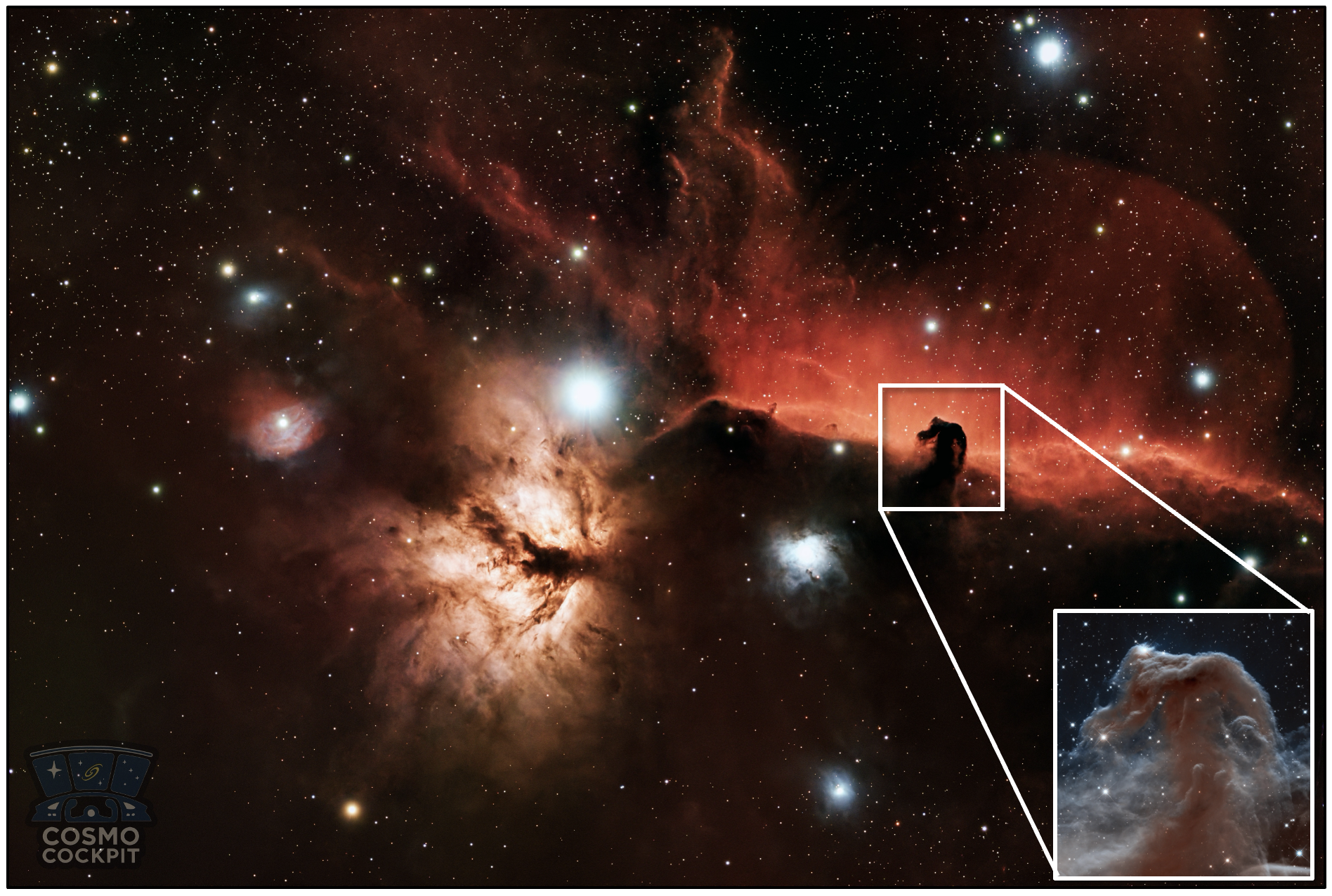
Astronomers have used NASA's Hubble Space Telescope to photograph the iconic Horsehead Nebula in a new infrared light to mark the 23rd anniversary of the famous observatory's launch aboard the space shuttle Discovery on April 24, 1990.
Observation
Although the Horsehead and Flame Nebulae are well known in astrophotography, observing them visually is a very different experience. Here’s what skywatchers can expect:
The Flame Nebula: Visible in medium‑to‑large telescopes (20 cm aperture and above) from dark skies. It appears as a bright, irregular glow with a dark lane cutting through it — the “flame” shape is subtle but recognizable.
The Horsehead Nebula: A true challenge object. Under excellent conditions, with an H‑beta filter and a 28 cm aperture telescope, the Horsehead appears as a small notch or indentation against the faint glow of IC 434.
Alnitak’s influence: The star’s brightness can make visual observation difficult. Using a filter and shielding against stray light improves contrast.
The best time to observe Orion is from December to February, when it is highest in the sky, offering the best transparency and least atmospheric distortion.
Urban expectations: From light‑polluted areas, the Flame may be faintly detectable with filters, but the Horsehead is generally beyond visual reach — making astrophotography the ideal way to explore it.
Astrophotography Tips
Imaging this region is a rite of passage for many astrophotographers — and a technical challenge worth embracing. Here are some field‑tested strategies to help others get the most out of this iconic target:
Tame Alnitak’s glare: This star is bright. Use shorter sub‑exposures for star control, or blend a separate star layer to preserve colour without blowing out the core.
Use narrowband or dual‑band filters: H‑alpha is your best friend here. It cuts through light pollution and enhances the Flame’s structure while helping the Horsehead stand out against IC 434.
Dial in precise framing: The Horsehead sits lower in the frame than many expect. A small rotation or slight offset can dramatically improve composition.
Watch your histogram: The Flame Nebula’s bright core and the Horsehead’s faint dust require careful exposure. Aim for a histogram that avoids clipping on both ends.
Prioritize long integration time: The dust lanes around the Horsehead are subtle. More hours = smoother gradients and better separation from the background.
Use gentle noise reduction: Over‑processing can erase the delicate texture of the dust. Work in stages and mask selectively.
Blend stars thoughtfully: Star reduction or star‑separated workflows help keep the viewer’s attention on the nebulae rather than Alnitak’s diffraction spikes.
Check our post in AstroBin.