Veil Nebula — The Shattered Echo of a Dying Star
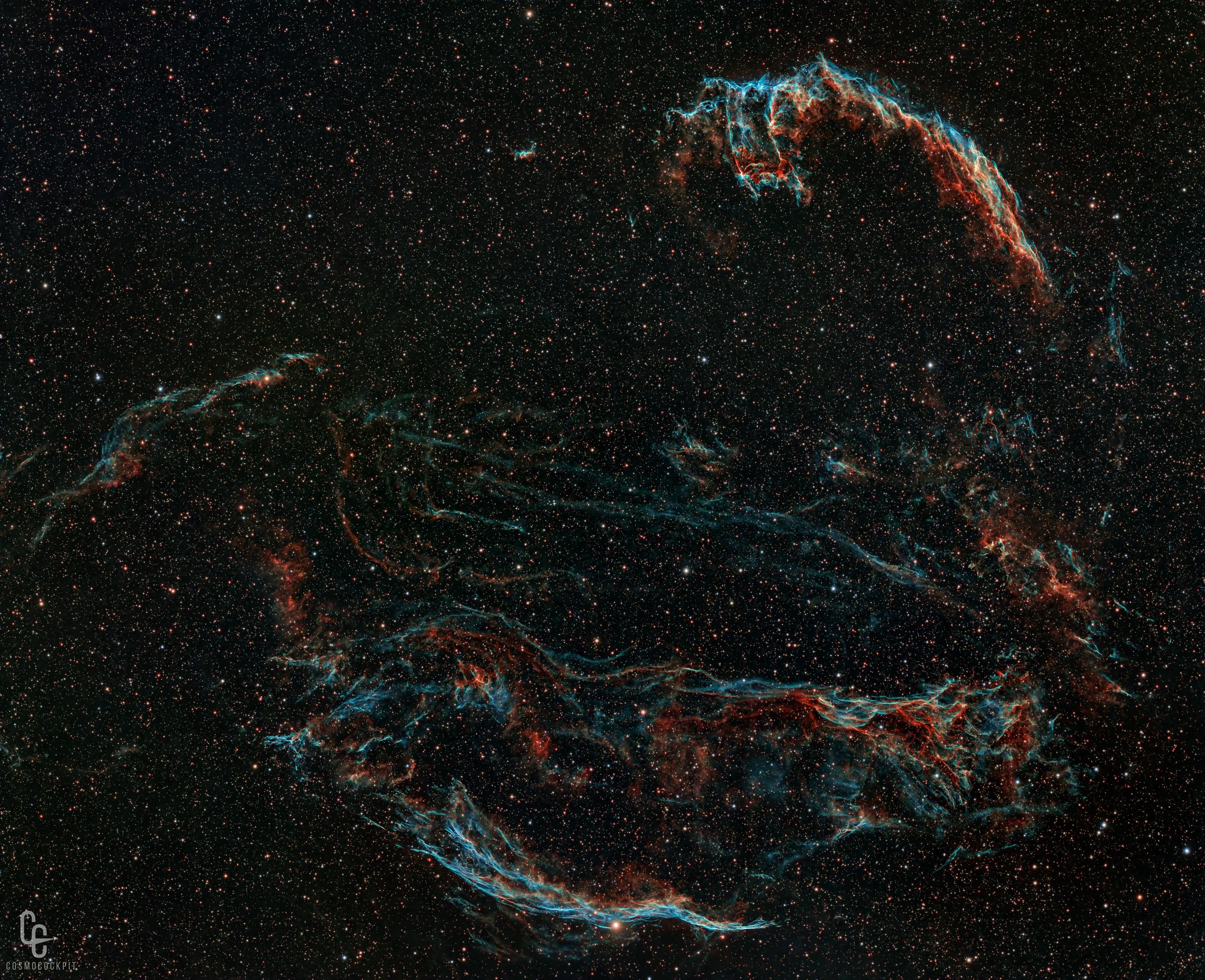
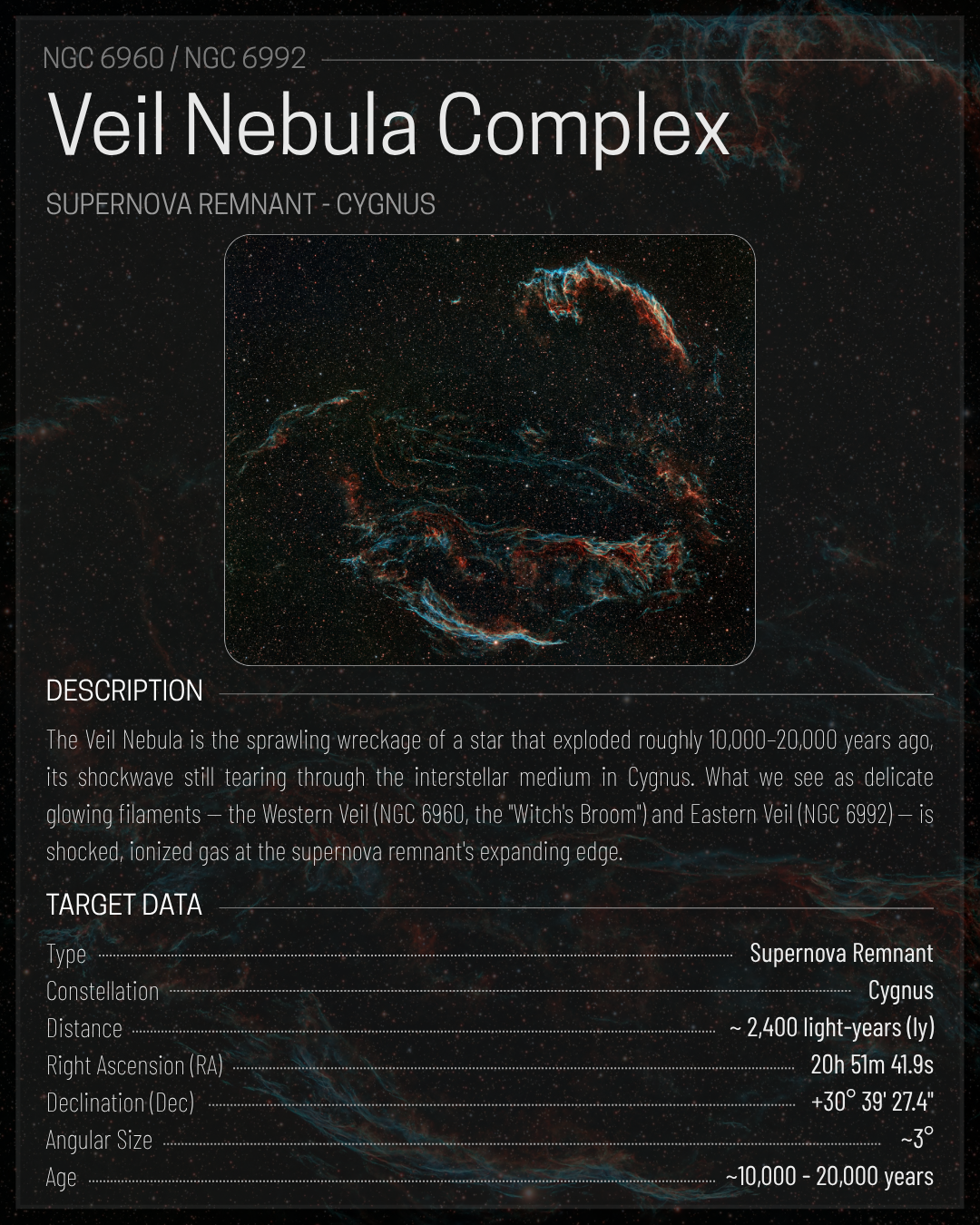
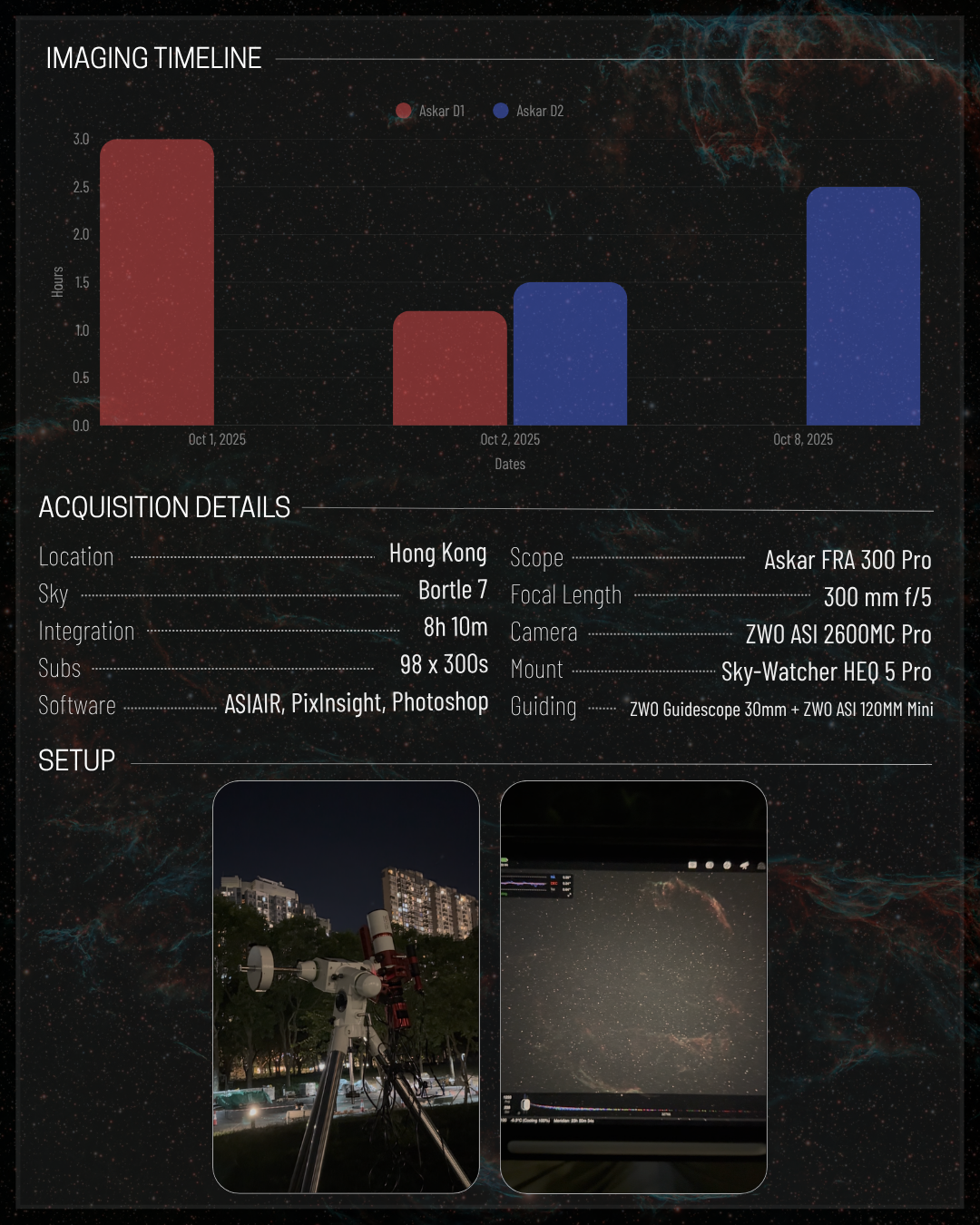
A supernova’s long‑fading footprint: Around 10,000–20,000 years ago, a massive star — roughly 20 times the mass of the Sun — reached the end of its life and exploded in a spectacular supernova. At the moment of detonation, it would have shone brighter than Venus and been visible even in daylight. What remains today is the Cygnus Loop, a vast bubble of expanding debris. Photo obtained after 8 hours of exposure, divided between Ha, OIII, and SII filters.
The Veil Nebula - a sprawling supernova remnant in the constellation Cygnus. Its delicate filaments, glowing arcs, and ghostly wisps of ionized gas stretch across a region of sky six times wider than the full Moon. A breathtaking reminder of both the violence and beauty of stellar evolution.
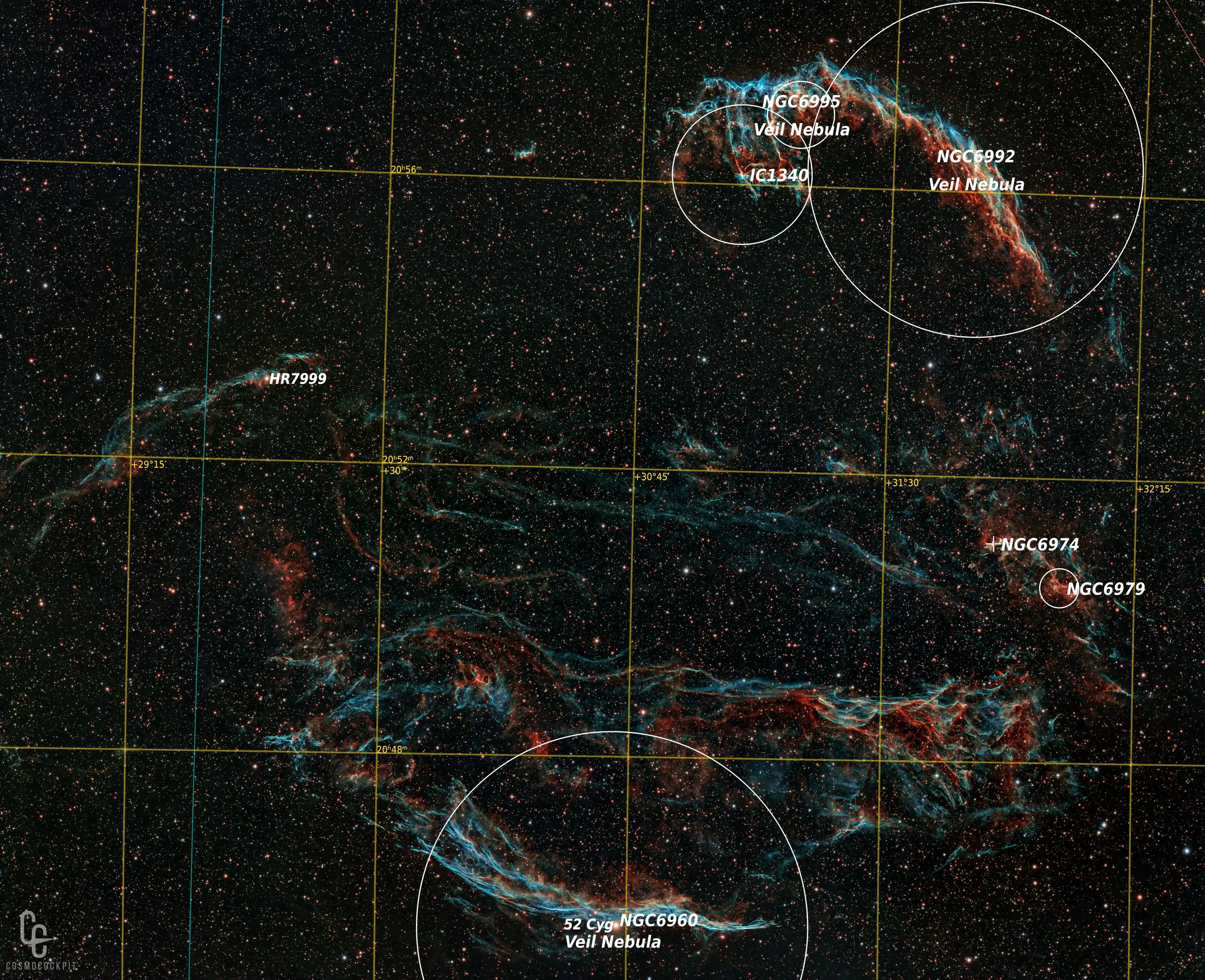
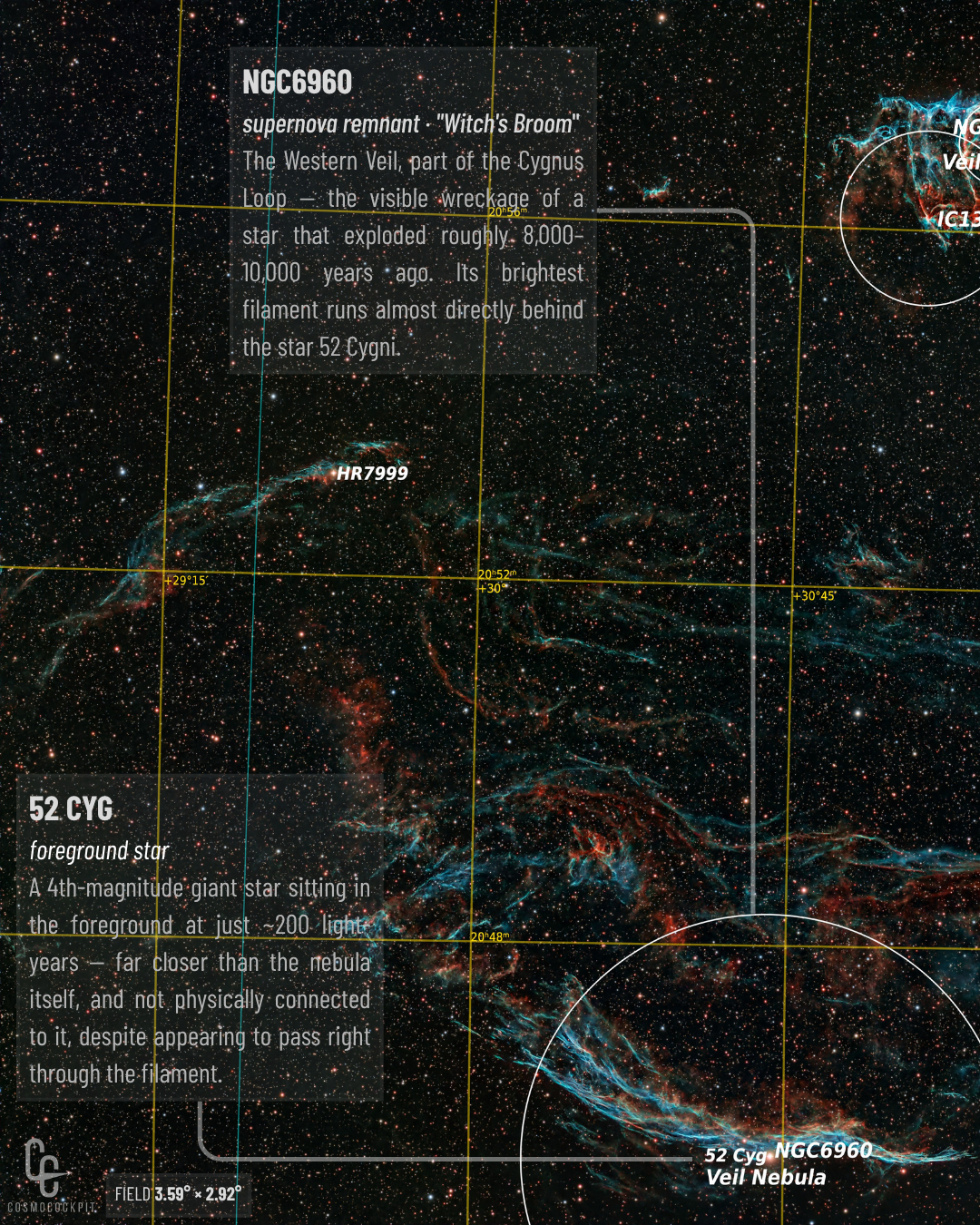
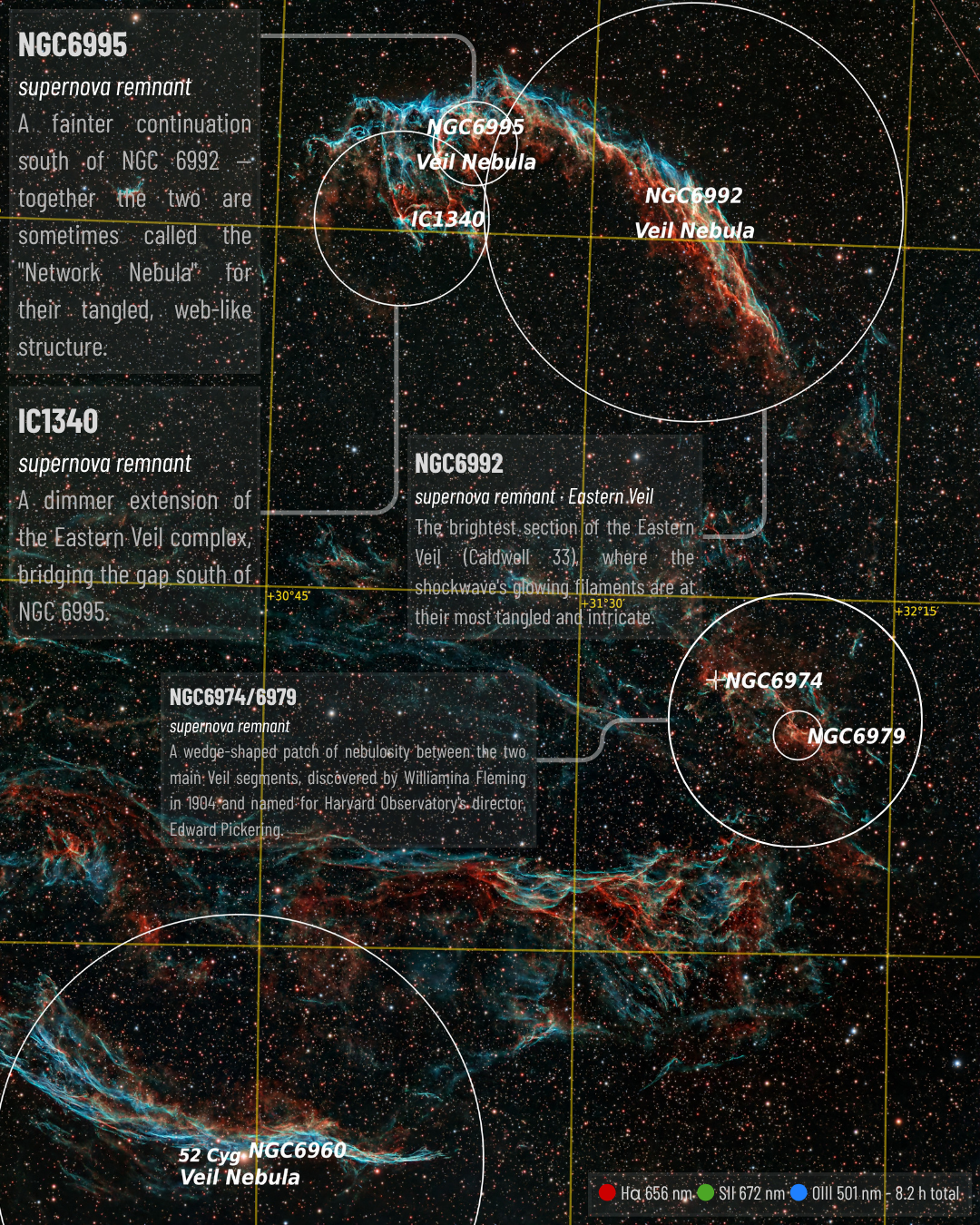
A tangle of cosmic filaments: The Veil Nebula represents the brightest and most intricate portions of this structure, catalogued under several designations: NGC 6960, NGC 6992, NGC 6995, NGC 6974, NGC 6979, and IC 1340. Plate solved and annotated in PixInsight.
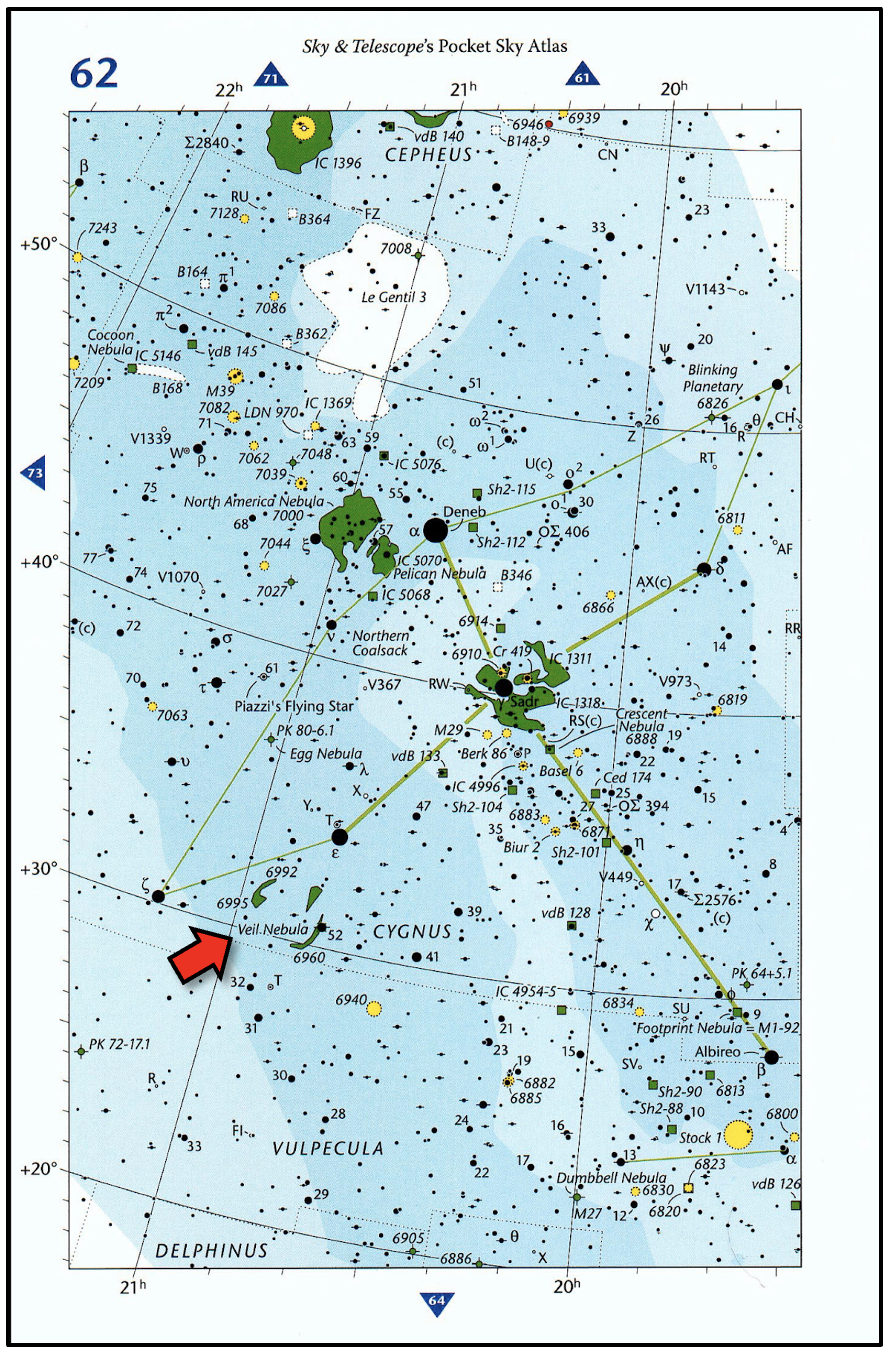
The Veil Nebula sits in the rich star fields of Cygnus, making it a prime summer target for observers in the Northern Hemisphere. Sky and Telescope's Pocket Sky Atlas - Roger W. Sinnott.
Astrophysics
The Veil Nebula lies about 2,400 light‑years from Earth, based on modern astrometric measurements.
The nebula’s appearance is shaped by shock fronts created as the supernova blast wave plows through the interstellar medium at speeds up to 600,000 km/h. These shocks heat the gas to millions of degrees before it cools and emits light in distinct wavelengths. The brighter regions correspond to where the shock wave encounters relatively dense material.
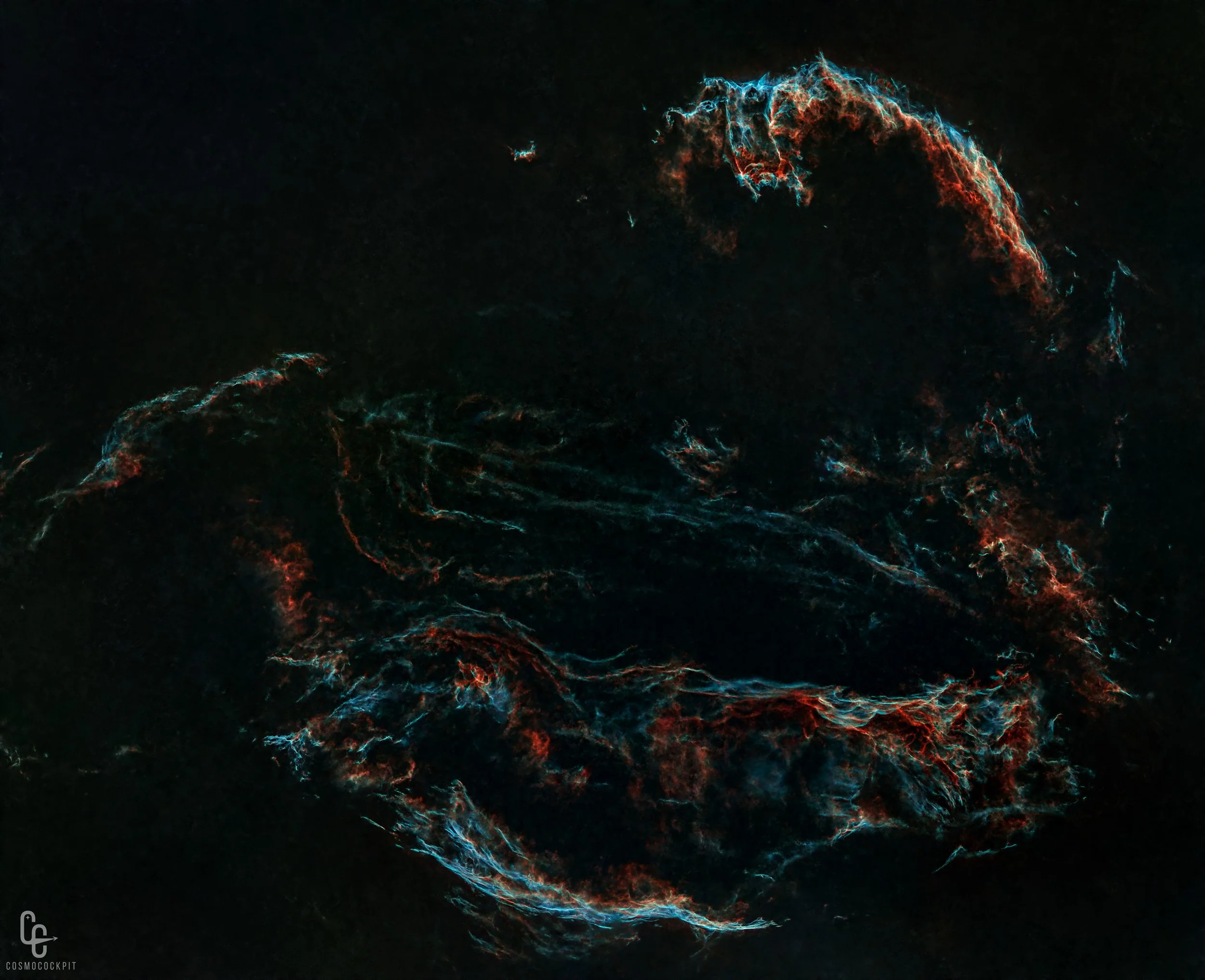
The Veil Nebula appearance after star removal by PixInsight. Filaments of ionized gas trace the shockwave of a star that died around 10,000 years ago.
Key emission lines include:
Hydrogen-alpha (Hα) — deep reds;
Doubly ionized oxygen (OIII) — teal and blue;
Singly ionized sulfur (SII) — deep crimson.
These elements trace the complex, rope‑like filaments that make the Veil Nebula so visually striking in narrowband imaging.
Because of its proximity, size, and unobscured location in our galaxy, the Veil Nebula is considered a textbook example of a middle‑aged supernova remnant. It offers astronomers a rare opportunity to study:
Shock physics;
Elemental enrichment of the interstellar medium;
The long‑term evolution of supernova debris.
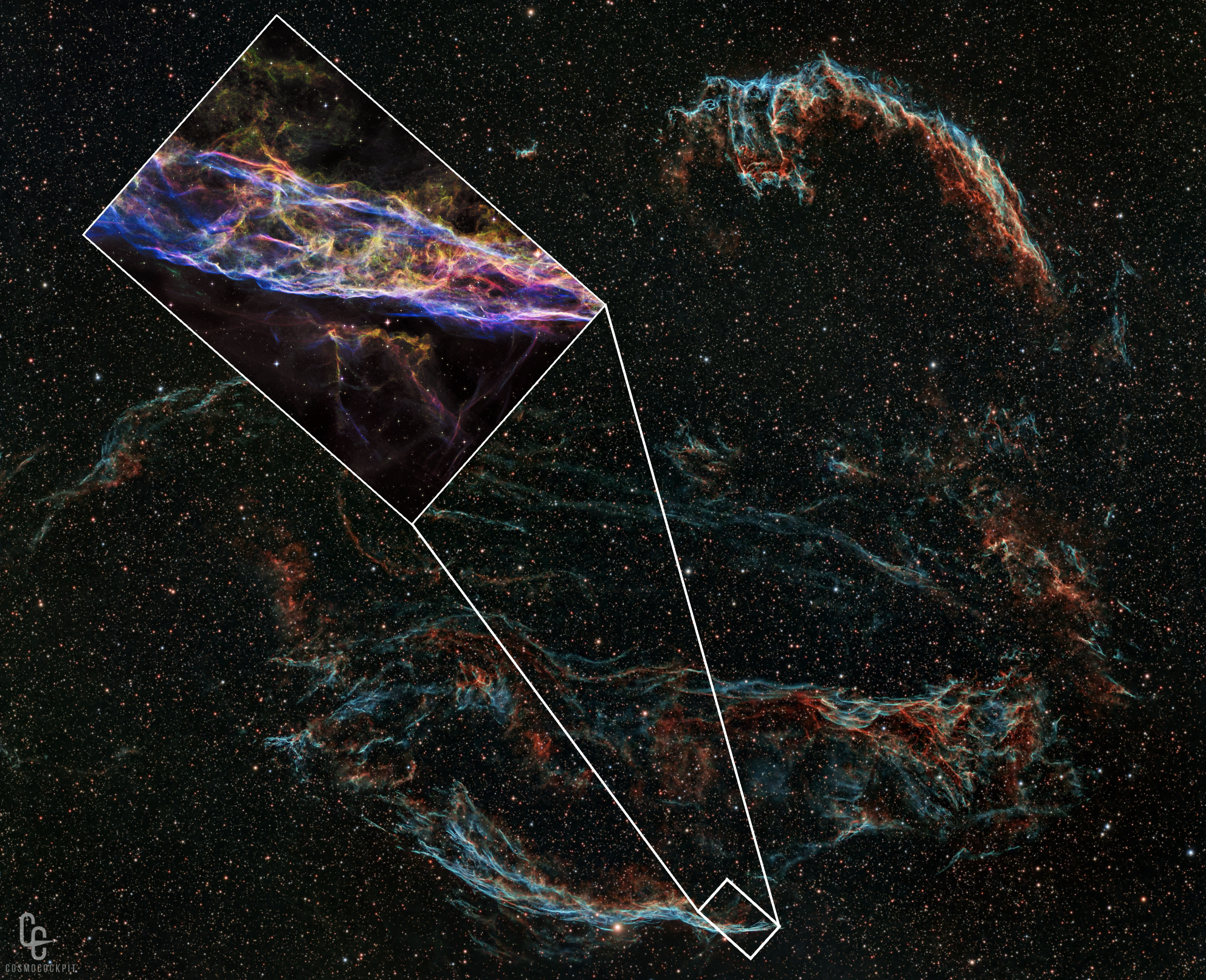
NASA's Hubble Space Telescope has unveiled in stunning detail a small section of the Veil Nebula. The image shows an incredible array of structures and detail from the collision between the blast wave and the gas and dust that make up the cavity wall.
Astrophotography Tips
The Veil Nebula is a narrowband dream and a perfect canvas for creative imaging.
Framing: Choose between wide-field mosaics or tight compositions of the Witch’s Broom (NGC 6960) or Eastern Veil.
Filters: Use Hα, O III, and S II for full SHO mapping. Dual-band filters also work well in light-polluted areas.
Exposure: Long integrations (10+ hours) reveal fine filaments and dynamic range. Dither and calibrate carefully.
Processing: Emphasize contrast between OIII and Hα to highlight shock fronts. Use star reduction to enhance filament detail.
Color Palette: SHO (Hubble Palette) gives a classic look, but HOO or custom blends can evoke different moods.