Christmas Tree and the Hubble’s Variable Nebulae: a Star‑Forming Wonderland in Monoceros
The region of NGC 2264 is one of the most enchanting corners of the winter sky — a tapestry of glowing hydrogen gas, delicate reflection nebulae, and a young open cluster shaped uncannily like a Christmas tree. Nestled within the same frame lies another gem: the Hubble’s Variable Nebula, a small but captivating reflection nebula whose brightness and shape change over time. Together, they form a dynamic portrait of stellar birth and cosmic motion.
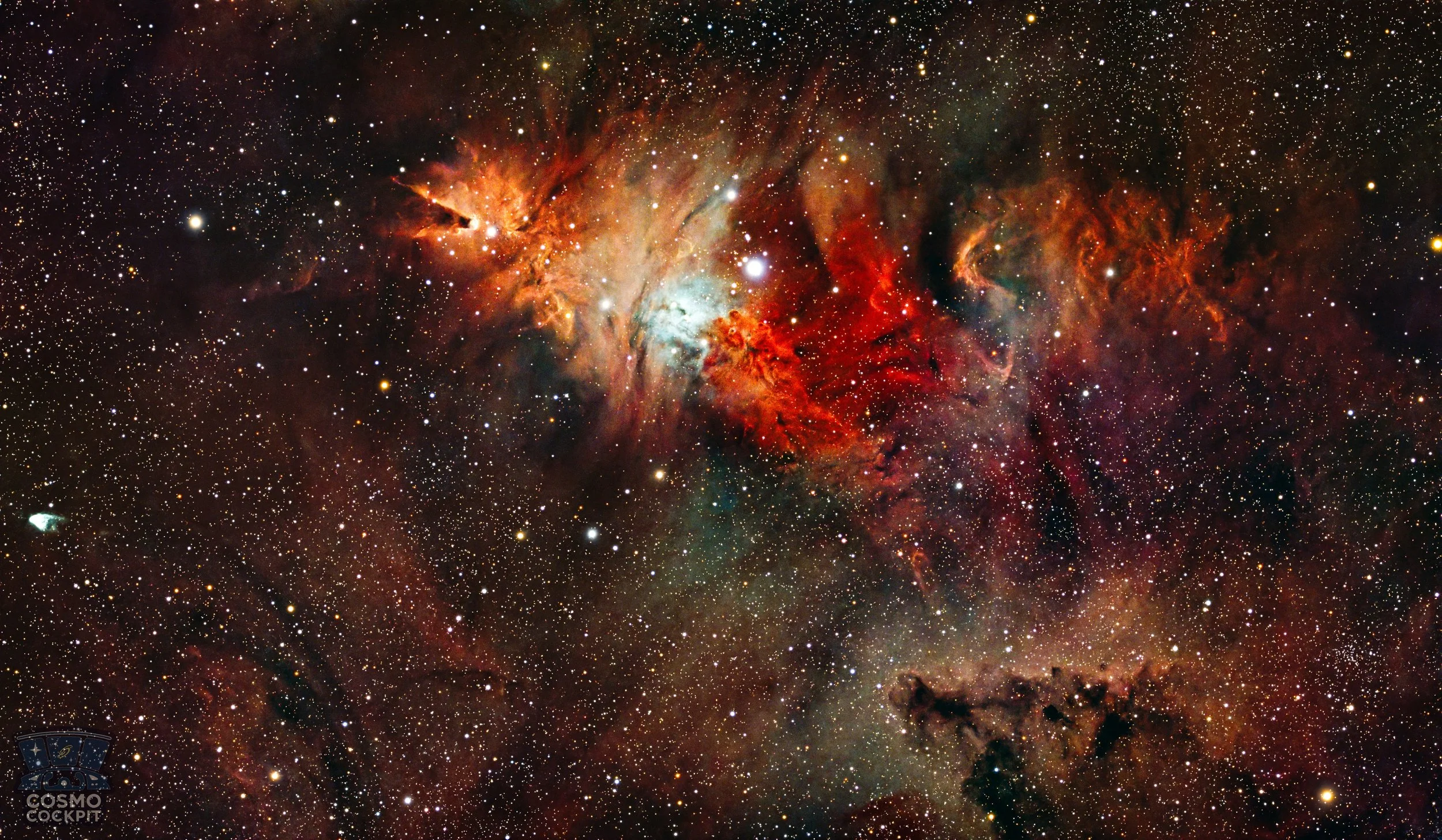
The Christmas Tree and the Hubble’s Variable Nebula in Monoceros — a vibrant star‑forming region where newborn stars illuminate clouds of hydrogen gas and drifting dust. The bright triangular cluster forms the “tree,” while the small fan‑shaped glow of Hubble’s Nebula reflects the flickering light of the young star R Monocerotis. Captured under Bortle 7 skies after 7 hours and 50 minutes total exposure time, this frame reveals both the structured emission nebulae and the delicate blue reflections that make NGC 2264 one of winter’s most enchanting sights.
History
The Christmas Tree Nebula and its surrounding complex were first catalogued in the 18th century by William Herschel, who noted the bright cluster of stars now known as NGC 2264. The triangular arrangement of its brightest members inspired the “Christmas Tree” nickname much later, as astrophotographers began revealing the surrounding nebulosity.
The Hubble’s Variable Nebula (NGC 2261) has a more modern story. It was first described by William Herschel in 1783, but its peculiar variability wasn’t fully understood until the 20th century. The nebula became famous thanks to Edwin Hubble, who studied it extensively and published detailed photographic sequences showing its changing appearance. These variations occur not in the nebula itself, but in the light from its central star, R Monocerotis, which casts shifting shadows through surrounding dust — a cosmic lighthouse illuminating a moving fog.
This region has long been a favorite of astronomers because it offers a rare combination of beauty, dynamism, and scientific intrigue.
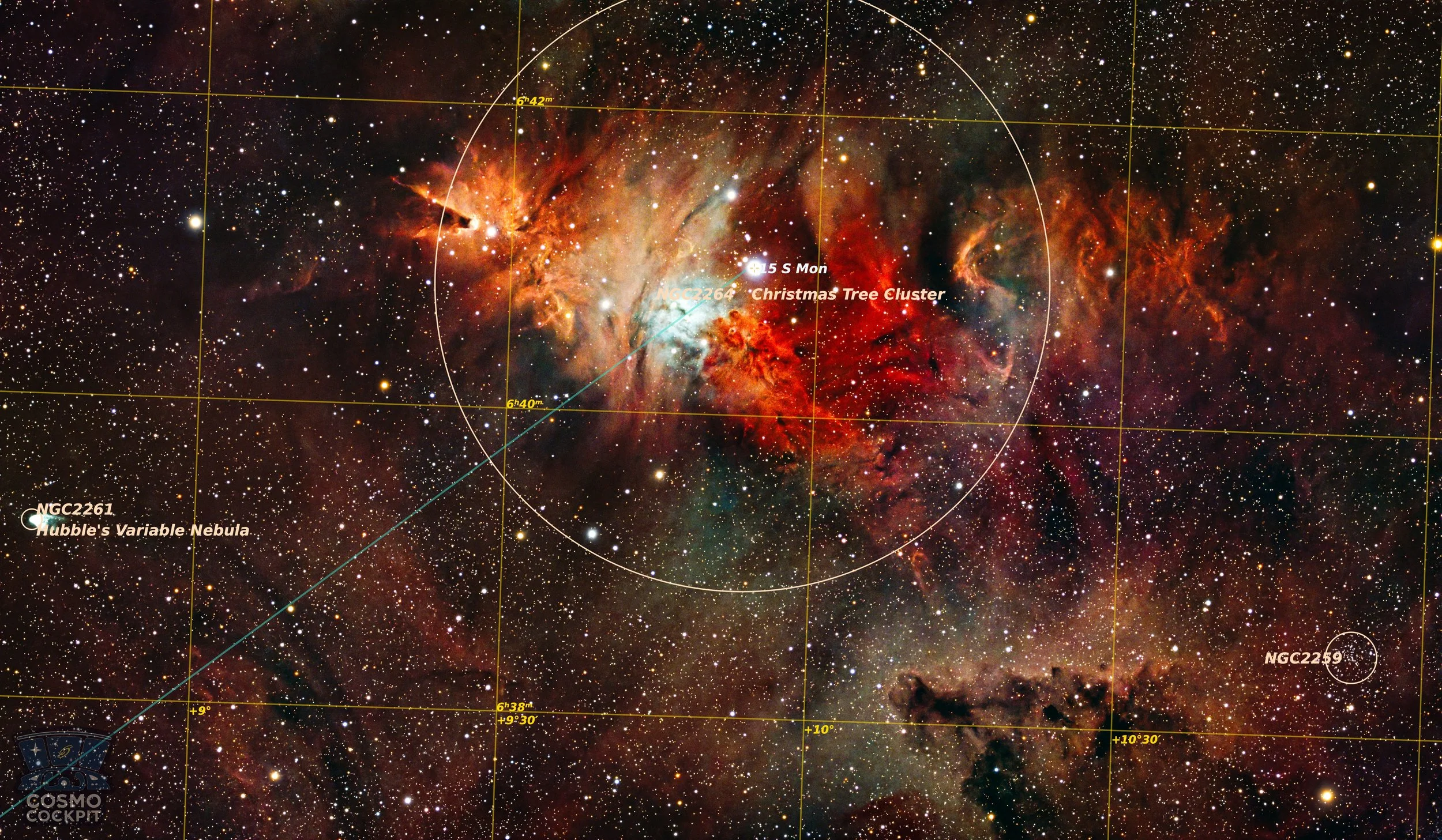
Annotated wide‑field view of the NGC 2264 region in Monoceros, showing the major structures within this active star‑forming complex. Labels mark the Christmas Tree Cluster at the center, surrounded by glowing hydrogen emission and dark dust lanes. The Cone Nebula appears to the left as a narrow, pointed pillar of obscuring gas extending downward from the cluster. To the left of the frame, the small fan‑shaped patch of Hubble’s Variable Nebula (NGC 2261) is identified near the young star R Monocerotis. Plate solved and annotated in PixInsight.
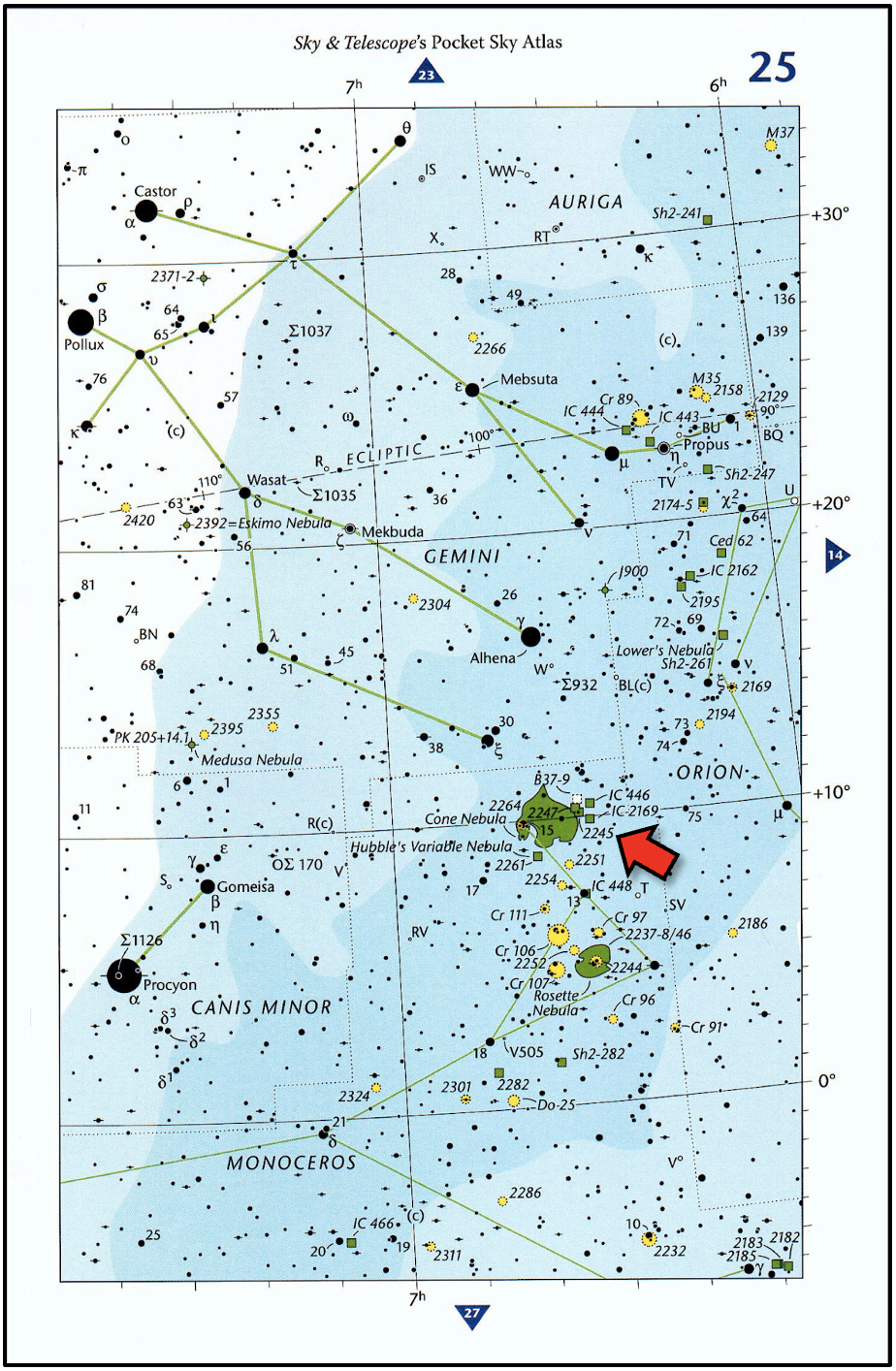
Sky atlas view of the constellation Monoceros showing the positions of the Christmas Tree Nebula (NGC 2264) and Hubble’s Variable Nebula (NGC 2261), located just east of Orion and along the rich winter Milky Way. Sky & Telescope’s Pocket Sky Atlas — Roger W. Sinnott.
Astrophysics
The NGC 2264 is not a single object but a vast star‑forming complex composed of:
The Christmas Tree Cluster — a young open cluster about 2,500 light‑years away.
The Cone Nebula — a dark pillar of cold molecular gas sculpted by stellar winds.
Bright emission nebulae glowing in hydrogen‑alpha.
Reflection nebulae illuminated by hot, young stars.
Hubble’s Variable Nebula — a reflection nebula shaped by the flickering light of R Monocerotis.
At the heart of the Christmas Tree region lies S Monocerotis, a massive star whose intense radiation energizes the surrounding hydrogen gas. This radiation carves out cavities, compresses nearby clouds, and triggers new waves of star formation.
The Cone Nebula is one of NGC 2264’s most visually striking features, resembling a towering column of gas and dust. This dense cloud is sculpted by intense stellar winds from a bright, massive star. The nebula's structure is somewhat similar to the famous Pillars of Creation in the Eagle Nebula (M16), acting as an incubator for developing stars. Over time, the radiation from young stars erodes the outer layers of the Cone, eventually leaving behind dense clumps where future planetary systems may form.
The Hubble’s Variable Nebula is a different kind of marvel. R Monocerotis is a young, unstable star surrounded by a thick, uneven disk of dust. As clumps of material orbit the star, they cast shadows onto the surrounding nebula, causing its brightness and shape to change on timescales of days to months. It is one of the few nebulae in the sky where observers can witness real‑time variability.
Together, these structures reveal a stellar nursery in action — a place where gravity, radiation, and turbulence sculpt the next generation of stars.
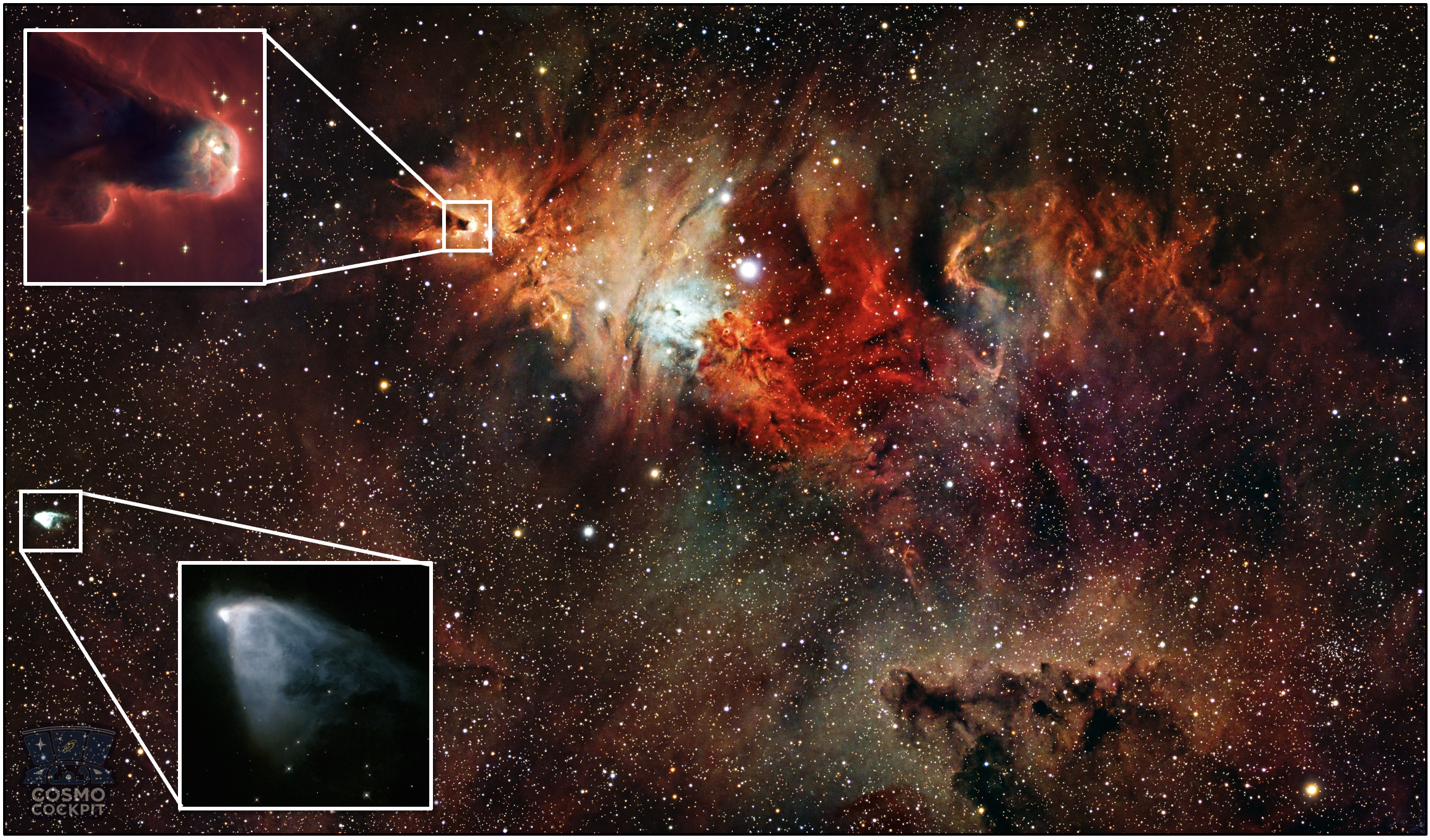
Upper left: called the Cone Nebula (NGC 2264), it is so named because, in ground-based images, it appears conical. This giant pillar resides in a turbulent star-forming region. It exhibits a craggy-looking mountaintop of cold gas and dust, a cousin to Hubble's iconic "Pillars of Creation" in the Eagle Nebula, photographed in 1995.
Bottom left: The Hubble's Variable Nebula, named after the American astronomer Edwin P. Hubble, who conducted some of the early studies of this object. It is a fan-shaped cloud of gas and dust illuminated by R Monocerotis (R Mon), the bright star at the top of the nebula. R Mon is believed to have a mass approximately 10 times that of the Sun and an age of only 300,000 years.
Credit: NASA/ESA and The Hubble Heritage Team (AURA/STScI).
Observation
The Christmas Tree Nebula lies in the constellation Monoceros, just east of Orion. Although the region is rich in nebulosity, much of it is faint and requires dark skies or long‑exposure imaging to be fully appreciated.
For visual observers:
Binoculars reveal the bright cluster of NGC 2264, with its triangular “tree” shape.
Small telescopes show the cluster more clearly, though the nebulae remain subtle.
Medium- to large-sized telescopes under dark skies may reveal hints of the Cone Nebula and its surrounding glow.
Hubble’s Variable Nebula is small but surprisingly bright; it appears as a tiny fan‑shaped patch near R Monocerotis.
The region is best observed from December to February, when it rises high in the southern sky in the mid‑evening hours.
Astrophotography Tips
A focal length of around 300–500 mm captures both the Christmas Tree region and the Hubble’s Variable Nebula in a single frame. Wider fields include the Cone Nebula and more of the surrounding hydrogen clouds.
Dual‑band or narrowband filters are particularly useful under Bortle 7 conditions, enhancing hydrogen emission.
Broadband RGB is essential for capturing the delicate blue reflection nebulae around R Mon and the cluster.
A long total integration time helps reveal faint dust and smooth out noise.
Check our post in Astrobin.
Posted in 2026 Chinese New Year :)