Flaming Star Nebula — A Winter Beacon in Auriga
The Flaming Star Nebula (IC 405) is one of the most dramatic and colorful regions in the constellation Auriga. Its sweeping arcs of glowing hydrogen and dust appear to flare outward from the hot star AE Aurigae, giving the nebula its fiery name.
Located roughly 1,500 light‑years away, IC 405 is a complex mix of emission and reflection processes, making it a favorite target for both visual observers and astrophotographers.
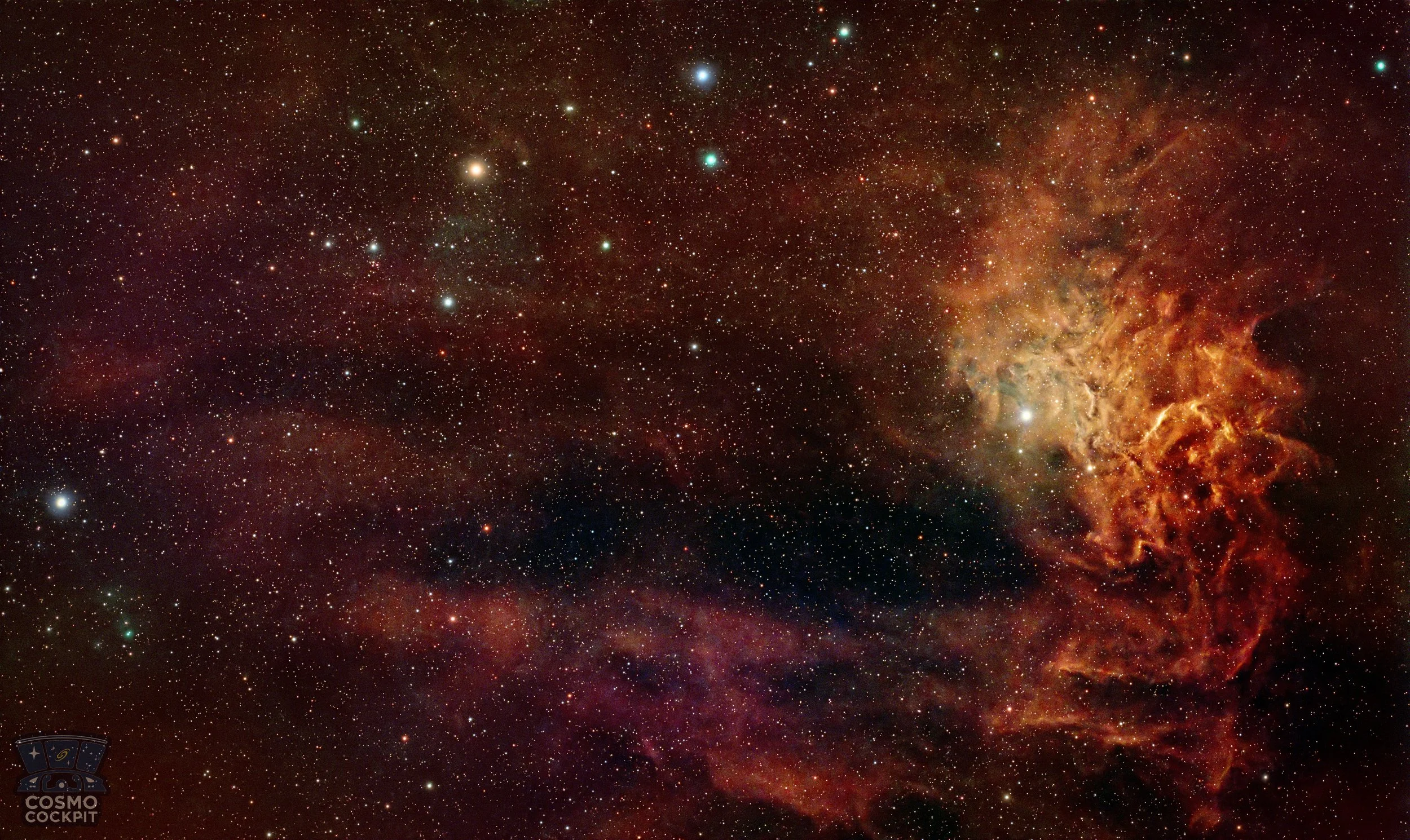
The Flaming Star Nebula glows with a mix of red hydrogen emission and blue reflection light, illuminated by the runaway star AE Aurigae. The sweeping arcs of gas and dust give IC 405 its characteristic flame-like appearance. 6 hours and 33 minutes of total exposure, divided between 10-minute (80%) and 3-minute (20%) sub-frames.
History
The Flaming Star Nebula was first recorded in the late 19th century during the era of photographic sky surveys, when astronomers began uncovering faint nebulae invisible to the naked eye.
AE Aurigae, the bright star illuminating the nebula, has an even more intriguing backstory. It is a classic “runaway star,” likely ejected from the Orion Nebula about 2.5 million years ago after a gravitational encounter between massive young stars. As AE Aurigae sped through the interstellar medium, it encountered a dense cloud of gas and dust — the material that now forms the Flaming Star Nebula.
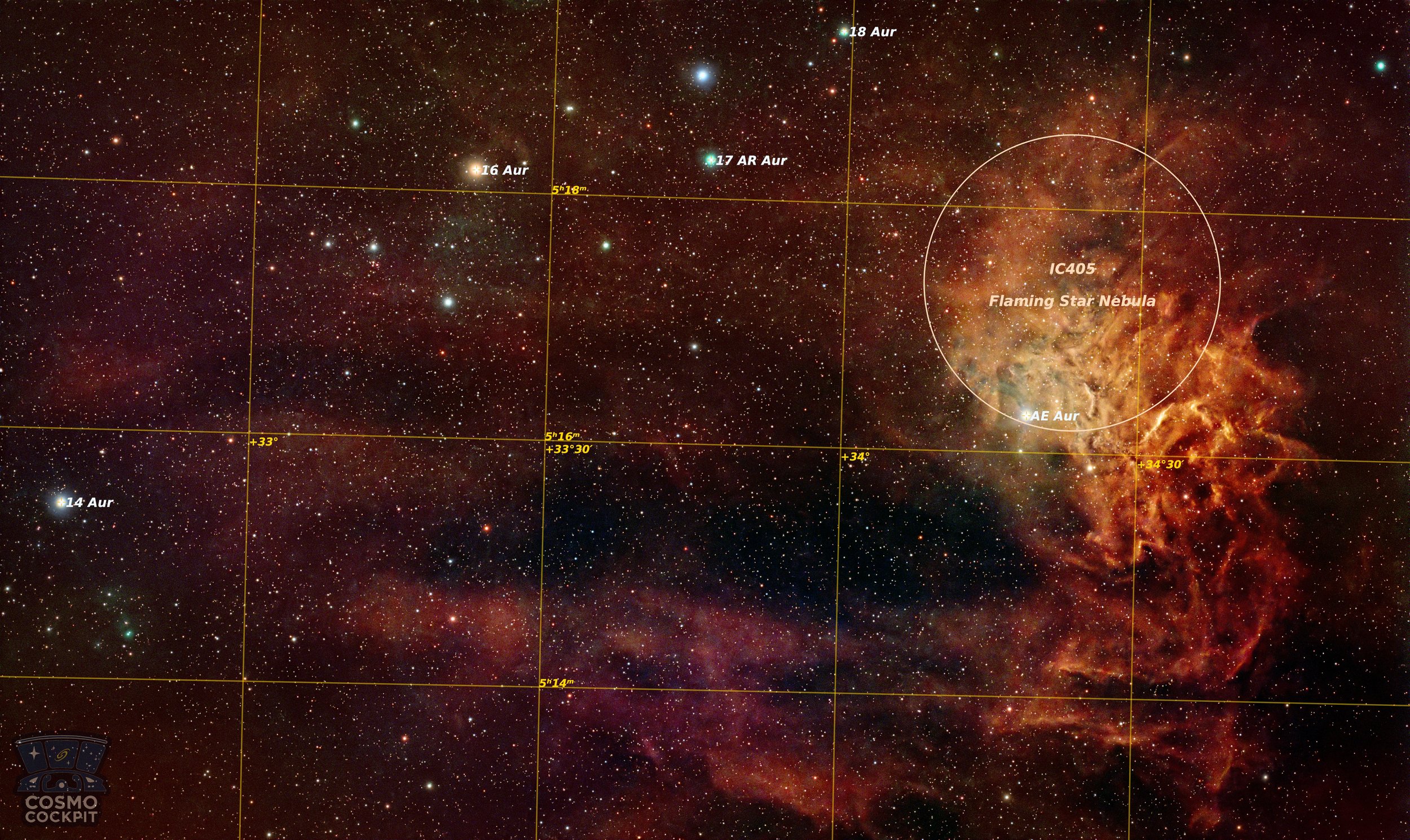
IC 405 showing AE Auriga and the surrounding emission and reflection structures. Plate-solved and annotated in PixInsight.
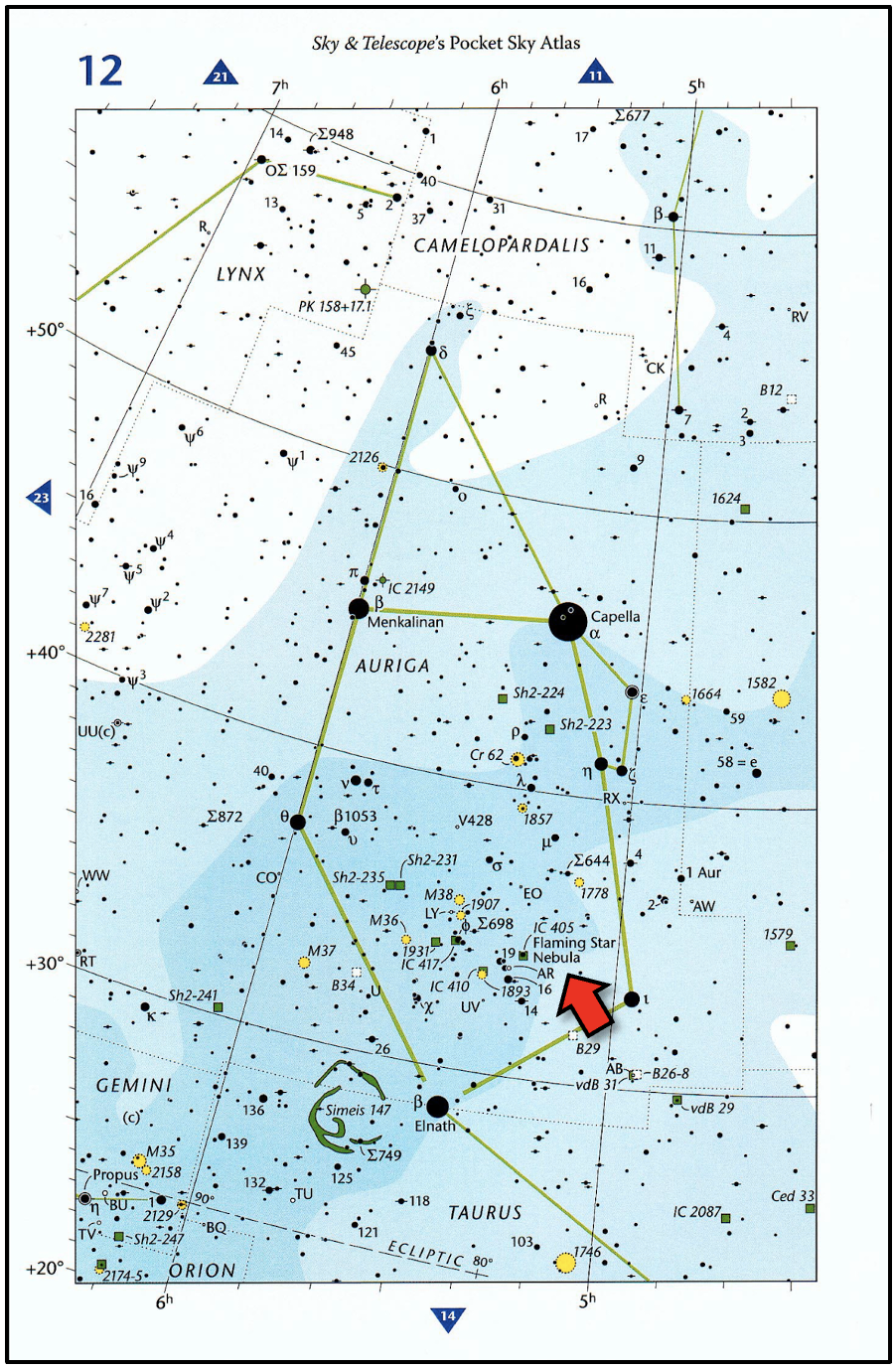
IC 405 sits inside the Auriga constellation, near the bright stars Elnath, Capella, and Menkalinan. This region is part of a dense Milk Way field filled with clusters, dust clouds, and star-forming regions. Sky and Telescope's Pocket Sky Atlas - Roger W. Sinnott.
Astrophysics
IC 405 is a hybrid nebula, combining two different physical mechanisms:
Emission Nebula Component
The red glow comes from ionized hydrogen (Hα) excited by the intense ultraviolet radiation from AE Aurigae. This ionization produces the characteristic crimson color seen in narrowband imaging.
Reflection Nebula Component
Surrounding dust grains scatter and reflect AE Auriga’s blue light. This creates the bright, smoky blue filaments that wrap around the star and extend outward.
Runaway Star Dynamics
AE Aurigae is moving at high velocity relative to the surrounding gas. Its motion compresses and shapes the nebula, contributing to the dramatic “flame-like” appearance.
The star’s origin is tied to a multi-body interaction in the Orion region, making IC 405 a living example of stellar dynamics sculpting the interstellar medium.
Observation
Under dark skies, IC 405 is extremely faint visually, but its central star, AE Aurigae, is easily seen with binoculars. Long-exposure imaging reveals its true beauty.
In the Northern Hemisphere, the best time to observe this nebula is from December to February.
Astrophotography Tips
The Flaming Star Nebula rewards both wide-field and medium‑focal‑length imaging. Here are some practical notes:
A focal length between 200 and 600 mm captures both the nebula and the surrounding dust structures.
Narrowband (Hα, OIII, SII) filters are excellent for cutting through light pollution and enhancing structure. Hα is especially strong; OIII is weaker but adds subtle teal highlights.
RGB or broadband is essential for capturing the blue reflection component.
Long Hα integrations bring out the flame-like emission arcs.
Star color preservation is important — AE Aurigae should remain a bright blue-white beacon.
Check our post in Astrobin.