Jellyfish Nebula: A Shockwave Sculpture in Gemini
Catalogued as IC 443, and also known as Sh2‑248, the Jellyfish Nebula is a striking supernova remnant located in the constellation Gemini, roughly 5,000 light‑years from Earth. Its distinctive arcing ridge and trailing filaments resemble a drifting cosmic jellyfish, illuminated by the shockwaves of a long‑ago stellar explosion. Positioned near the bright star Eta Geminorum, IC 443 is one of the most studied examples of a supernova remnant interacting with dense molecular clouds.
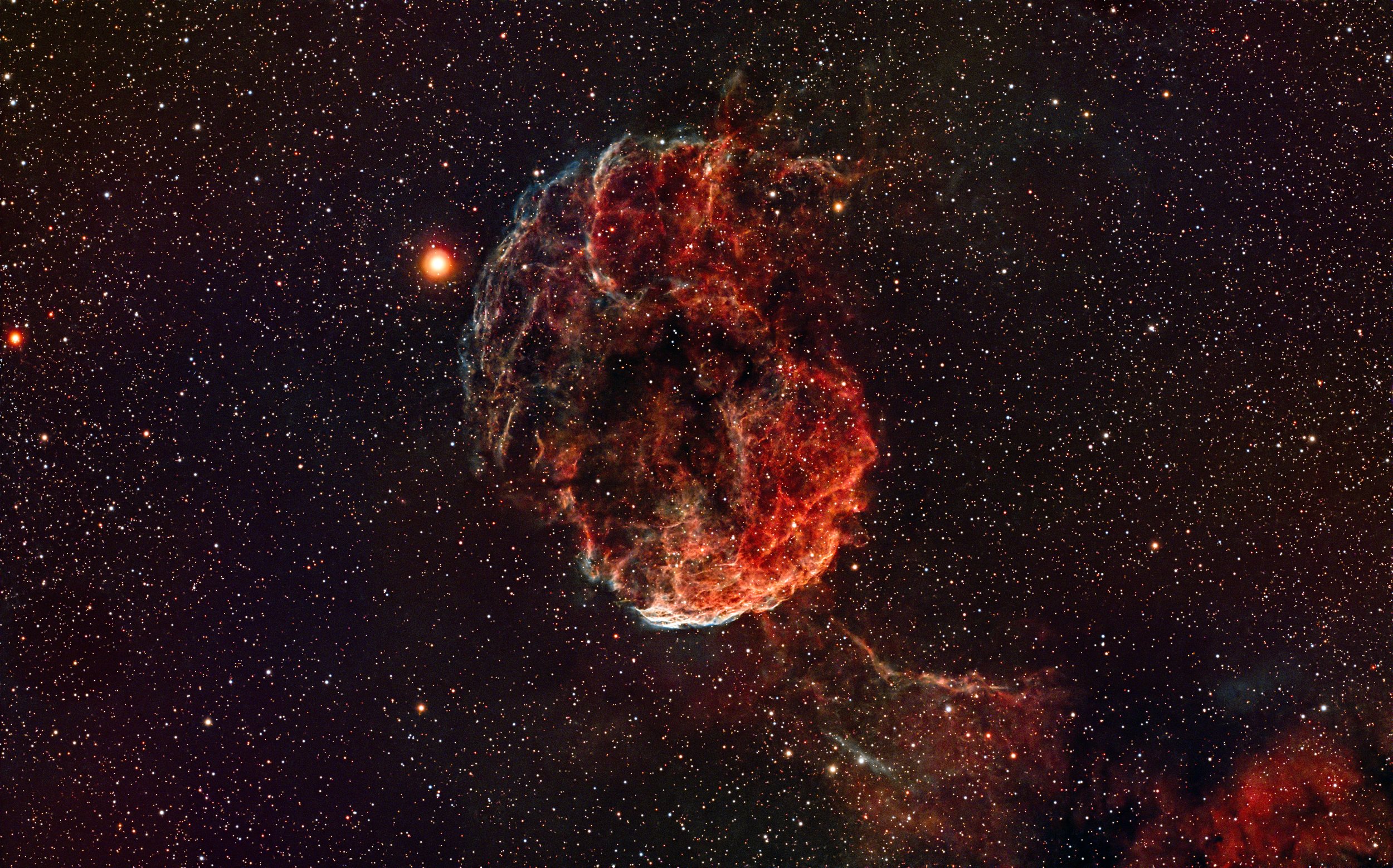
The Jellyfish Nebula is the expanding debris of a long‑ago supernova. Its bright arc and faint filaments show how shockwaves sculpt the gas and dust of our galaxy. 7 hours of total exposure time, Ha + OIII, SII + OIII, and Optolong L-Pro filters used. 10 minutes and 3 minutes sub-frames. Sky Bortle 7 conditions.
History
IC 443 was first photographed in 1892, when Max Wolf captured it while imaging the nova T Aurigae, noting two bright nebulae near μ and η Geminorum. A few years later, E. E. Barnard independently recorded the same structure in 1894, describing a faint, curved nebulosity nearly half a degree long. Its nickname, the Jellyfish Nebula, emerged from its curved “head” and filamentary “tentacles,” though it is often confused with the similarly named Medusa Nebula (Abell 21).
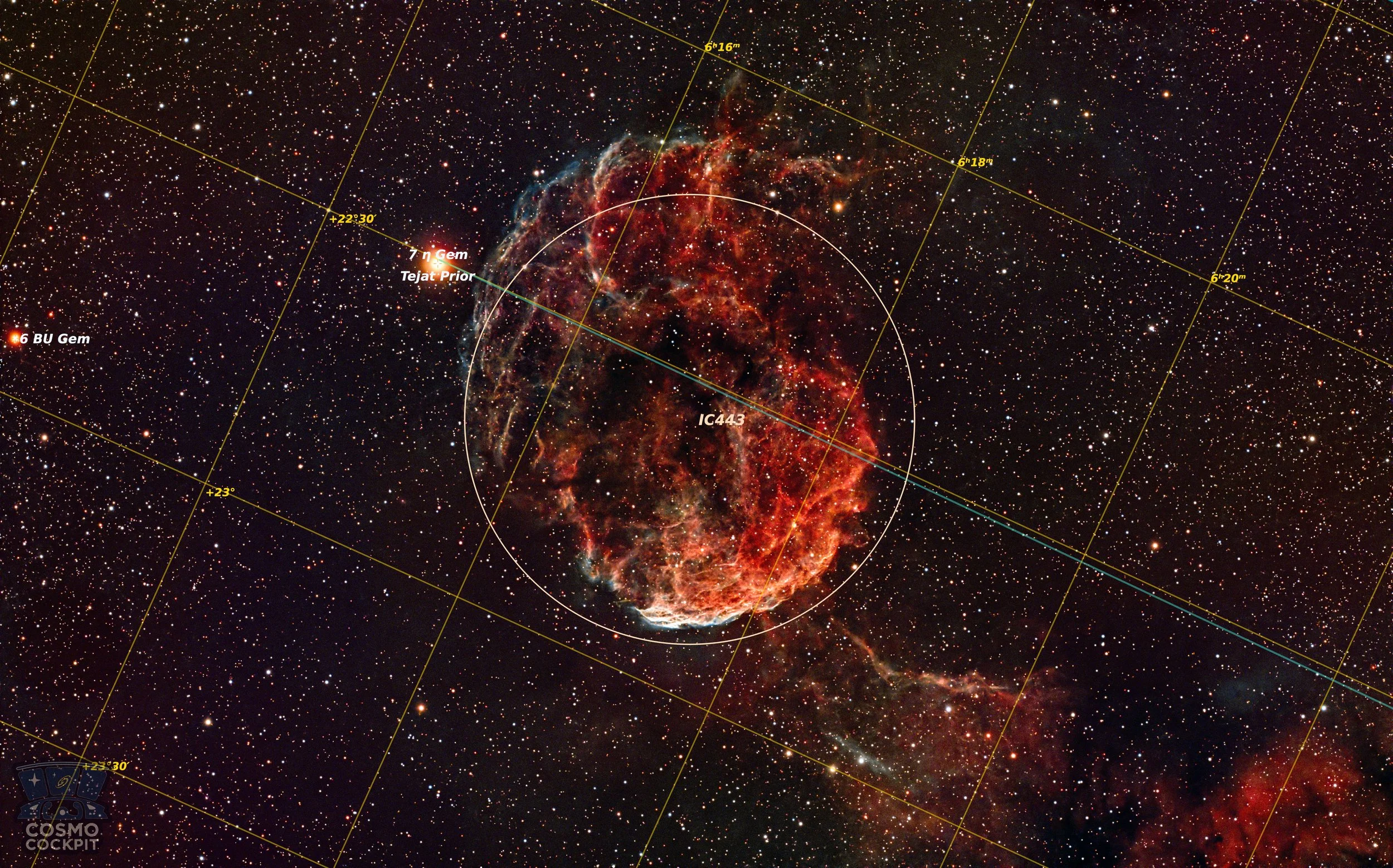
Positioned near the bright star Eta Geminorum, IC 443 is one of the most studied examples of a supernova remnant interacting with dense molecular clouds. Plate-solved and annotated in PixInsight.
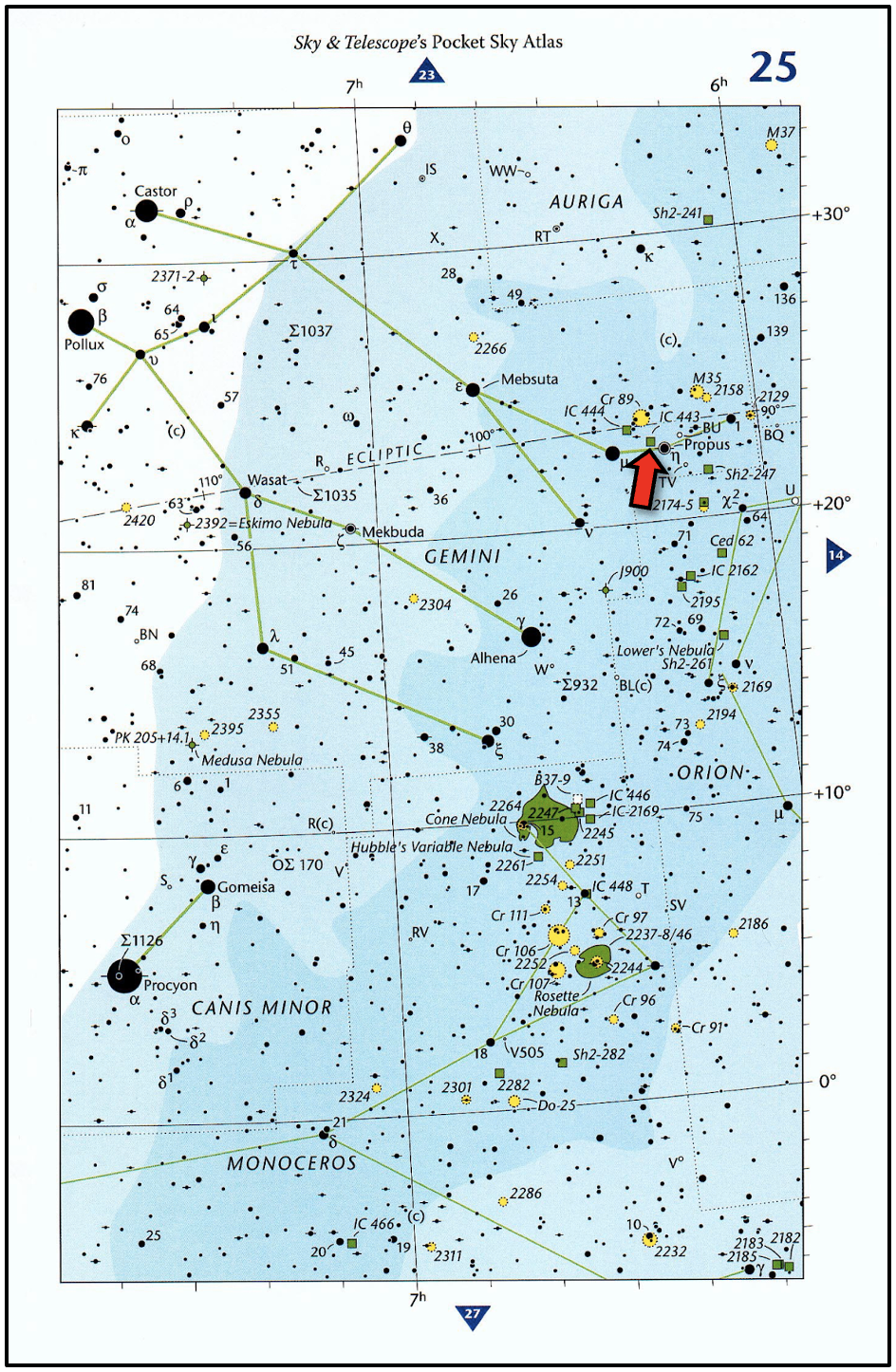
Tucked inside the stars of Gemini, the Jellyfish Nebula (IC 443) drifts below the twin stars Castor and Pollux, making it an ideal spring astrophotography target in the Northern hemisphere. Sky and Telescope’s Pocket Sky Atlas - Roger W. Sinnot.
Astrophysics
The Jellyfish Nebula is the expanding debris field of a Type II supernova, the explosive death of a massive star. Light from the explosion likely reached Earth 30,000–35,000 years ago. Embedded within the nebula is a neutron star, CXOU J061705.3+222127, the collapsed core of the progenitor star.
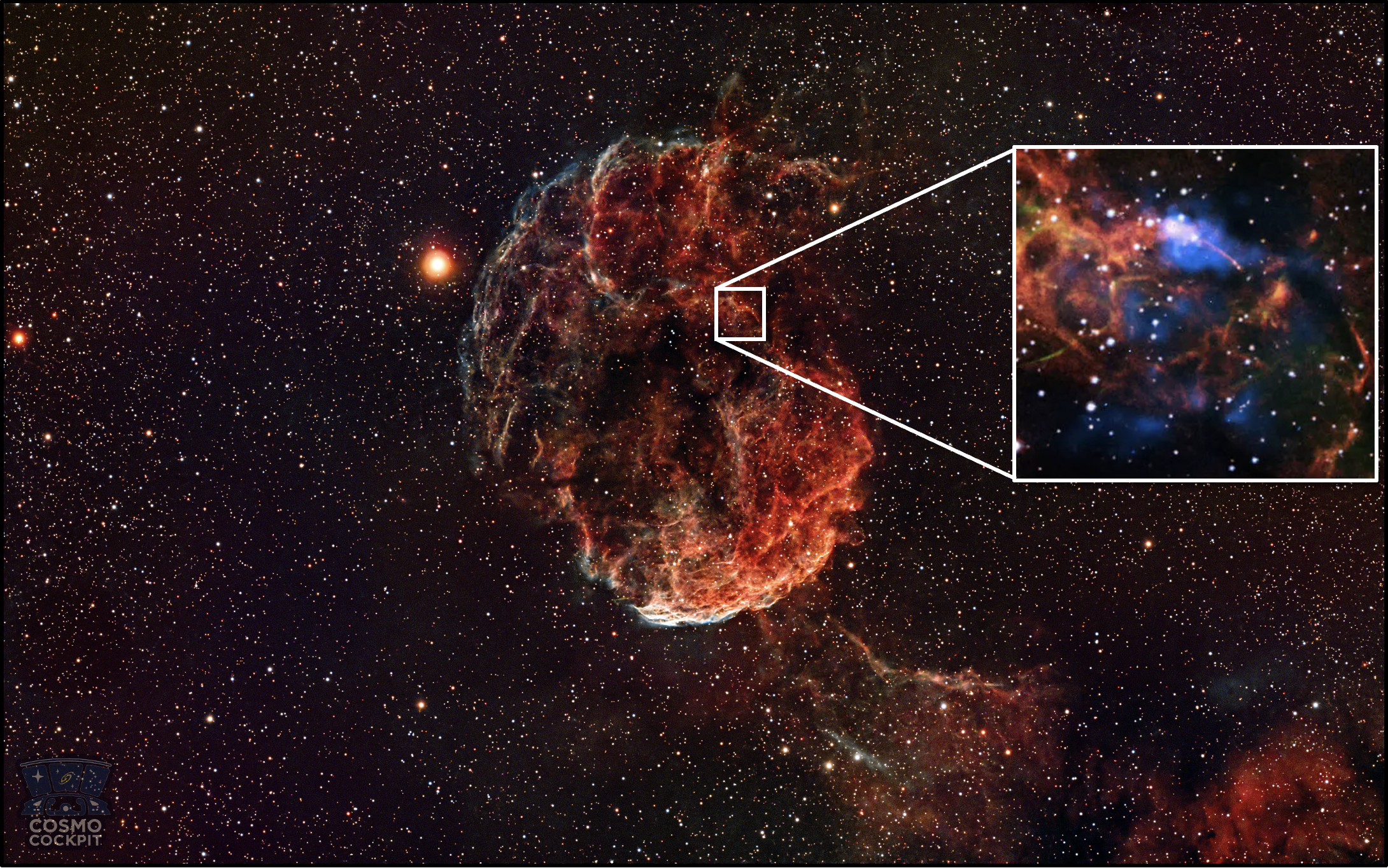
New NASA’s Chandra X-Ray Observatory pictures indicate that the explosion that created the Jellyfish Nebula may have also formed a peculiar object located on the southern edge of the remnant, called CXOU J061705.3+222127 (or J0617 for short), likely a rapidly spinning neutron star, or pulsar. Inset x-ray photo: NASA/CXC/MSFC/D.Swartz et al.
The nebula spans roughly 50 arcminutes on the sky (larger than the full Moon), corresponding to a physical size of about 70–140 light‑years (depending on the measurement method). Its structure is complex: two overlapping shells with different centers, plus shock fronts interacting with foreground molecular clouds. These interactions produce bright emission in optical, radio, and X‑ray wavelengths, making IC 443 a textbook example of a mixed‑morphology supernova remnant.
High‑energy observations reveal:
Thermal X‑ray emission concentrated toward the center.
A pulsar wind nebula near the southern rim.
A jet‑like feature emerging from the neutron star.
Observation
IC 443 lies near Eta Geminorum (Propus) in Gemini, making it accessible from late autumn through spring in the Northern Hemisphere. Its surface brightness is low, so visual observation is challenging.
A 400 mm telescope with an O‑III filter reveals the brightest curved arc using averted vision.
The nebula’s full extent is extremely faint and best appreciated through long‑exposure imaging rather than direct observation.
Astrophotography Tips
The Jellyfish Nebula is a rewarding but demanding target, especially if you want to capture both the bright shock front and the faint, trailing filaments. Here are some tips:
1. Narrowband is your friend
The nebula emits strongly in Hα and O III, with additional structure in S II. SHO palettes work beautifully, allowing you to highlight the contrast between the bright ridge and the softer tentacles.
2. Go long on integration
Because the faint outer structures are extremely dim, total exposure times of 20+ hours are common for high‑quality results. The brightest arc will appear early, but the “jellyfish tentacles” need patience.
3. Moderate focal lengths work best
A focal length of around 500–1000 mm frames the nebula well, capturing both the head and the trailing filaments. Larger setups can reveal intricate shock structures but may require mosaics.
4. Watch your star field
IC 443 sits in a rich region near the Galactic plane. Star reduction and careful color calibration help keep the nebula from being overwhelmed by the stellar background.
5. SHO color balancing
The nebula’s natural structure lends itself to dramatic color mapping. Many imagers emphasize:
Gold/orange for Hα and SII in the “head”.
Blue/teal for OIII in the filaments.
This creates a dynamic, flowing appearance reminiscent of a drifting jellyfish.
6. Complementary broadband
Adding RGB stars or a touch of broadband luminance can soften the narrowband look and improve color fidelity around Eta Geminorum.
Check our post in AstroBin.