Lagoon and Trifid Nebulae: The Summer Showpieces of Sagittarius
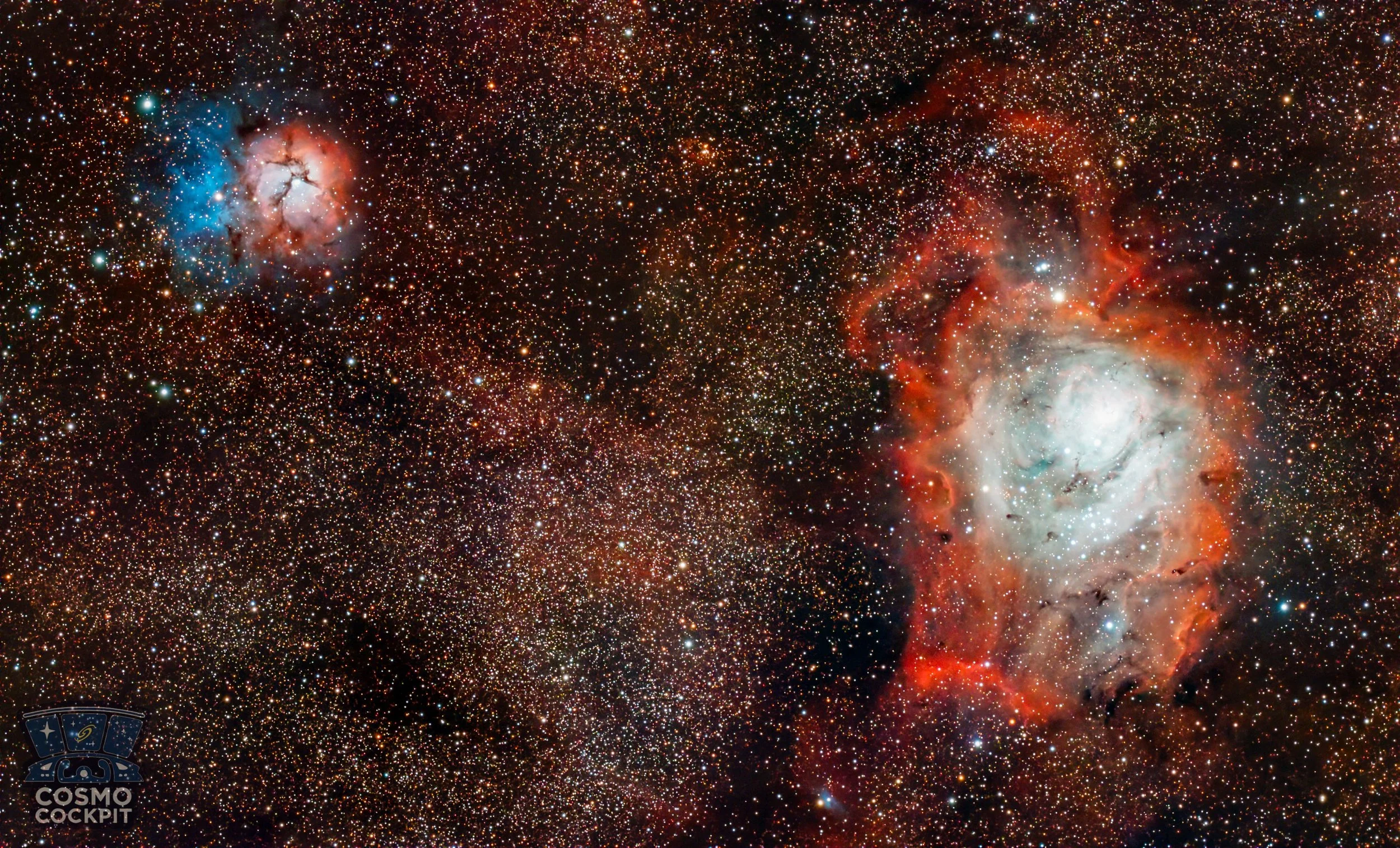
The Lagoon (M8) (center right) and the Trifid Nebulae (M20) (top left): two giant star-forming regions in Sagittarius. 5 hours of total exposure time.
The summer skies of Sagittarius host two of the most iconic deep-sky objects: the Lagoon Nebula (M8) and the Trifid Nebula (M20). These stellar nurseries, located roughly 4,000–5,000 light-years away, are striking examples of cosmic creation and destruction, offering astrophotographers and astronomers alike a glimpse into the dynamic processes that shape our galaxy.
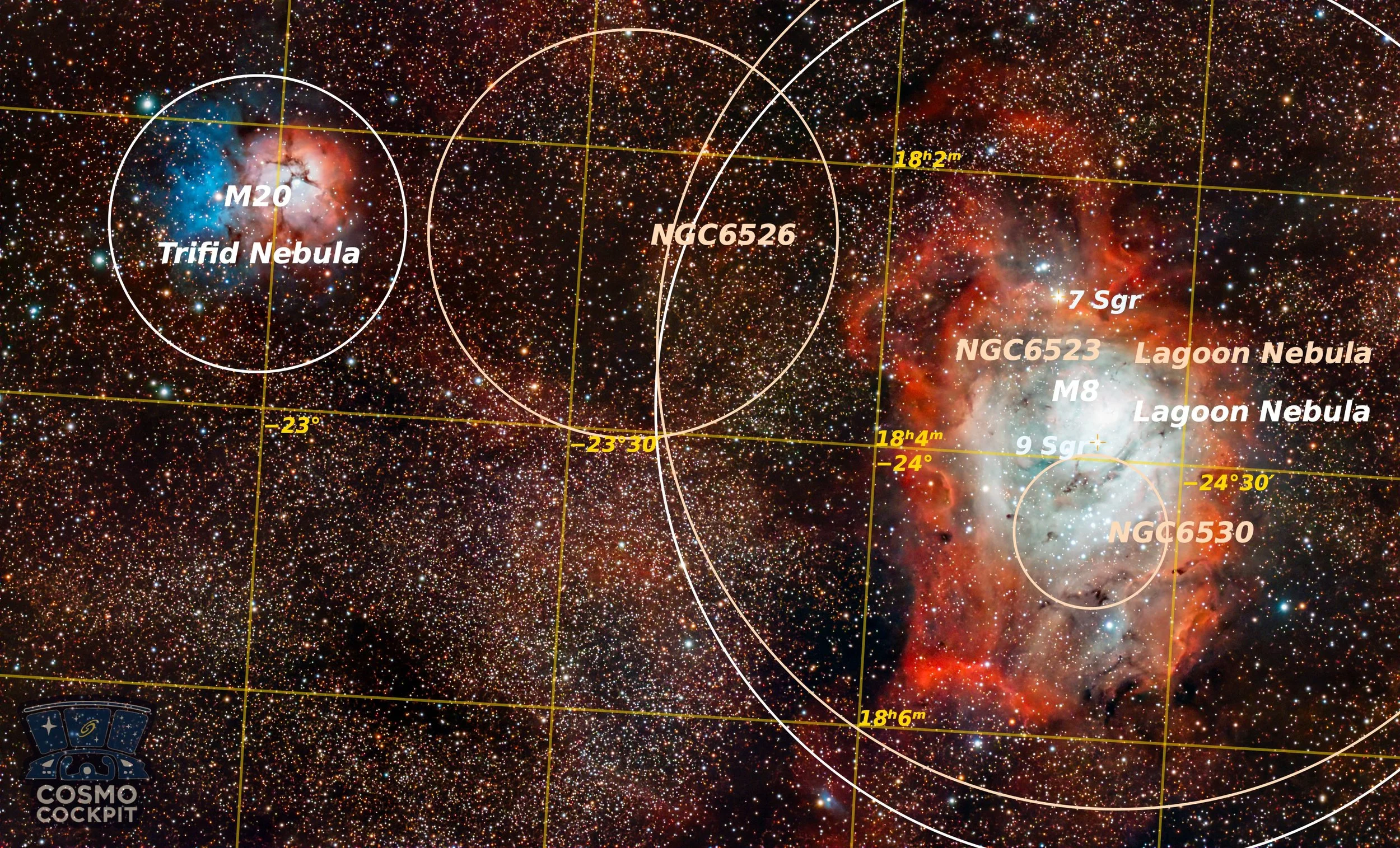
The Lagoon (M8) and the Trifid Nebulae (M20). Plate solved and annotated in PixInsight.
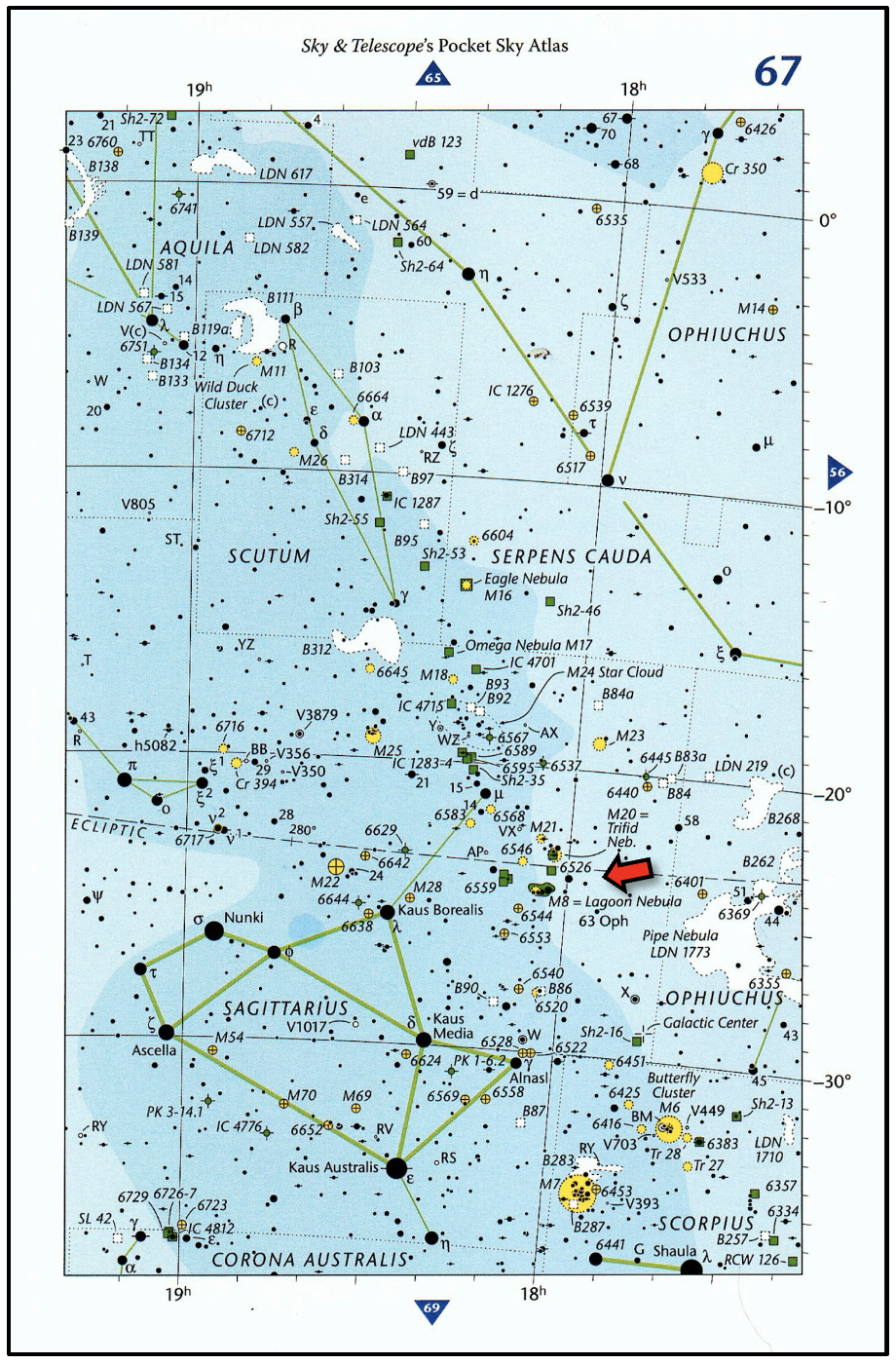
Sky and Telescope's Pocket Sky Atlas - Roger W. Sinnott.
Lagoon Nebula (M8)
The Lagoon Nebula, cataloged as Messier 8 (M8) and NGC 6523, is a sprawling emission nebula and one of the few star-forming nebulae faintly visible to the naked eye from mid-northern latitudes.
History
Guillaume le Gentil first recorded the NGC 6523 nebula in 1749, describing it as:
"West of a star cluster, this nebula has the exact shape of a slightly elongated, equilateral triangle, tip pointing south-west."
On May 23, 1764, Charles Messier observed M8 and recorded:
"Cluster of stars which appears in the form of a nebula when it is viewed with a simple refractor; but with an excellent instrument one does not notice but a great number of small stars; near this cluster is a quite brilliant star, surrounded by a very faint light; this cluster appears in an elongated shape, which extends from North-east to South-west."
For Messier, the star cluster defined his object No. 8, with the nebula only barely noticed.
The name Lagoon Nebula was inspired by Agnes Clerke’s 1890 description, which likened the nebula's appearance to a lagoon surrounded by bright fog.
Astrophysics
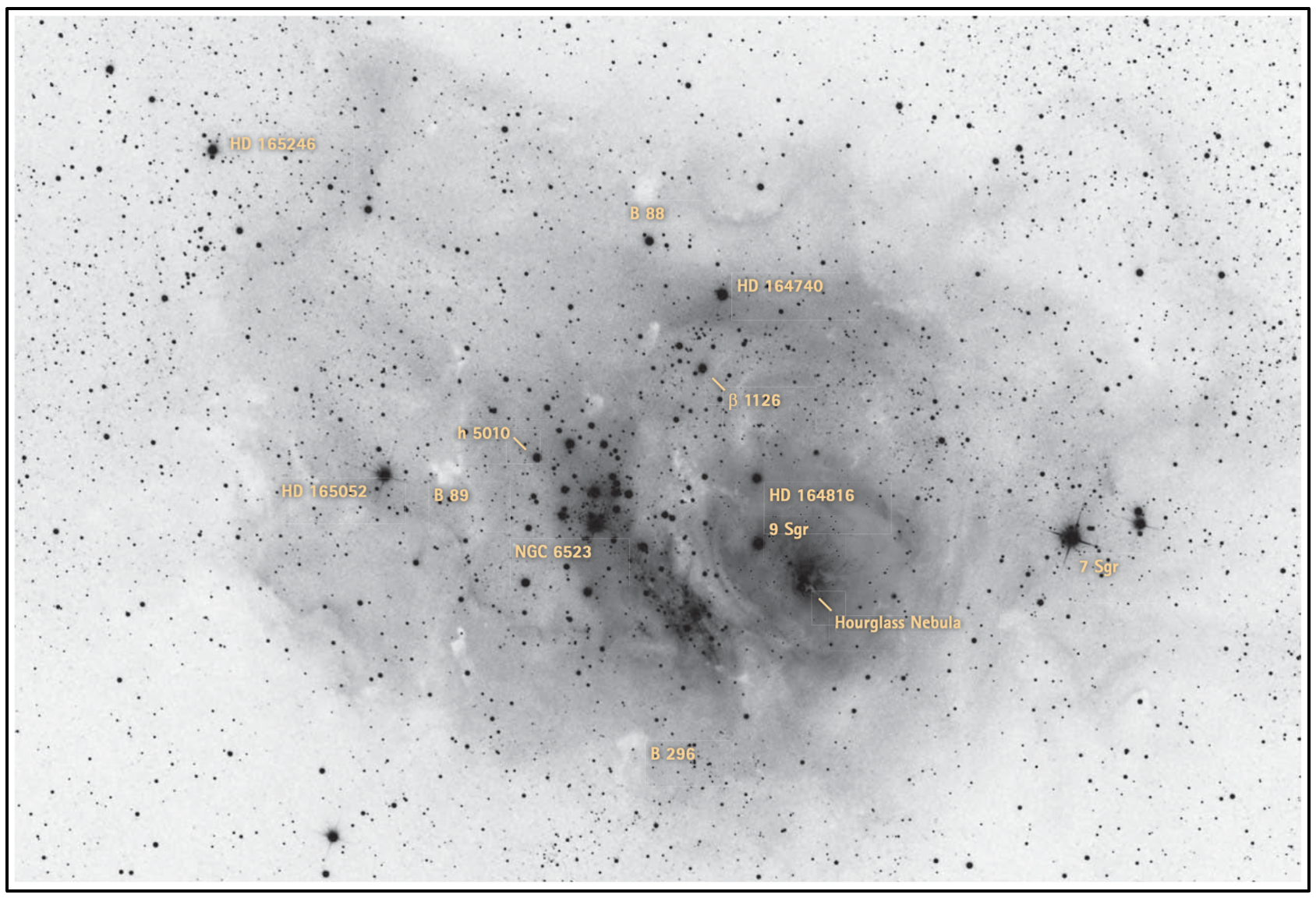
M8 is a young stellar cluster in an active star-forming region, about 6,490 light-years away and roughly 110 by 50 light-years across. Stellar winds and UV radiation from nearby stars shape the prominent Hourglass Nebula at its center.
Observation
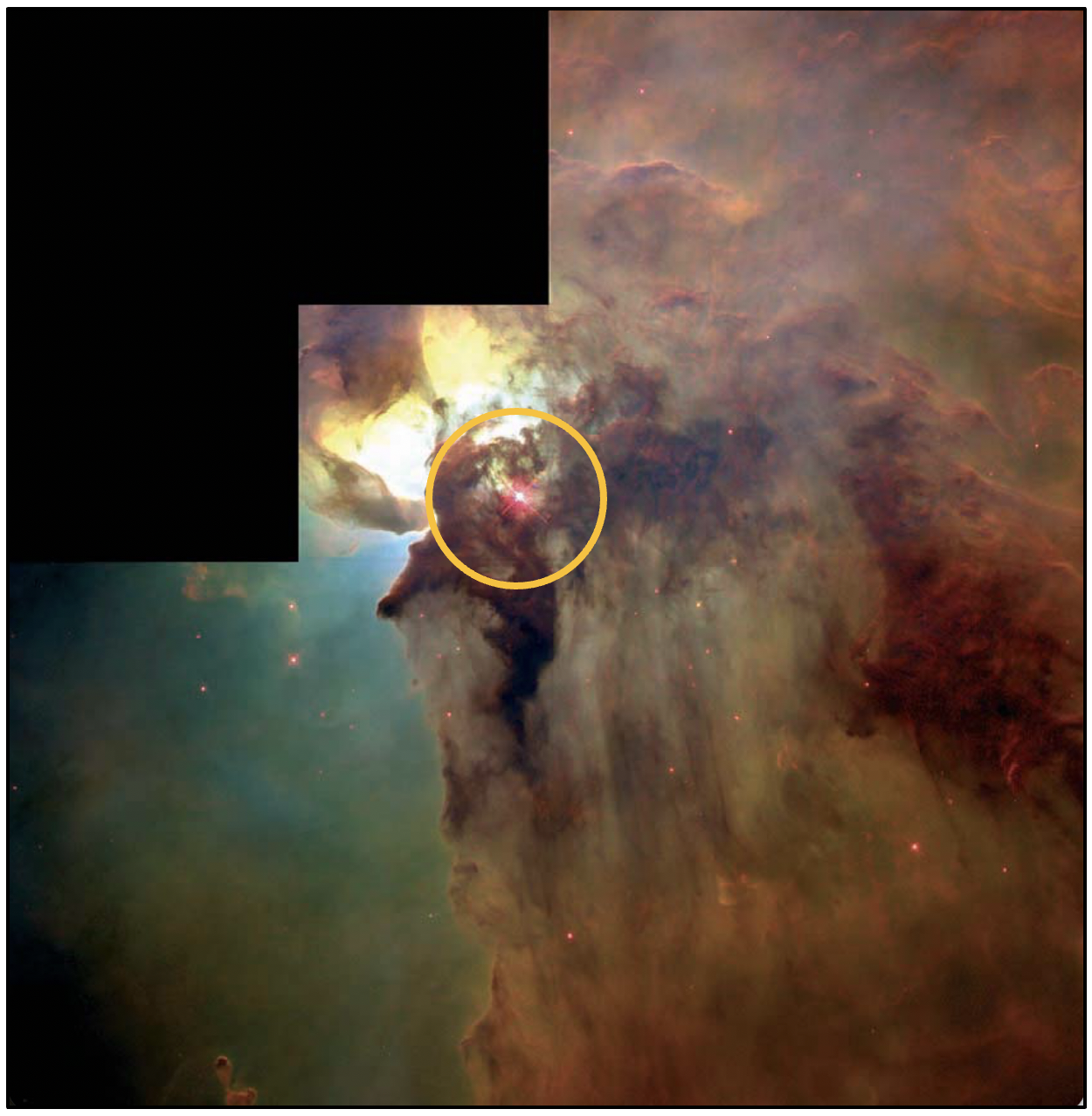
The Hourglass Nebula with the double star Herschel 36. Hubble Space Telescope.
M8 is large and very bright, an impressive sight to the naked eye as a long, nebular spot. The bright star 7 Sagittarii adds further glamour to this field. A nebula filter shows the whole area in a diffuse glow.
The nebulous region in the west offers details on the smallest scales – especially around the Hourglass Nebula, which is by far the brightest feature of the whole nebula.
Trifid Nebula (M20)
Near the Lagoon Nebula, 5,200 light-years away from us, lies the Trifid Nebula (Messier M20 / NGC 6514), a prominent star-forming region that combines three distinct features: a pink emission nebula, a blue reflection nebula, and dark dust lanes that divide the cloud into three sections — hence its name. The Trifid is a dramatic showcase of how massive stars carve their environment, blasting out winds and radiation that reshape the surrounding gas, making it a favorite among both professional and amateur astronomers.
History
On the 5th of June 1764, Charles Messier discovered:
“Cluster of stars, a little above the Ecliptic, between the bow of the Archer & the right foot of Ophiuchus.”
William Herschel, observing from England, was the first to clearly recognize the nebula. He cataloged M20 in three sections and wrote:
"Three nebulae, faintly joined, form a triangle. In the middle is a double star."
The popular name of M20, the Trifid Nebula, was named by John Herschel over 200 years ago to describe its trilobed appearance, when he noted:
“Trifid, three nebulae with a vacuity in the midst, in which is centrally situated the double star.”
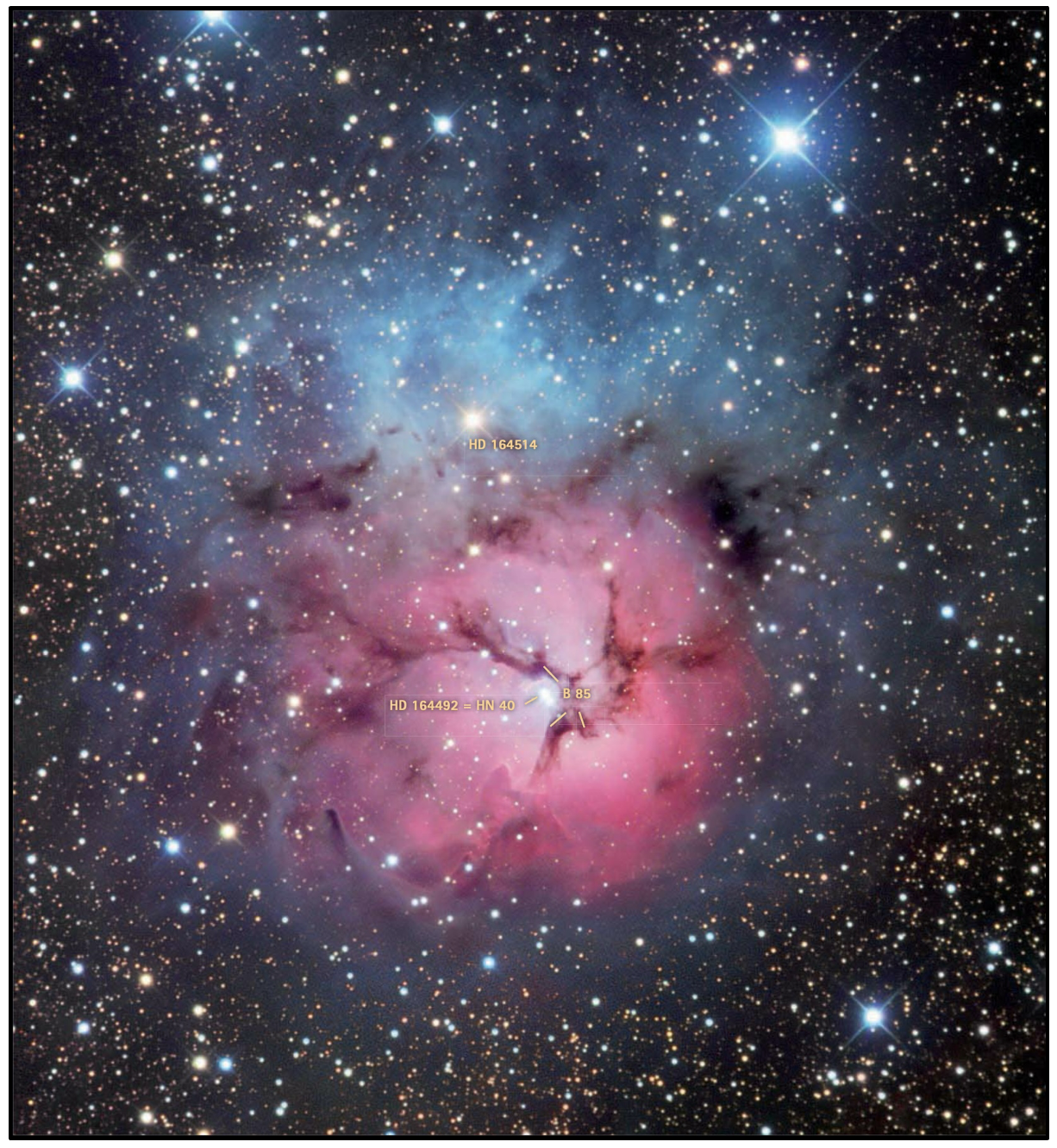
The Trifid Nebula's red emission nebula and the surrounding dust cocoon, which scatter blue light, are distinct visual features. At its core, the massive multiple star system HD 164492 ionizes the surrounding hydrogen, producing red Hydrogen-Alpha light. A cluster of about 3,100 young stars is also present. Photo by Robert Gendler. Atlas of the Messier Objects - Highlights Of The Deep Sky, by Ronald Stoyan.
Astrophysics
The Trifid Nebula is around 300,000 years old. Dark dust lanes (Barnard 85) divide it into three lobes, giving M20 its name. These lanes are known as Barnard 85. At 15 light-years across and 2,660 light-years away, it appears in front of neighboring M20 and M21 in the sky.
The Trifid Nebula shows various stages of star formation and interstellar interactions. In 1997, Hubble images revealed dense star-forming clouds and jets from young stars, offering insights into stellar development.
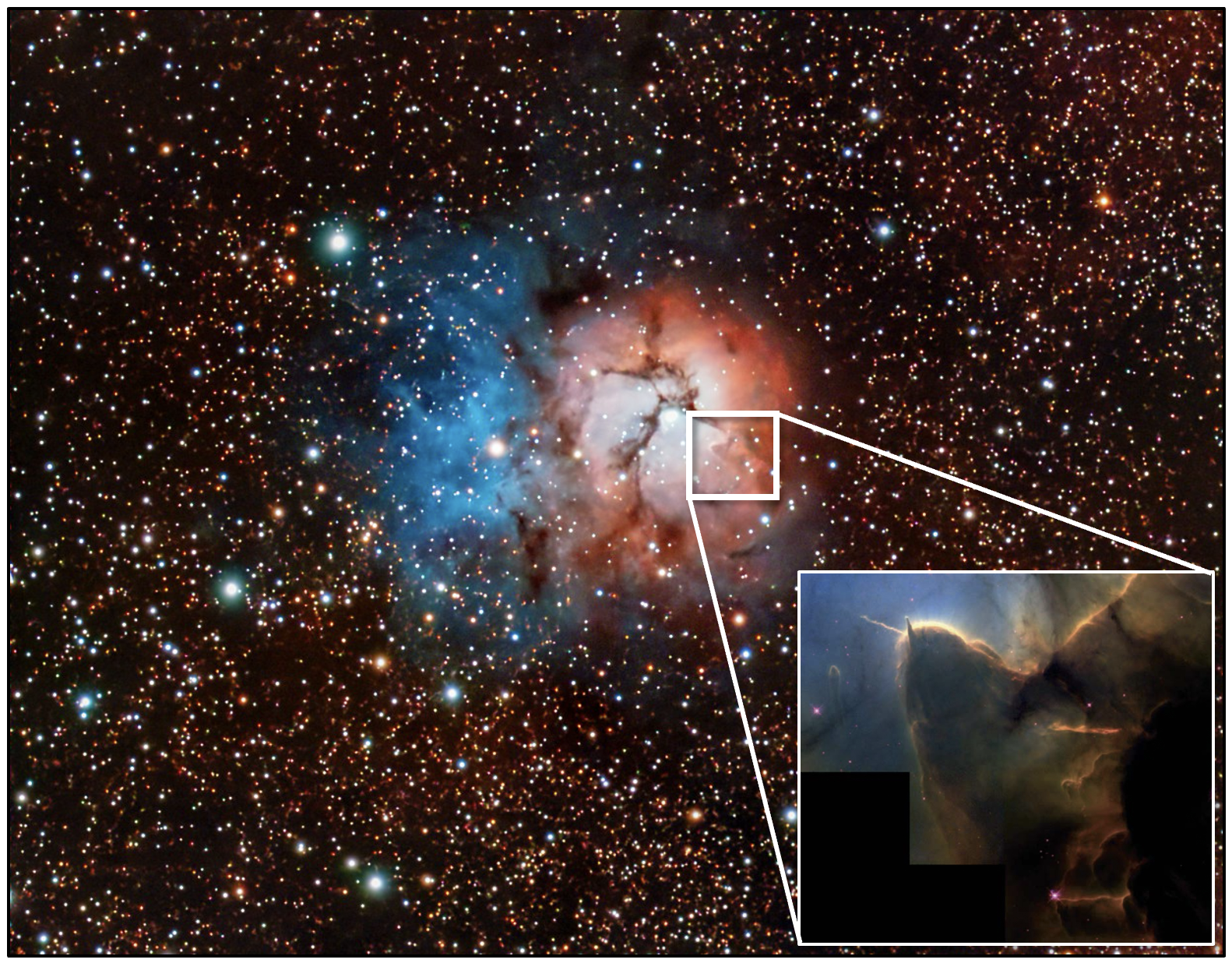
This dark nebula, with tentacle-shaped extensions in its southeastern part, hosts some very young stars. Hubble Space Telescope.
Observation
M20 looks spectacular in photographs, but it is not a bright object for visual observers. The Trifid Nebula is frequently imaged for its striking red-blue contrast and dust lanes, which divide it into at least three parts.
Astrophotography Tips
Together, the Lagoon and Trifid nebulae form a breathtaking duo visible in the same low-power field of view. Their proximity in Sagittarius, near the dense starfields of the Milky Way’s core, creates a spectacular backdrop for imaging. Long-exposure photos reveals the intricate web of dust lanes and star clusters that connect these regions, highlighting the ongoing cycle of stellar birth and evolution.
For astrophotography, use wide-field setups to frame both nebulae together. Apply narrowband filters to isolate and enhance the emission lines of hydrogen and oxygen, revealing nebular structures.
The Lagoon Nebula looks excellent in RGB or narrowband. Even short exposures reveal wispy tendrils and dark globules.
The Trifid's bold colors appear even in RGB exposures without narrowband filters.
Check our post in AstroBin: https://app.astrobin.com/i/def8e2.