Andromeda: Our Neighbor Across the Cosmic Sea
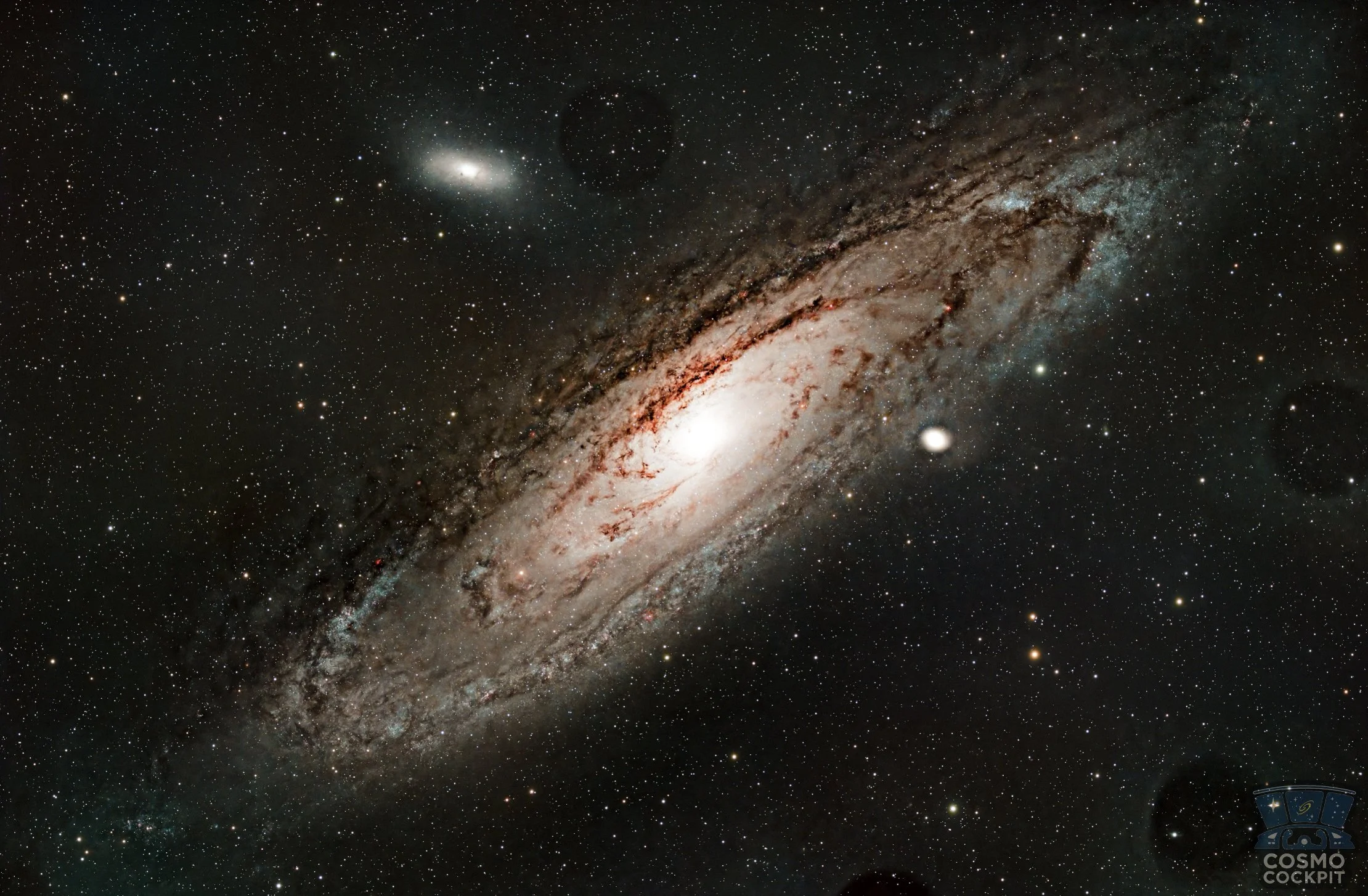
Our neighboring galaxy, Andromeda (M31) - 2.5 million light-years away - is one of the most impressive objects in the night sky. In the photo, its two brightest companion galaxies - M32 (below the center, to the right) and M110 (above left) - can be seen. Circular dark spots created by dust deposited either on the telescope lenses, the light-pollution filter, or the camera sensor are visible. 4h 25m total exposure time.
The Andromeda Galaxy (Messier 31, M31) is the nearest spiral galaxy to our own Milky Way and the largest in the Local Group. Visible to the naked eye under dark skies, it has fascinated astronomers and storytellers for centuries.
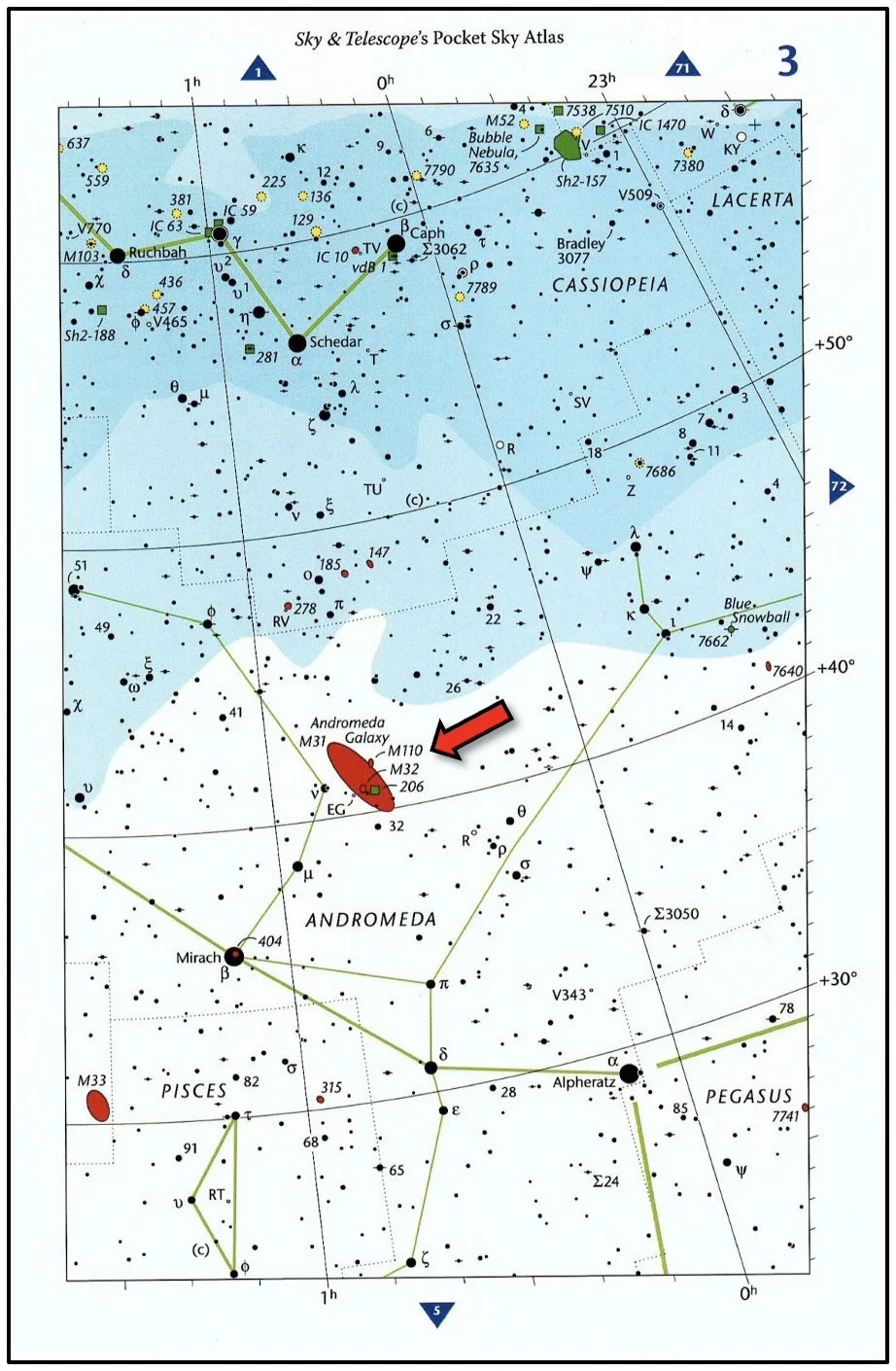
Sky and Telescope's Pocket Sky Atlas - Roger W. Sinnott.
History
Before the invention of the telescope, naked-eye nebulae were virtually unknown (except for M44 - The Beehive Cluster, the prototypical “nebulosa”), and there was simply no interest in this kind of phenomenon. Hence, pre-telescopic astronomers may have seen M31. Still, it was plainly ignored as unimportant to them (around 964 AD, the Persian scholar Abd al-Rahman al-Sufi was the first to note a “small cloud” in the constellation Andromeda).
Charles Messier observed M31 several times. His note from August 1764 reads:
“The beautiful nebula in the girdle of Andromeda, in the shape of a spindle; it resembles two cones or pyramids of light, facing each other at their bases, with an axis directed from northwest to southeast; the two points of light or apices are about 40’ apart; the common base of the two pyramids 15’.”
In 1785, William Herschel prophetically supposed M31 to be a “sister of the Milky Way,” but his distance estimate of 2,000 times that of Sirius was far too small. He described M31 as “undoubtedly the nearest of all the great nebulae."
The actual distance and nature of the “nebula” M31 became clear only in the following years:
In 1912, Slipher measured a radial velocity of 300 km/s, indicating that the object was extragalactic.
Curtis wrote in 1918, based on the first set of photographs: “This wonderful object, the largest of the spiral nebulae, is too well known to need description. Exposures of 1min to 3min show an almost stellar nucleus, with traces of spiral structure in the surrounding nebular matter.”
The first distance measurement had to wait until 1923, when Edwin Hubble discovered the first cepheids in M31. Then it was finally clear that the Andromeda Nebula and many other similar spiral nebulae represent Milky Ways of their own.
Astrophysics
M31 is regarded as the best-studied galaxy of all. Its proximity and inclination enable consistent studies of various classes of objects that, in our own galaxy, are obscured by dense interstellar dust in the galactic disk.
With a diameter of about 160,000 light-years, M31 is significantly larger than our Milky Way, although less massive. Billions of stars are packed tightly together at the galaxy’s core, creating the bright central glow, concealing a massive black hole.
M31 possesses an extended system of companion galaxies. Their brightest, M32 and M110, are even fellow members of the Messier catalog.
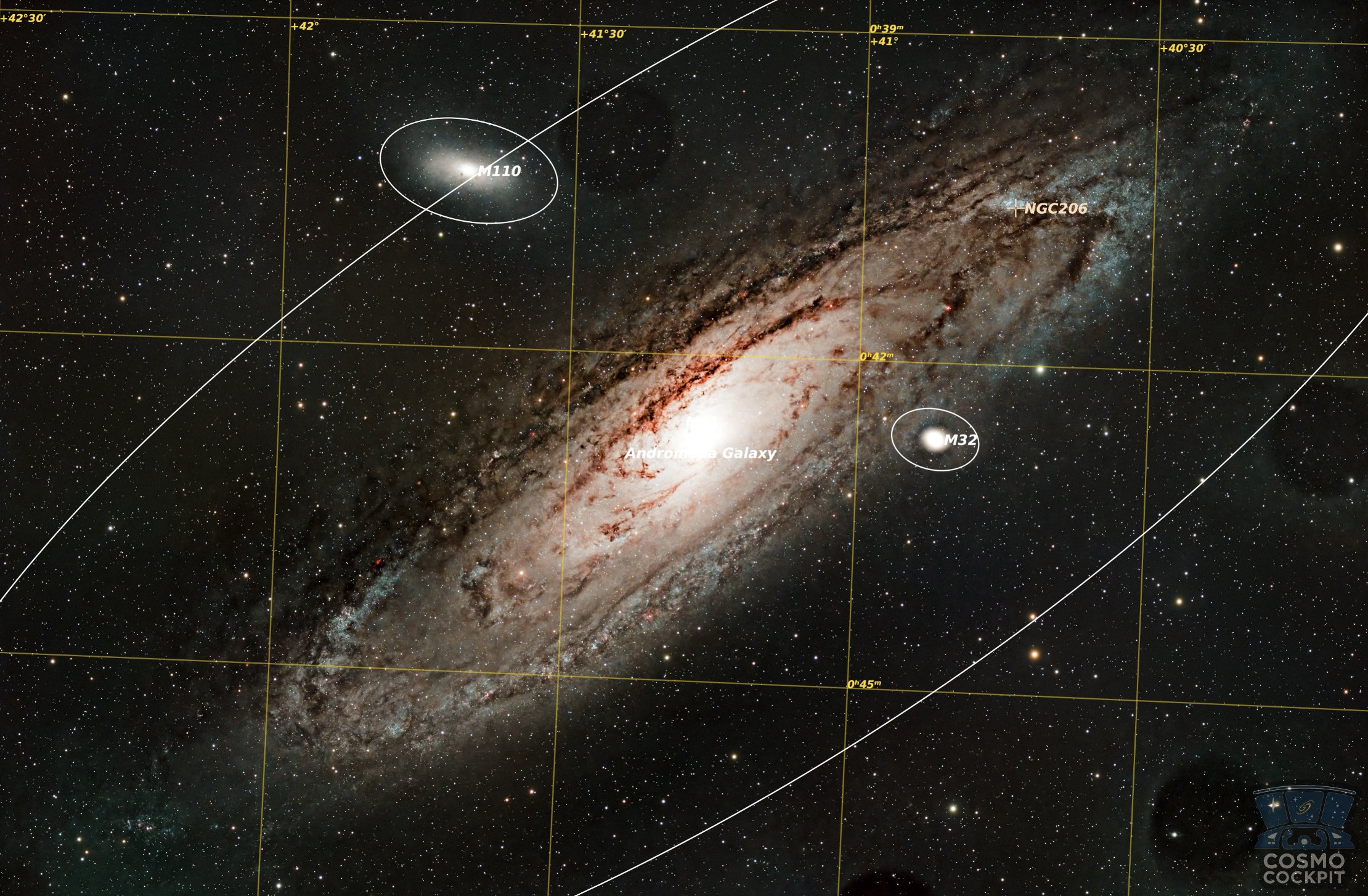
Like M110, M32 is a physical companion of the Andromeda Galaxy (apparently close to it, just 22' south of the core of M31). Unfortunately, it is not unambiguously clear whether M32 stands in front of or behind Andromeda from our perspective. Plate-solved and annotated in PixInsight.
M32
M32 is an elliptical dwarf galaxy of only 6,500 light-years in diameter and about 3 billion solar masses. This small galaxy probably owes its survival within the gravitational field of M31 to its very compact core.
An observer on the edge of M32 would enjoy a marvellous night sky, half of which would be richly populated with the stars of M32, and the other half filled with the Andromeda Galaxy in all its splendor.
M110
Like M32, M110 is a physical companion of the great Andromeda Galaxy and has about the same distance of 2.5 million light-years. It contains about 10 billion solar masses, which makes it the largest companion of M31. However, with its diameter of only 16,000 light-years, it is still a dwarf within our local galaxy group.
The only recognizable structures in this galaxy are the two dark patches near its center. These dust clouds are somewhat atypical features for an elliptical or spheroidal dwarf galaxy, which has lost most of its interstellar gas and dust during encounters with the central galaxy.
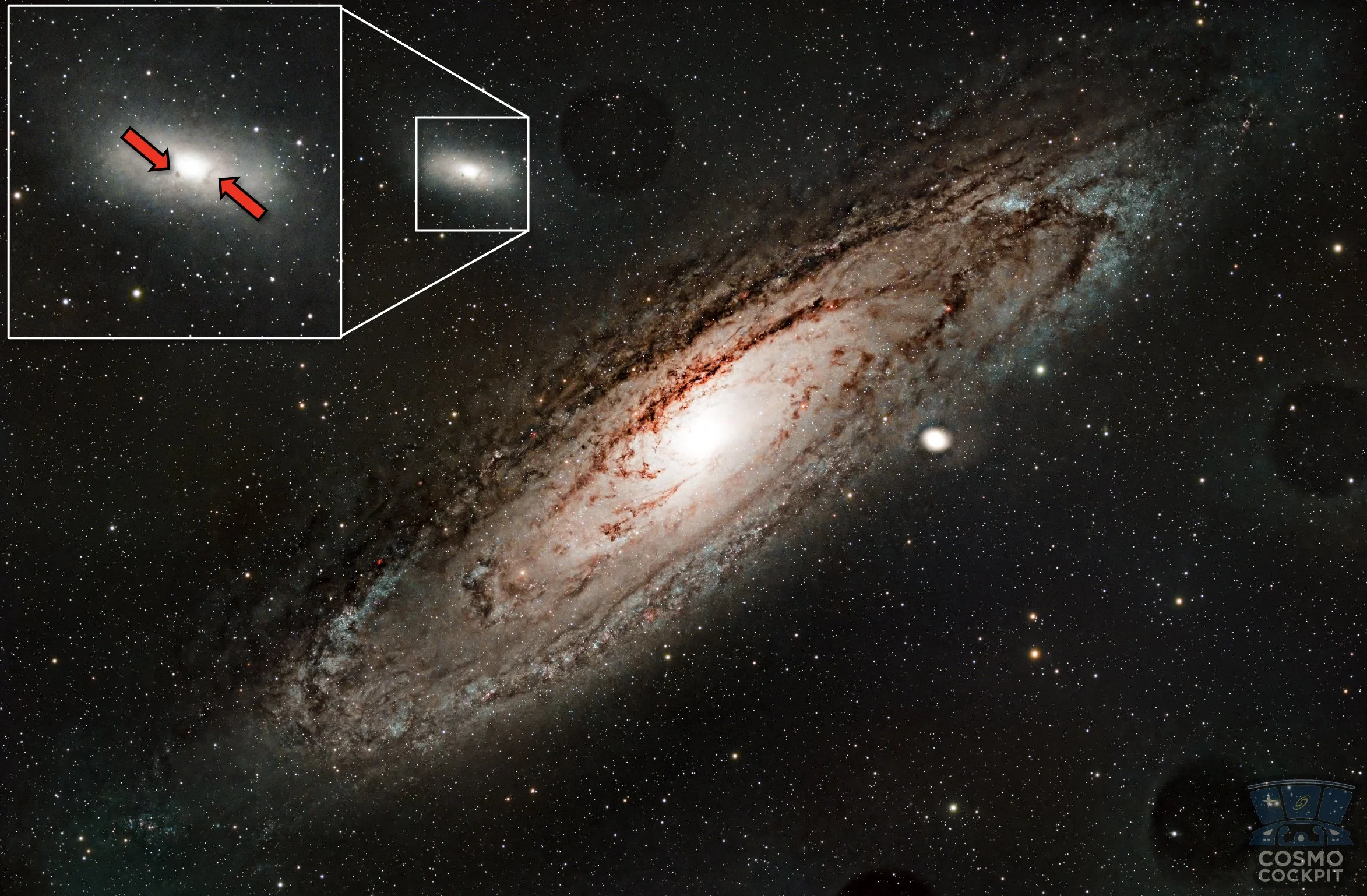
Dark patches near M110 center.
Observation
The Andromeda Galaxy is the farthest object that most of us will ever see with the naked eye - the only extragalactic object in the northern sky that is visible to the naked eye without any difficulty. At a distance of over 2.5 million light-years, this galaxy is so giant that it occupies an area in the sky equivalent to six full moons wide. It is best viewed from late summer through early winter in the Northern Hemisphere, when Andromeda is high in the sky.
The most apparent feature of M31 is the bright star-like nucleus, which is visible in small telescopes – especially with higher magnification. The central regions of M31 can be seen as a nebulous star even under mediocre skies (only badly light-polluted urban sites do not show it). In a dark, clear mountain sky, M31 becomes a truly impressive large oval nebula.
Of all the companion galaxies of the Andromeda Nebula, M32 is the one easiest to see (M110 is distinct only under good sky conditions).
Astrophotography Tips
The Andromeda Galaxy should be one of the first targets attempted by a novice imager.
Aim for new moon nights or thin crescents to avoid washed-out details;
A Bortle 4 or darker site helps reveal faint spiral arms and dust lanes.
Shooting when Andromeda is near the horizon reduces sharpness - wait until it’s 45°+ altitude.
APO triplet refractors in the 80 – 120 mm range give sharp stars and wide framing to fit Andromeda’s full disk.
Ha filters highlight star-forming regions in Andromeda’s arms, adding depth to images.
Check our post in AstroBin.