Pleiades: The Seven Sisters of Taurus
Few celestial sights are as iconic and instantly recognizable as the Pleiades star cluster (Messier 45). Nestled in the Taurus constellation, this open cluster — often called The Seven Sisters — has captivated humanity for millennia, representing a dazzling jewel of the winter sky.
With a distance of only 425 light-years, the Pleiades is one of the very nearest open clusters and the nearest Messier object - this is why M45 can be observed so well from Earth.
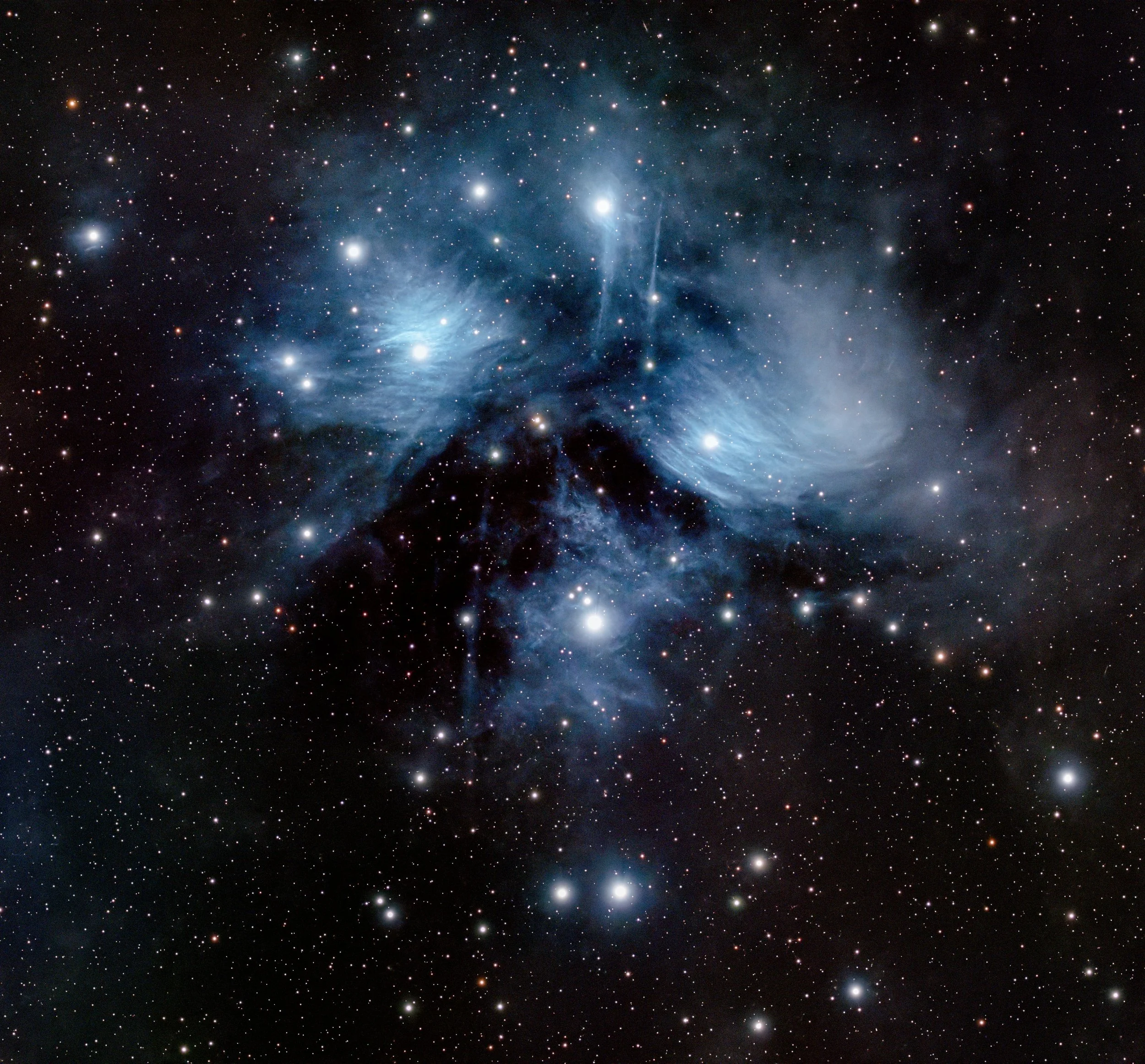
The Pleiades star cluster - The Seven Sisters of Taurus. 7h 50m total exposure.
Mythology and Cultural Significance
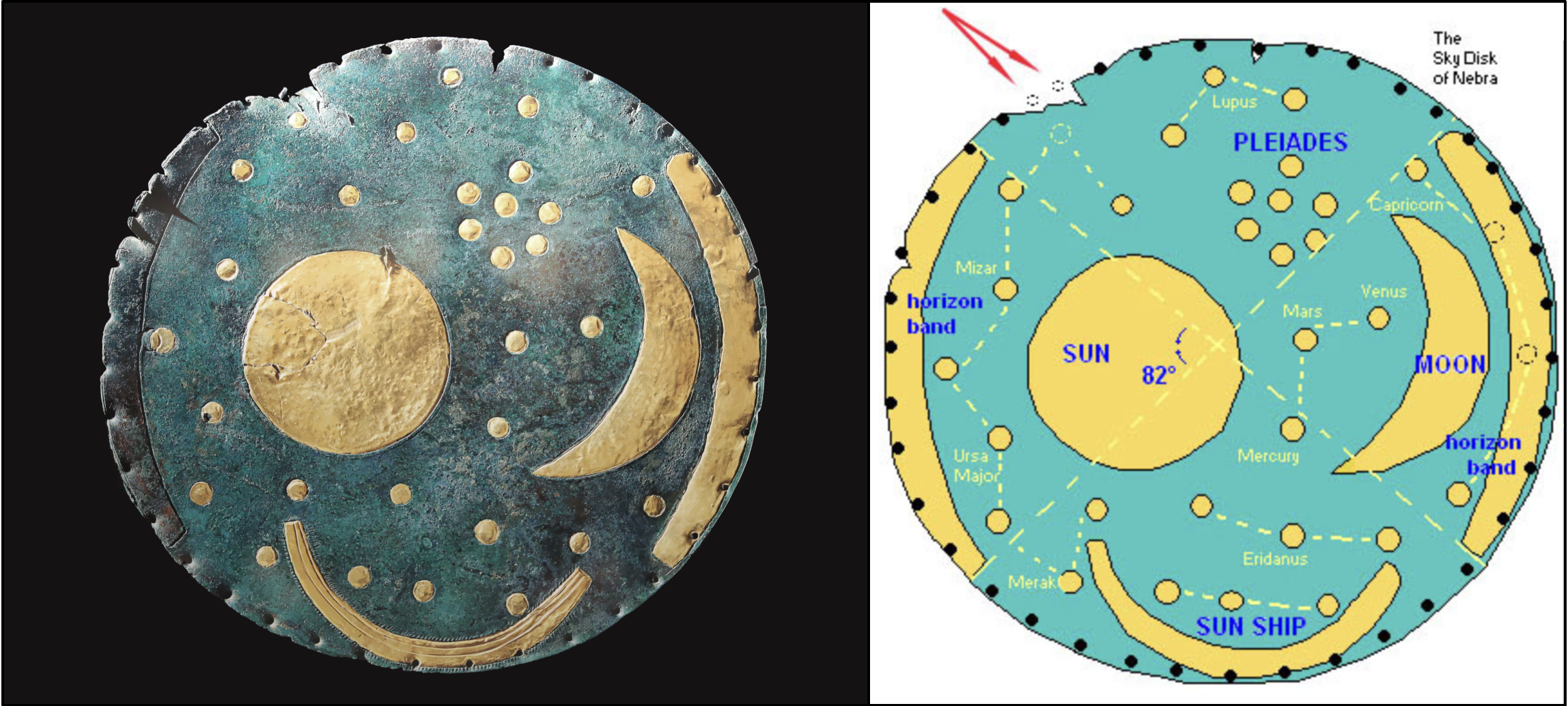
The Nebra Skydisk. Photo by Frank Vincentz.
This open cluster, which appears to the naked eye as a brilliant object, is part of the folklore and myths of many cultures. Early descriptions date back to Mesopotamian mythology, about 2,500 BC. Only recently discovered is the now-famous ancient image of the Pleiades on the Nebra Skydisk from Germany, which is believed to have been made about 1,600 BC.
The name Pleiades may be derived from the Greek plein, meaning “to sail.” In Greek mythology, Alcyone, Asterope, Maia, Electra, Merope, Taygeta, and Celaeno are named after the mythological Seven Sisters, daughters of the ocean nymph Pleione and Atlas, whom Orion had chased across the Earth for seven years. When the Pleiades appealed to Zeus for help, the god transformed them into doves so they could find refuge among the stars.
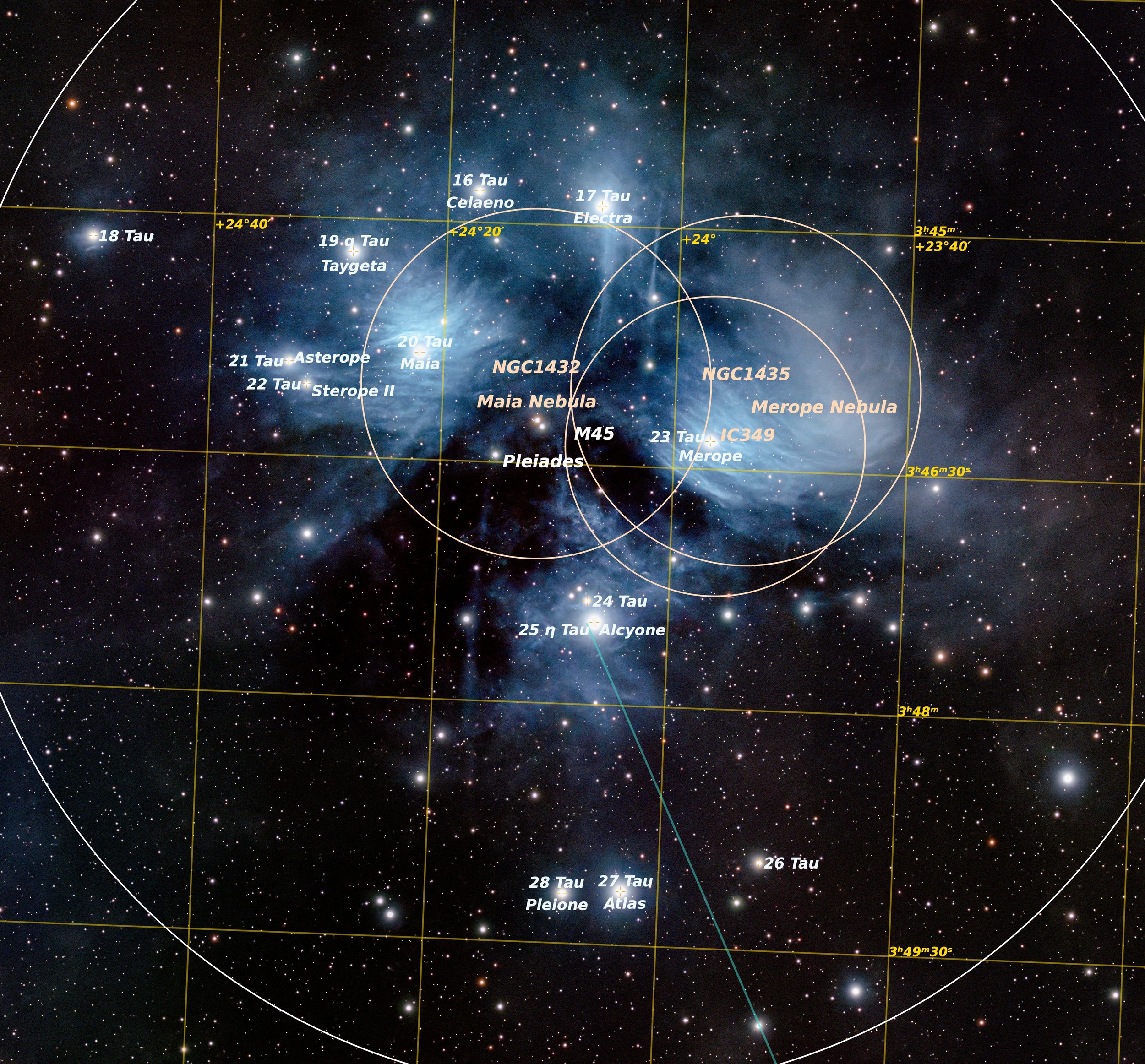
The Pleiades stars. Plate solved and annotated in PixInsight.
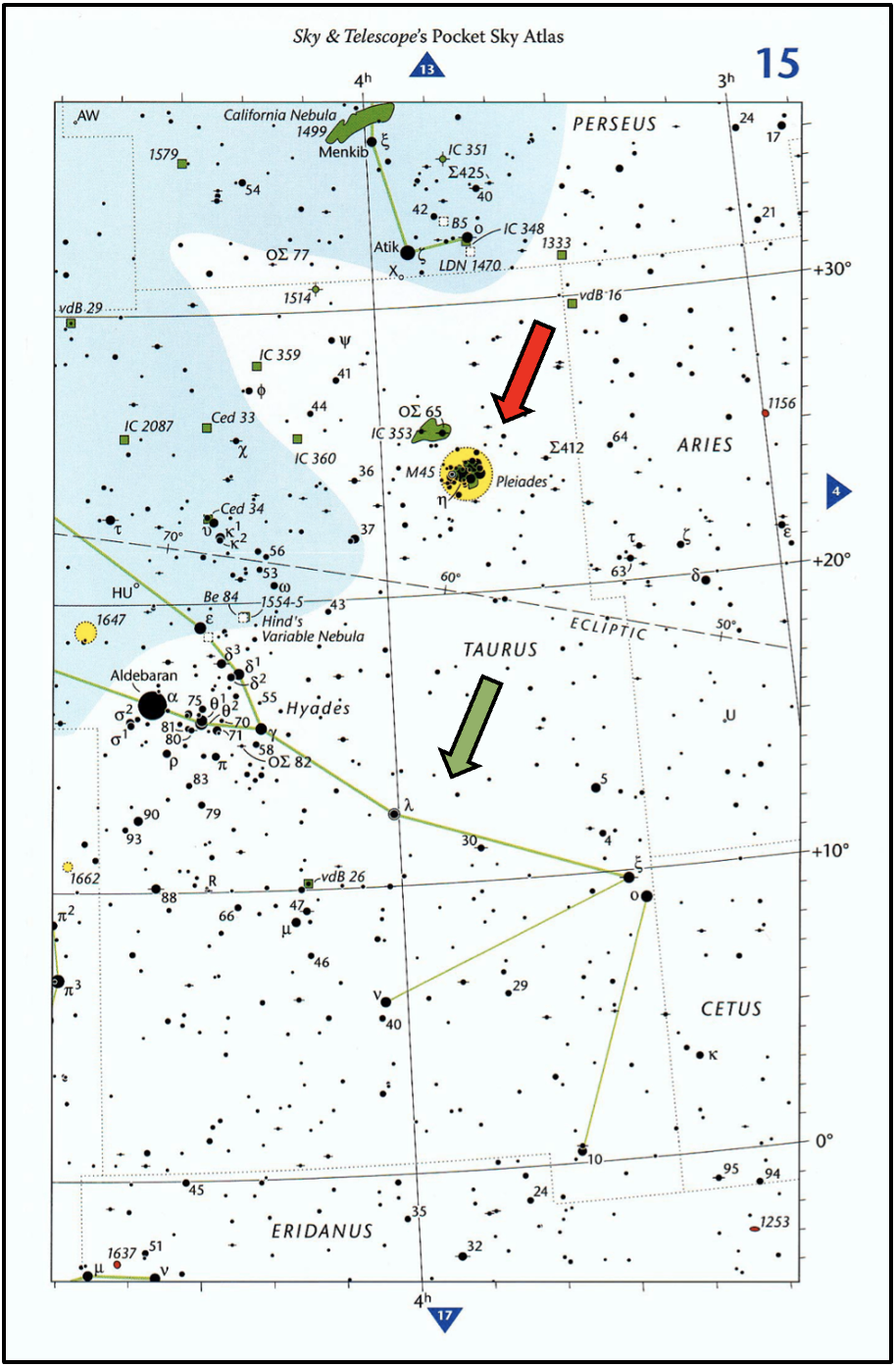
The Pleiades star cluster - Sky & Telescope’s Pocket Sky Atlas, Roger W. Sinnott.
In Japanese, “Subaru” has a double meaning:
Astronomically, it refers to the Pleiades;
Linguistically, it conveys the idea of bringing things together in harmony.
This last meaning was chosen to symbolize the merger of five companies into Fuji Heavy Industries (FHI) in 1953, which later became Subaru Corporation.
Astrophysics
Cluster type:
Open star cluster.
Astronomers estimate the Pleiades will remain gravitationally bound for another 250 million years before dispersing into the Milky Way due to galactic tidal forces.
Age:
Between 75 and 150 million years.
Distance from Earth:
425 light-years.
Size:
Spans about 20 light-years across.
The innermost region, as covered by the 6 to 8 Pleiades stars visible to most naked eye observers, measures only 7 light-years.
Stars:
Over 800 members, dominated by hot, luminous blue B-type stars.
Those 6 to 8 bright blue cluster stars visible to the naked eye are young stars with several solar masses.
Brightness:
Apparent magnitude of 1.6, making it one of the most obvious clusters in the night sky.
With 1,000 times the solar luminosity, Alcyone is the brightest Pleiades star.
Reflection Nebula
The Pleiades are not just a cluster of bright stars; they are also surrounded by a dusty blue reflection nebula, which includes the Merope Nebula (NGC 1435) and NGC 1432. The blue color is due to the blue light emitted by the brightest stars, which is enhanced by the blue-light-scattering properties of small dust particles in the reflection nebula. This striking feature is evident only in long-exposure photographs of the cluster.
Perhaps counterintuitively, it is not the cluster’s harsh stellar winds that have formed these threads. Instead, the magnetic fields within the cloud itself have stratified the charged particles.
As for whether the cloud has any association with the star cluster, it is most likely that the cluster is simply passing through a nebulous region in Taurus on its journey around the Milky Way. Ironically, the Pleiades path in space is headed toward their unwanted pursuer — the Orion Constellation.
Observation
Best season:
October to April, with peak visibility in November when the cluster is visible all night.
Naked-eye view:
The Pleiades are the most impressive star cluster for naked-eye observation. Generally, six bright stars are seen. Under good conditions, three more stars - Pleione, Celaeno, and Asterope - can be perceived, raising the total number to nine.
Tip for Beginners: If you can spot Orion’s Belt, draw a line upward - it points directly toward the Pleiades.
Binoculars/telescopes:
Reveal dozens of stars and the faint nebulosity, making the Pleiades a favorite target for amateur astronomers and astrophotographers alike.
In a field of 2° by 2°, 500 stars have been counted.
Astrophotography Notes
The Pleiades are a perfect wide-field target for astrophotographers:
Equipment:
A short-focal-length refractor (300–500 mm) captures the entire cluster beautifully.
Filters:
A broadband filter (e.g., Optolong L-Pro, SVBonny SV260) helps reduce light pollution while preserving star color.
Exposure:
Long integrations reveal the faint nebulosity, but even short exposures highlight the brilliant blue stars.
Framing:
Include surrounding space for context — the cluster’s compact size makes it easy to center.
Check our post in AstroBin.