Pinwheel Galaxy: A Spiral Giant in Ursa Major
The Pinwheel Galaxy (Messier 101) is one of the most iconic face‑on spiral galaxies in the northern sky. Its enormous angular size, delicate spiral arms, and rich population of Hydrogen-II (HII) regions make it a favorite target for both visual observers and astrophotographers. Lying about 22 million light-years away from Earth, and with a diameter of nearly 184,000 light‑years, M101 contains at least 1 trillion stars.
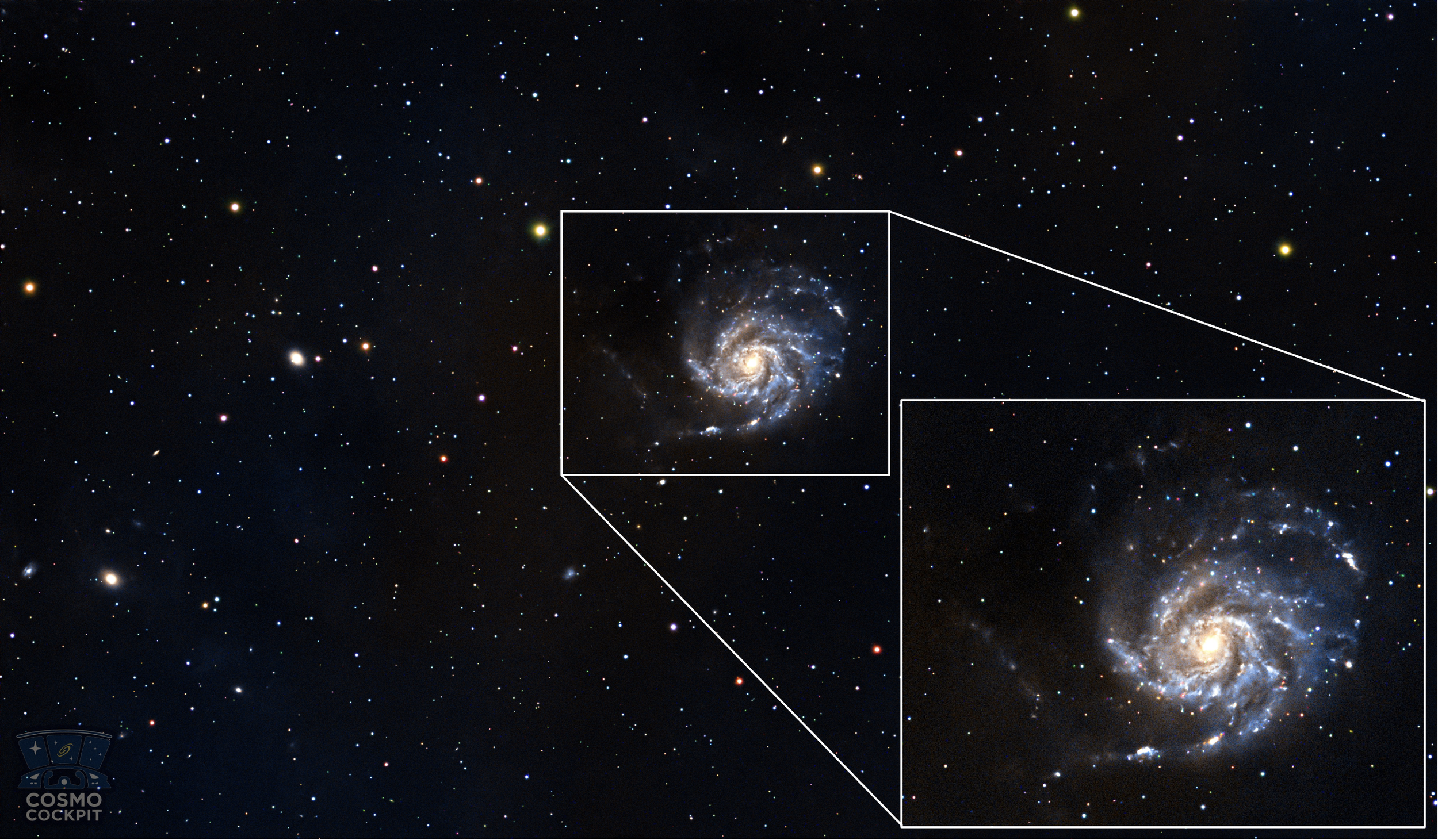
A six‑hour portrait of the Pinwheel Galaxy, revealing its sprawling spiral arms and the faint companions that orbit in its gravitational wake.
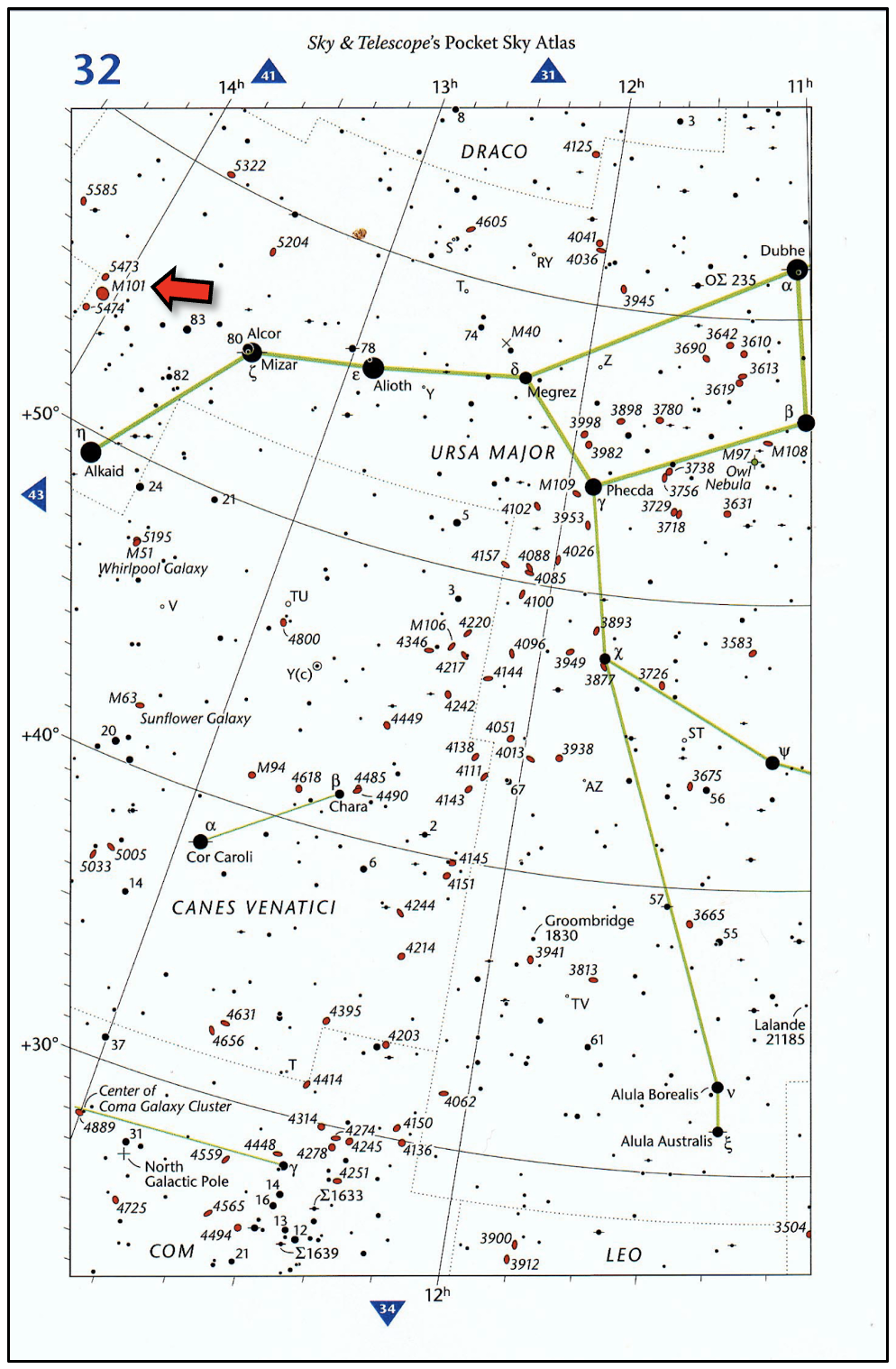
The Pinwheel Galaxy can be found to the northwest of the midpoint between Mizar and Alkaid, near the tip of Ursa Major’s (a.k.a. Big Dipper) hand. Sky and Telescope’s Pocket Sky Atlas - Roger W. Sinot.
History
M101 was discovered by Pierre Méchain in 1781 and added to the Messier catalog shortly thereafter. William Herschel later described it as a “nebula with spiral structure,” one of the earliest recognitions of spiral morphology before galaxies were understood as island universes.
In the 20th century, M101 became a key object in the study of:
Spiral arm star formation, thanks to its unusually bright H II regions.
Metallicity gradients, which are among the steepest known in a spiral galaxy.
Supernova events, including SN 1909A and SN 2023ixf, the latter observed by amateurs worldwide.
Its proximity and orientation make it a natural laboratory for understanding how spiral galaxies evolve.
Astrophysics
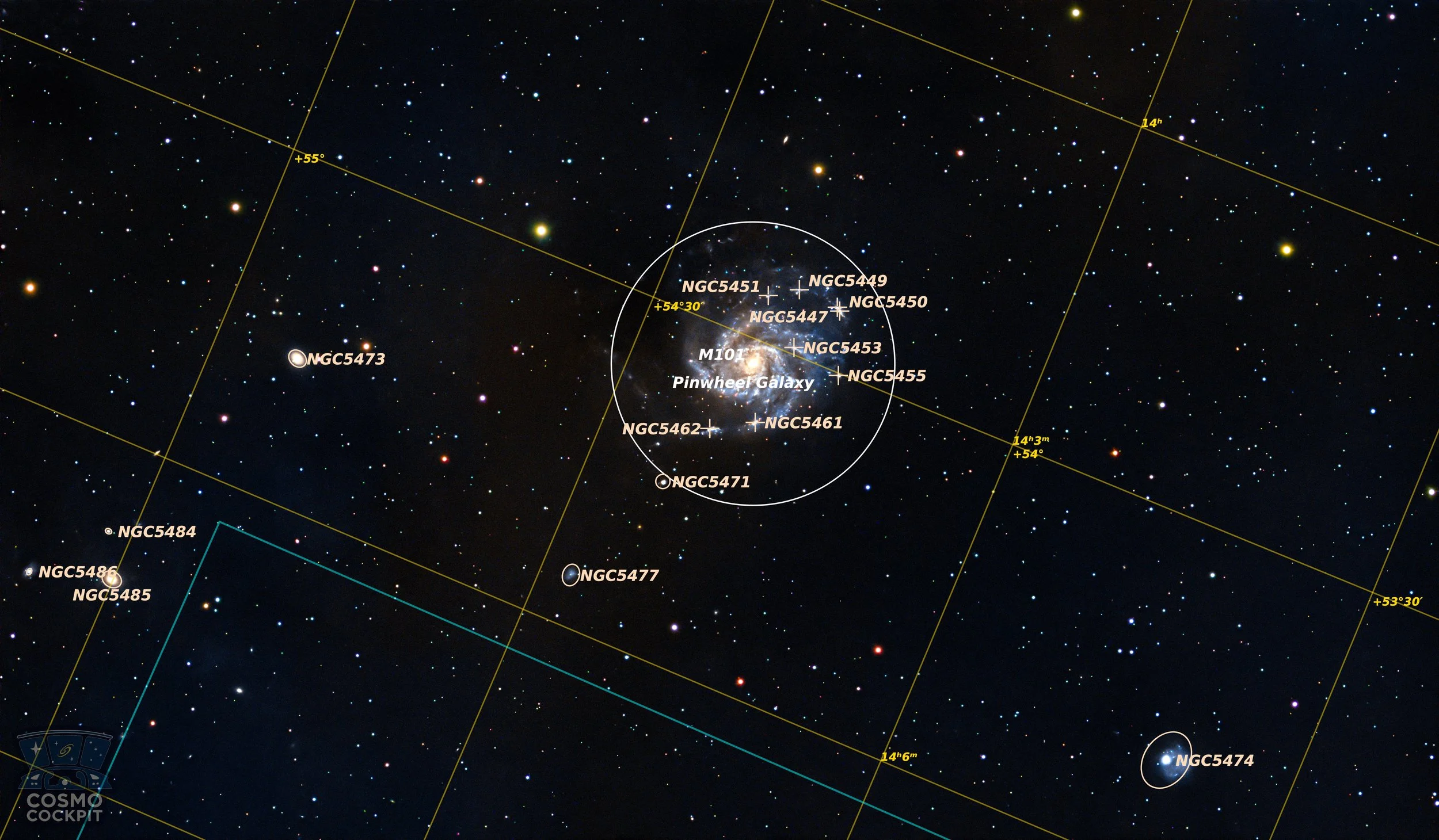
Wide‑field view of the M101 Group. Some of its companions — NGC 5473, NGC 5474, NGC 5477, and NGC 5485 — scattered across the frame. Annotated and plate-solved in PixInsight.
M101 is the textbook example of a “grand design” spiral, which we see face-on. It is an important object for calibrating and comparing various distance measurement methods and distance indicators. In 1995, the Hubble Space Telescope found several Variable Cepheid stars, from which a distance of 24 million light-years was derived. Recent cepheid recalibrations, however, corrected the Hubble data to a distance of 22 million light-years. Even this smallest distance value for M101 yields a very large physical diameter of 184,000 light-years – almost twice as large as our Milky Way!
What are Cepheid Variables? Cepheids are pulsating supergiant stars whose brightness rises and falls in a precise rhythm. The period of this pulsation reveals the star’s true luminosity, making Cepheids some of the most important distance indicators in Astronomy. Cepheids in M101 helped anchor measurements of the galaxy’s distance and contributed to calibrating the Hubble constant (i.e., the number that tells us how fast the Universe is expanding right now. It links a galaxy’s distance to how fast it appears to be moving away from us).
The Pinwheel Galaxy shows several interesting astrophysical features, such as:
Grand‑design spiral structure: M101 shows a loosely wound spiral with a weak bar and well‑defined star‑forming regions. The arms are asymmetric, likely due to gravitational interactions with its satellite galaxies. Past gravitational interactions with companion galaxies (such as NGC 5204, 5474, 5477, and 5585) have warped M101’s shape and likely enhanced star formation in its spiral arms.
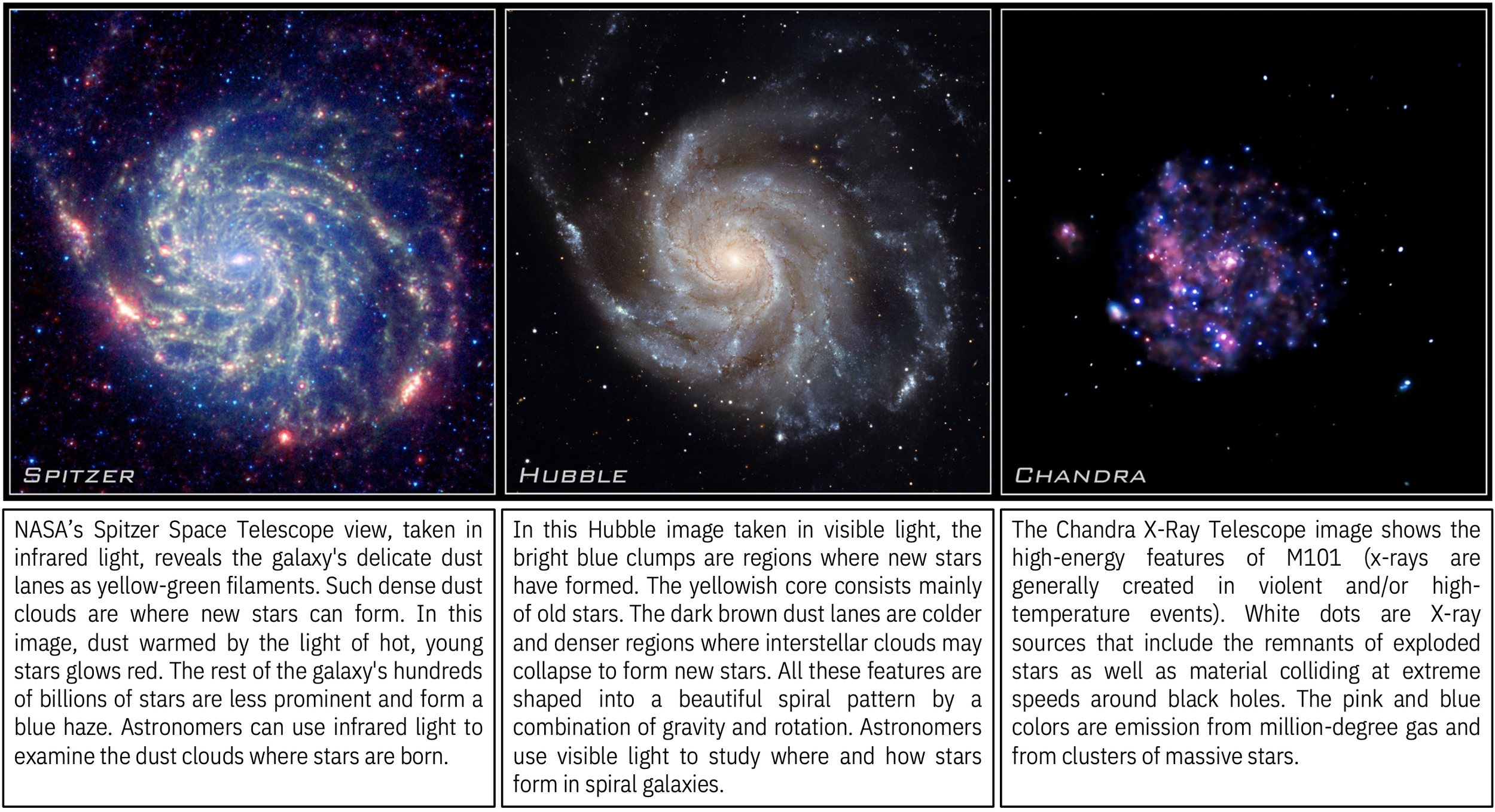
HII regions: M101 is famous for its exceptionally bright and numerous HII regions — vast clouds of ionized Hydrogen lit up by clusters of newly formed, massive stars. These regions trace the spiral arms like glowing beads, revealing where the galaxy is actively building its next generation of stars (giant HII complexes such as NGC 5461 and NGC 5462 are among the brightest known outside the Milky Way). The galaxy has hosted at least six supernova explosions since the early 20th century.
Metallicity gradient: M101 has one of the steepest metallicity gradients among nearby spiral galaxies. In Astronomy, “metallicity” refers to the abundance of elements heavier than Helium — the products of previous generations of stars. The inner disk of M101 is metal‑rich, meaning it has undergone many cycles of star formation and enrichment. On the other hand, the outer arms are metal‑poor, suggesting more pristine gas and slower chemical evolution. This gradient helps astronomers reconstruct the galaxy’s assembly history, including gas inflow, star‑formation bursts, and gravitational interactions.
Dark matter halo: Studies of the galaxy’s speed rotation predict a massive dark matter halo extending far beyond the visible disk.
The galaxy’s slight lopsidedness is thought to be caused by tidal interactions with NGC 5474, which appears distorted even in amateur images.
Observation
Face-on galaxies are generally difficult objects to see through backyard telescopes because of their low surface brightness. But with patience, the galaxy will reveal its asymmetrical form and dim far-flung arms with only moderate magnifications.
Best time to observe:
March to June, when Ursa Major is high in the northern sky.
Near the zenith for observers at mid‑northern latitudes.
What you can see visually:
Under dark skies: a faint, diffuse glow with hints of structure.
With large Dobsonian telescopes: the brightest H II knots.
Astrophotography Tips
M101 is a rewarding but deceptively challenging target. Its bright core is small, its outer arms are faint, and the galaxy spans nearly half a degree — meaning you need both resolution and depth to do it justice.
Short- to medium-refractors (400–800 mm) are ideal for framing the entire galaxy and its companions.
Longer focal lengths (1000–2000 mm) reveal finer detail in the spiral arms and H II regions but require excellent tracking and seeing.
A field flattener is recommended to keep stars sharp across the frame, especially with APS‑C or full‑frame sensors.
M101’s low surface brightness means long total integration is more important than individual sub‑exposure length. Aim for 4–10 hours of total exposure for a clean, detailed result.
Keep the histogram peak between 20–35% to avoid clipping shadows or blowing out the core.
Broadband (or no filter) gives the most natural color and best star quality.
Dual‑band filters (Hα/O III) can help highlight the H II regions in the spiral arms, especially under light‑polluted skies.
Check our post in Astrobin.