Elephant's Trunk Nebula (IC 1396): A Cosmic Silhouette in Cepheus
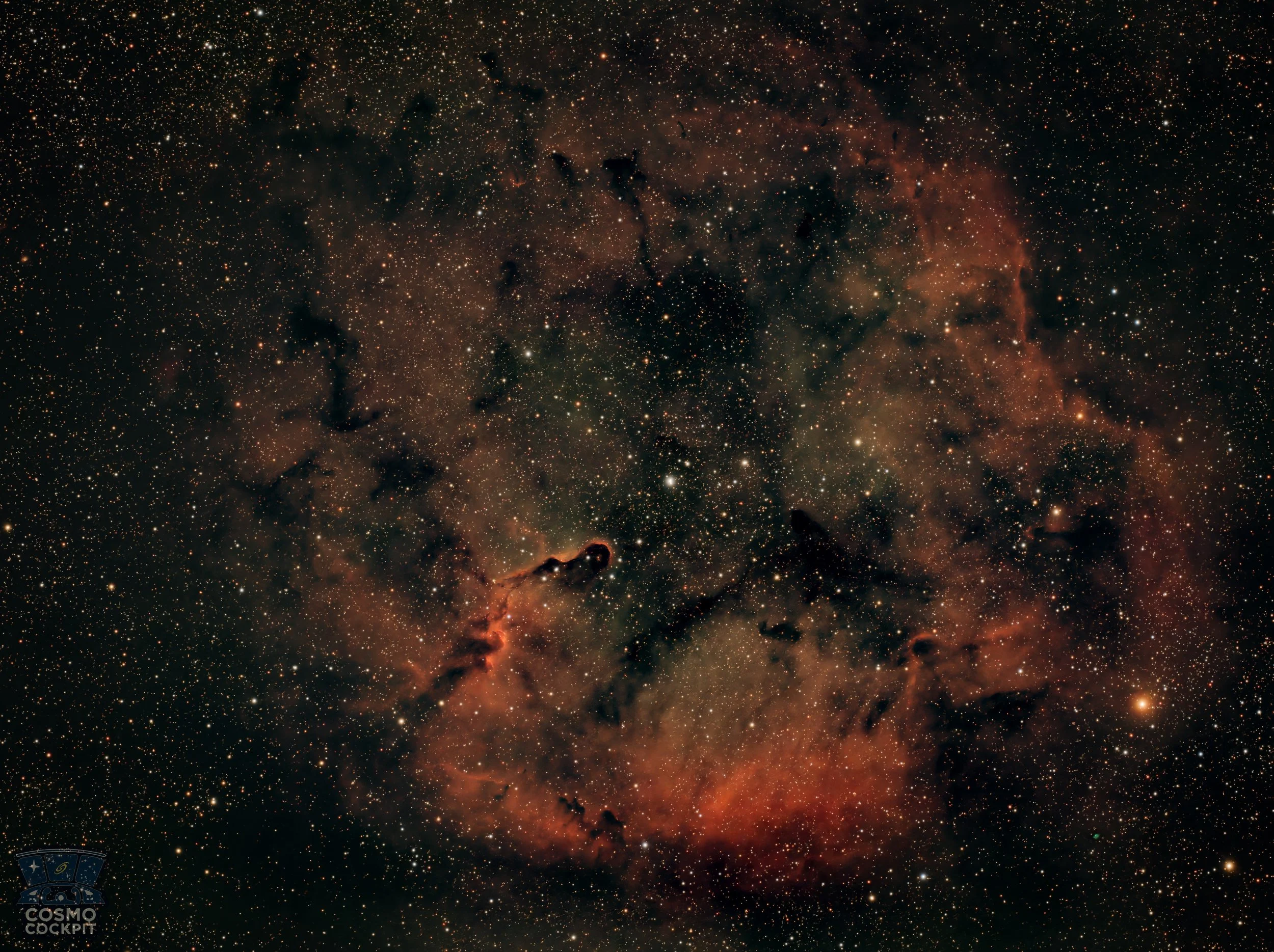
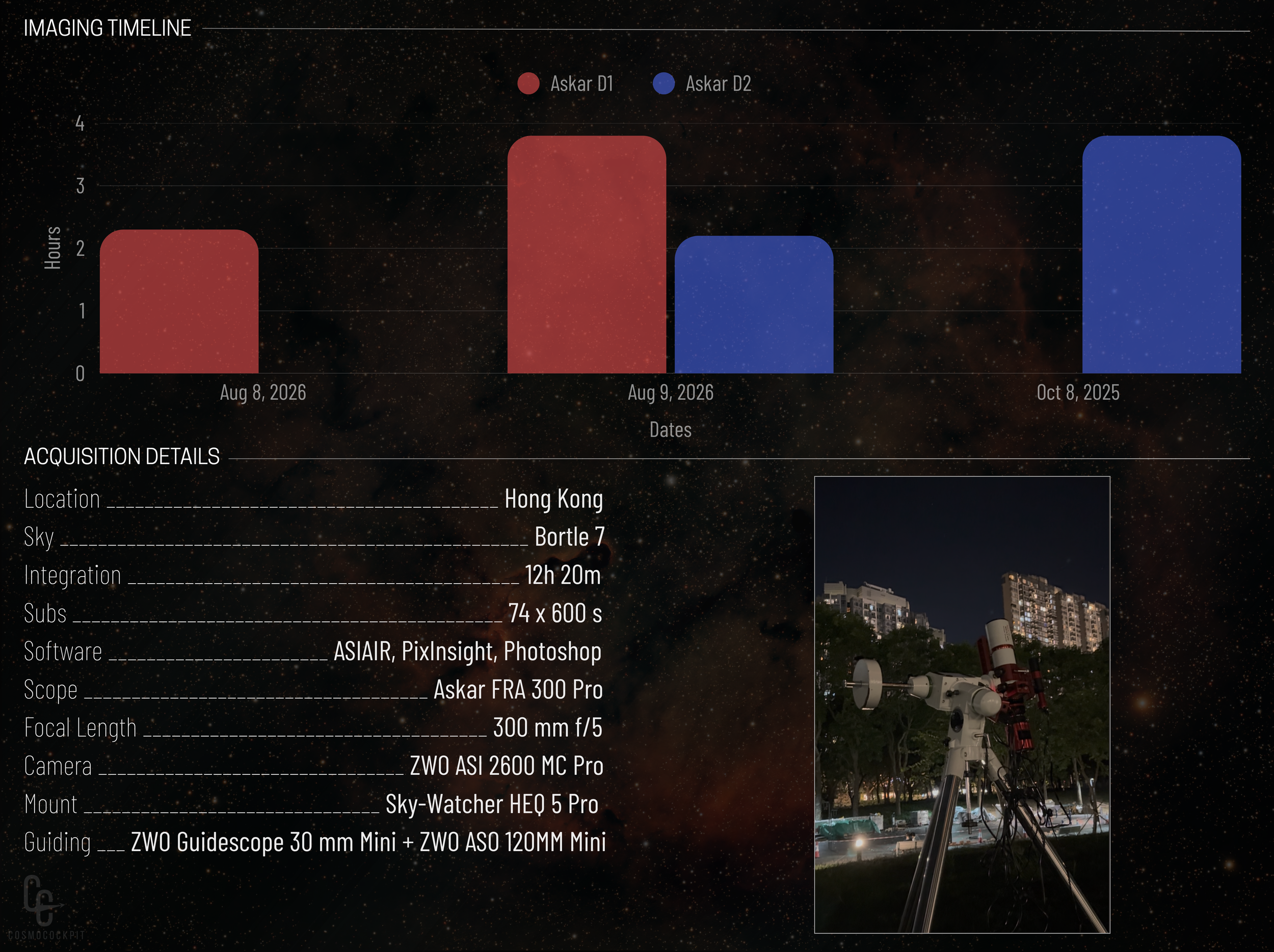
Elephant's Trunk Nebula (IC 1396A) — 12h 10m total exposure (Askar FRA 300 Pro, ZWO ASI 2600 MC).
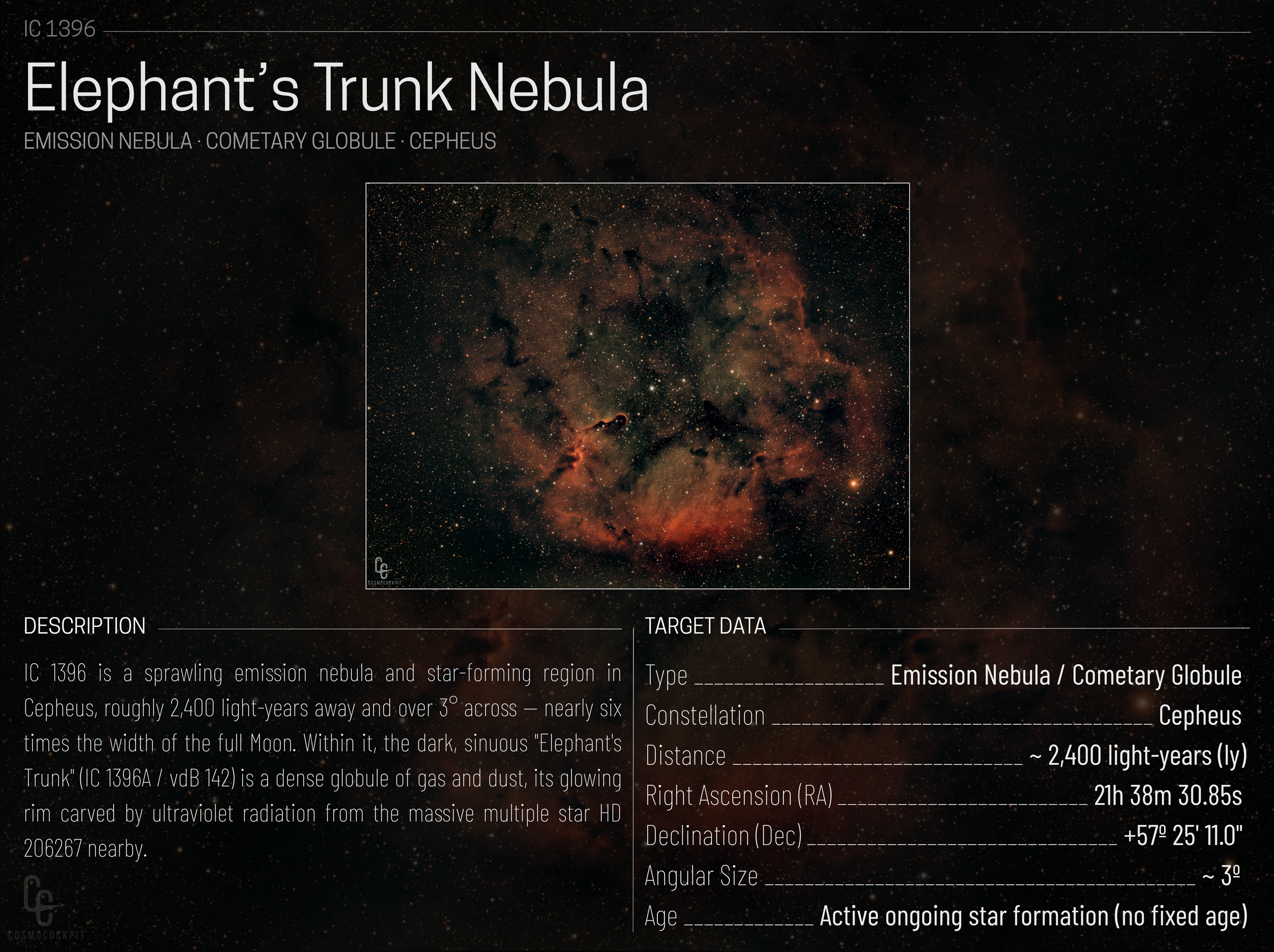
The Elephant's Trunk Nebula (IC 1396A) is one of the most striking dark silhouettes in the northern sky — a dense, sinuous globule of gas and dust carved by radiation and set glowing at its edges, adrift inside the much larger emission nebula IC 1396 in the constellation Cepheus. The nebula lies about 2,400 light-years away from Earth. The Trunk itself stretches roughly 20 light-years in length and about 2 light-years across — a narrow, elongated pillar of cold gas set against the sprawling 100-light-year span of IC 1396 as a whole. Despite that enormous scale, this small dark cloud is quietly hiding one of the most active star-forming pockets in our corner of the galaxy.
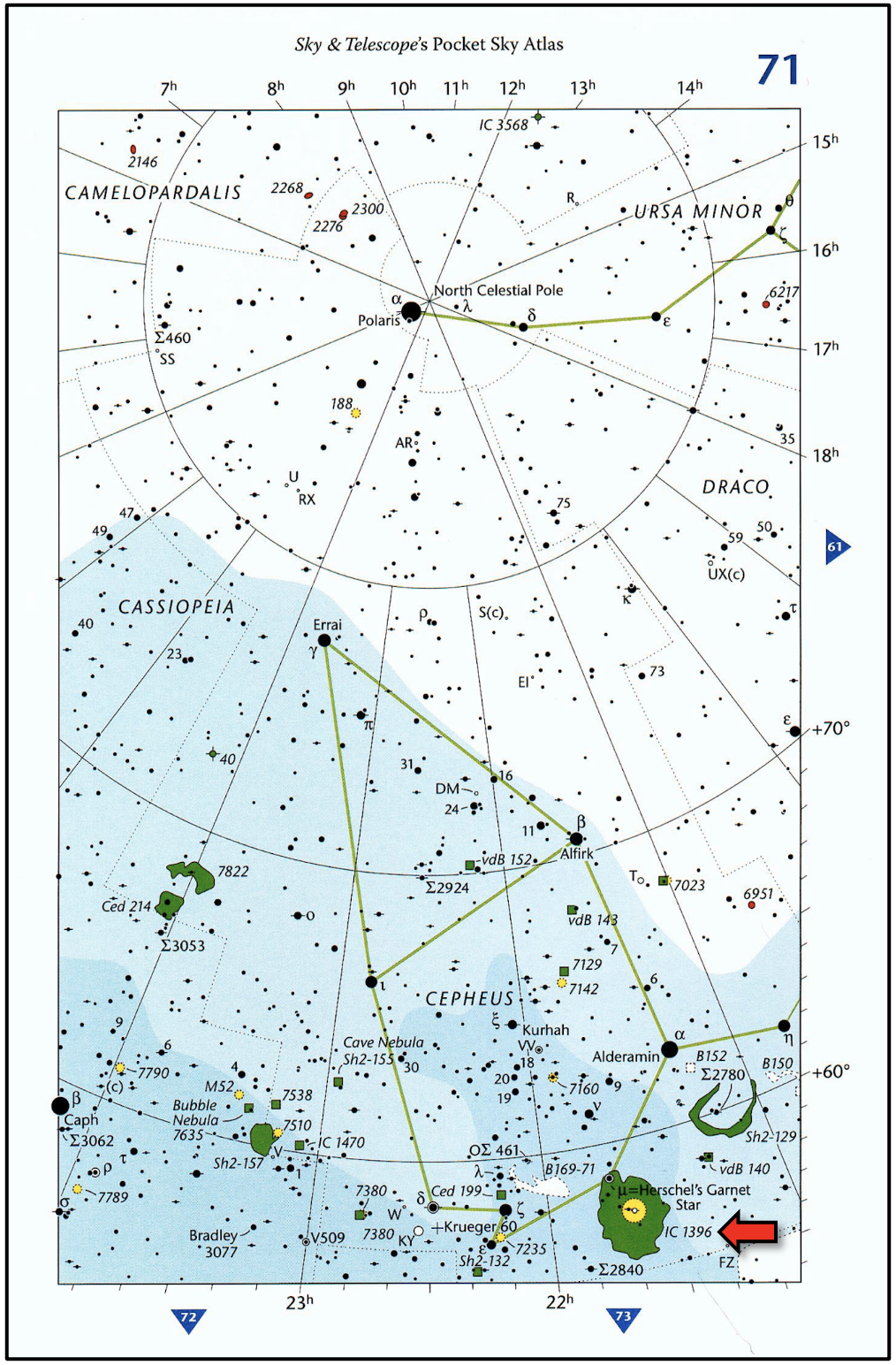
IC 1396 lies in Cepheus, near the border with Cygnus, drifting through the rich star fields of the summer/autumn Milky Way. Sky and Telescope's Pocket Sky Atlas – Roger W. Sinnott.
History
IC 1396 takes its name from J.L.E. Dreyer's Index Catalog, the early 20th-century supplement to the New General Catalog (NGC) compiled from the first wave of astronomical photography. The nebula itself is vast — spanning roughly 3° of sky, among the largest emission regions visible from Earth — but it took decades for its structure to be properly understood.
At its heart sits the open cluster Trumpler 37, cataloged by Swiss-American astronomer Robert Trumpler in 1930, whose young, hot stars are responsible for lighting up the surrounding gas. It was only with later photographic and radio surveys that astronomers identified the numerous dark, comet-shaped globules scattered across the nebula — of which the Elephant's Trunk (IC 1396A) is the most famous, its shape unmistakable even in modest amateur images.
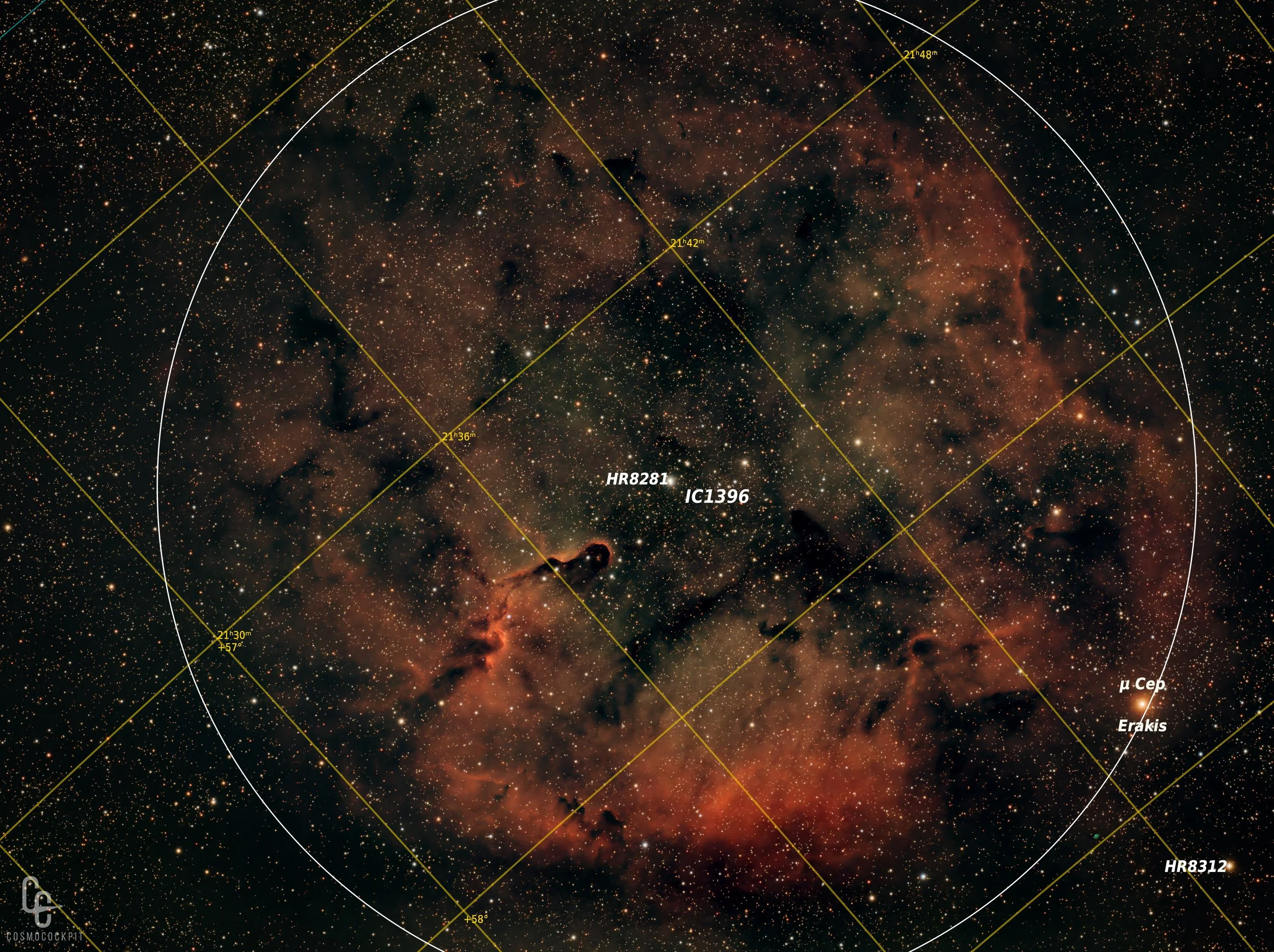
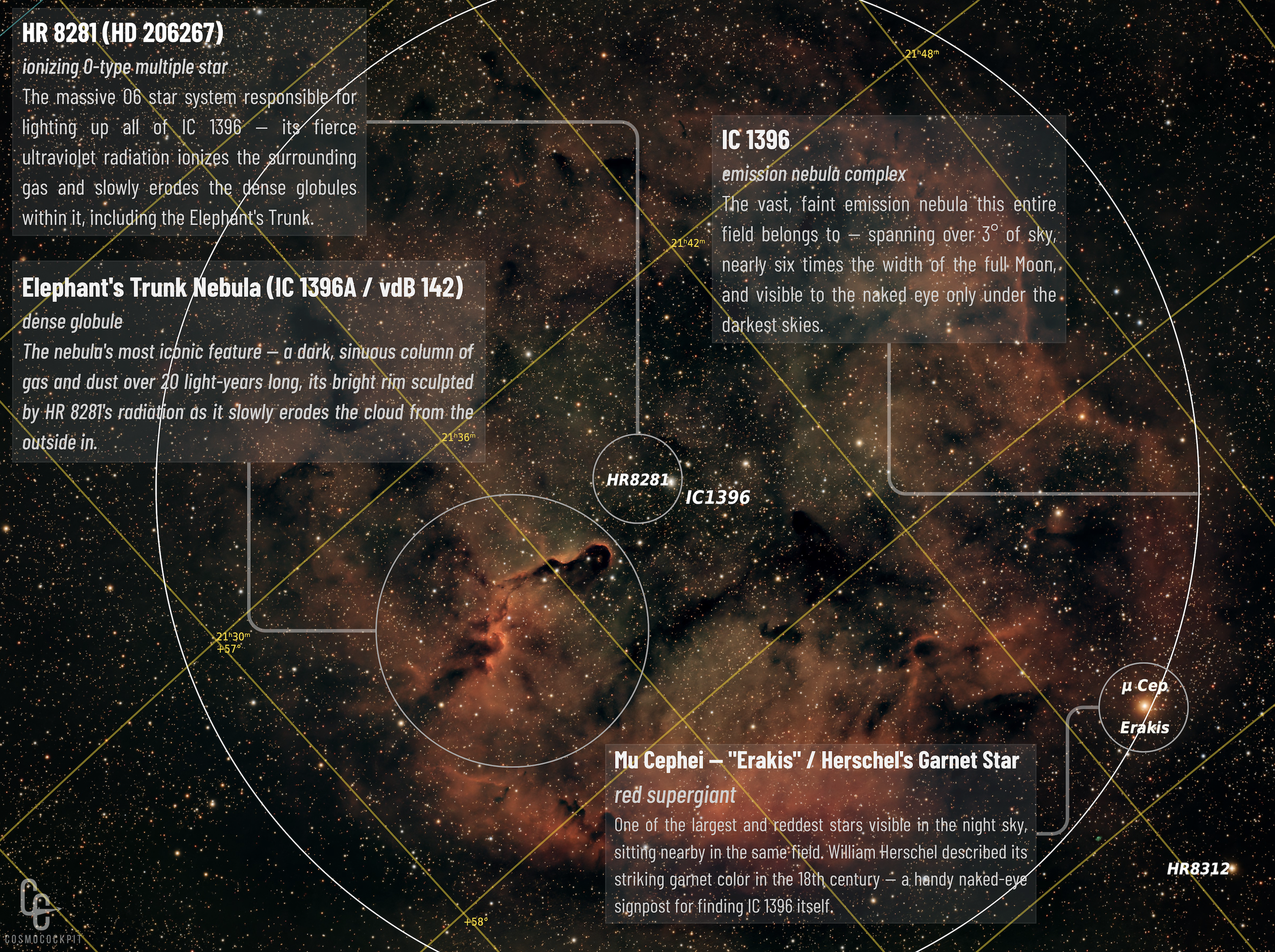
IC 1396, annotated and plate-solved in PixInsight.
Astrophysics
IC 1396 is what astronomers call an H II region — a cloud of interstellar hydrogen ionized by the fierce ultraviolet output of young, massive stars. The entire structure is powered by HD 206267, an O6.5-type star at the center of Trumpler 37, one of the hottest and most luminous types of star known. Its radiation strips electrons from the surrounding hydrogen gas, causing it to glow — and it is slowly eroding away everything in its path. That erosion is exactly what shaped the Elephant's Trunk. A few key features make this region such a rich target for both imaging and research:
A bright-rimmed globule: the Trunk is a dense pocket of gas and dust that has resisted the ionizing radiation flooding the rest of the nebula. Its outer edge glows brightly where the radiation front meets the cloud, while its interior remains dark and opaque — the classic silhouette that gives it its name.
Triggered star formation: the same radiation pressure eating away at the globule is also compressing it, and in doing so, triggering the collapse of new stars within it. Researchers estimate that around 20% of the stars in the Trumpler 37 cluster may have formed this way — born from clouds squeezed into collapse by their more massive neighbors.
Hidden protostars: at visible wavelengths, the Trunk is simply a dark shape blocking the light behind it. But infrared observations — famously from the Spitzer Space Telescope — pierce straight through the dust, revealing a population of embedded protostars and young stellar objects actively forming inside. Spitzer's infrared view transformed the globule into what NASA nicknamed a "flying dragon."
Part of a larger family: IC 1396 hosts more than 20 bright-rimmed globules like the Trunk, scattered around its periphery — each one a small laboratory for studying how massive stars sculpt and seed the clouds around them.
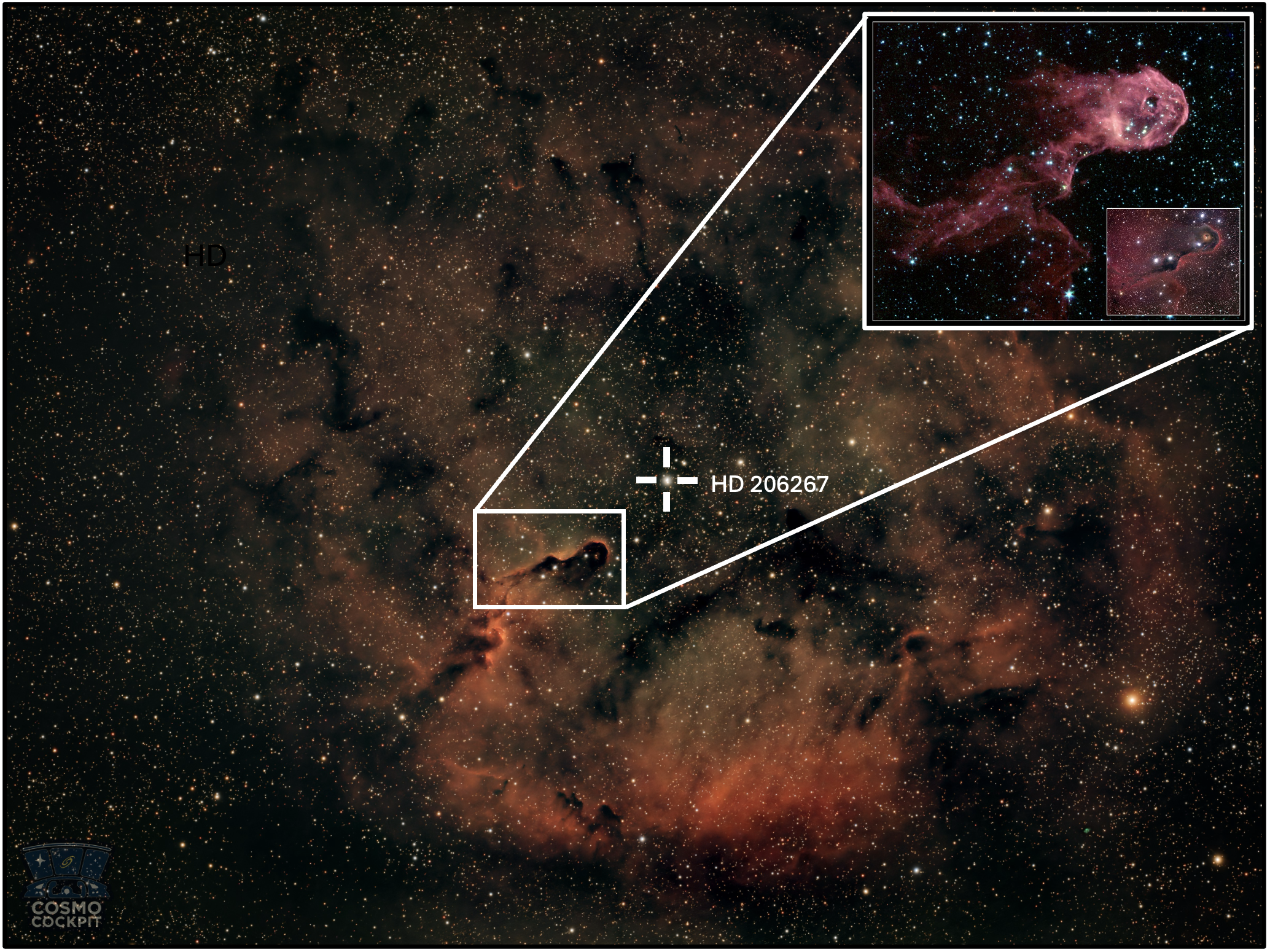
NASA's Spitzer Space Telescope image of a glowing stellar nursery provides a spectacular contrast to the opaque cloud seen in visible light. The Elephant's Trunk Nebula is an elongated dark globule within the emission nebula IC 1396 in the constellation of Cepheus. Located 2,450 light-years away, the globule is a condensation of dense gas that is barely surviving the strong ionizing radiation from the star HD 206267. The Spitzer Telescope’s infrared image (which transforms the dark cloud into a 'flying dragon’) can pierce the obscuration to reveal the birth of new protostars (embryonic stars) and previously unseen young stars. Credit: NASA/JPL-Caltech/W. Reach (SSC/Caltech).
What is a Bok Globule? A Bok globule is a small, extremely dense, opaque cloud of gas and dust, cold enough and compact enough for gravity to eventually win out and collapse into new stars. Named after astronomer Bart Bok, who first proposed in the 1940s that these dark clouds were stellar nurseries — a hypothesis later confirmed by infrared and radio observations. The Elephant's Trunk is technically a bright-rimmed cloud rather than a classic isolated Bok globule, but it shares the same basic physics: dense gas, sheltering new stars, slowly being consumed by the environment around it.
Herschel's Garnet Star
Right at the edge of IC 1396 sits Mu Cephei (µ Cep), one of the largest stars known — a red supergiant with a radius more than a thousand times that of the Sun and a luminosity around 100,000 times greater.
It is bright enough to be seen with the naked eye, and its deep red color is so striking that William Herschel described it in 1783 as “a very fine deep garnet color... a most beautiful object.” That description is the source of its popular name, and in 2024 the IAU formally adopted Garnet Star as its official designation.
At roughly the same distance as IC 1396 itself, it is a fitting, fiery neighbor to a nebula shaped by the light of massive stars. And because Mu Cephei is both so large and so evolved, it is also considered a strong candidate to end its life as a supernova.
William Herschel was a German-born British astronomer and composer, best known for discovering Uranus in 1781.
Observation
IC 1396 is best placed for observation from late summer through autumn, when Cepheus climbs high in the northern sky through the evening hours.
What you can see visually:
The open cluster Trumpler 37 is visible in binoculars and small telescopes as a loose scattering of stars.
The surrounding nebulosity, however, is extremely faint — IC 1396 has very low surface brightness, and even under dark skies it typically requires a wide-field telescope with a nebula filter (or astrophotography) to reveal any real structure.
The Elephant's Trunk itself is essentially invisible to the eye at the telescope — this is a target that only truly comes alive in long-exposure imaging.
Astrophotography Tips
IC 1396 is a rewarding but genuinely demanding target — faint, enormous, and (depending on your location) potentially sitting in a difficult part of the sky.
Short-focal-length refractors (300–500mm) are ideal — the nebula spans nearly 3°, and you'll want a wide field to capture the Trunk along with the surrounding nebulosity rather than cropping in tight.
Narrowband filters (Hα, OIII, SII) are extremely effective here, especially under light-polluted skies, since IC 1396's overall surface brightness is low but its emission lines are strong relative to typical urban skyglow.
If you're imaging from a location with significant light pollution in one direction, check where your target actually transits — shooting near meridian crossing minimizes both airmass and the amount of atmosphere (and light dome) you're punching through, even if that direction isn't your darkest patch of sky.
Watch the OIII/blue channel carefully if you're fighting urban light pollution — modern broadband LED streetlighting has enough output in the blue-cyan range to leak past even a narrow OIII bandpass filter, and since IC 1396's genuine OIII signal is fainter than its Hα, that contamination can disproportionately affect your final color balance. A careful gradient correction pass, with extra attention to the frame edges, goes a long way.
Aim for long total integration — the Trunk's bright rim will show up relatively quickly, but the fainter outer nebulosity and dust lane detail reward patience. Multiple nights of 8–10-minute narrowband subs, stacked into many hours of total data, make the difference between a flat image and one with real depth.
For a Hubble-style palette, Hα + OIII and SII + OIII dual-band filters (rather than three individual narrowband filters) can be combined to reconstruct a full three-channel narrowband image on a color camera — a practical option for OSC imagers without a mono setup and filter wheel.