Crescent Nebula (NGC 6888): A Stellar Wind Bubble in Cygnus
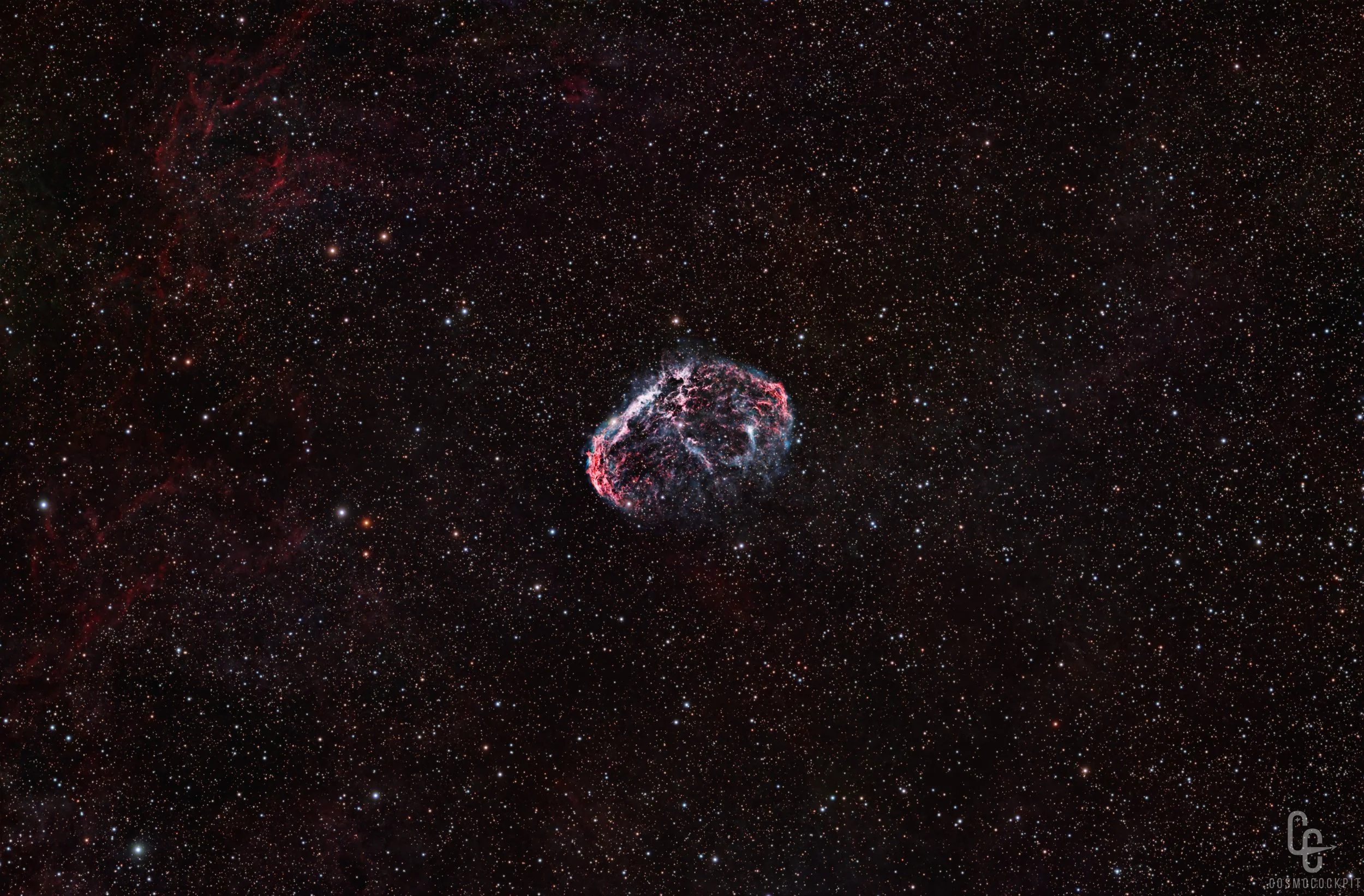
Crescent Nebula (NGC 6888) — 6h 10m total exposure (Askar 103 APO, ZWO ASI 2600 MC).
The Crescent Nebula (NGC 6888) is a glowing shell of gas in the constellation Cygnus, blown outward by one of the most violent phases in a massive star's life. It lies about 5,000 light-years away from Earth, and the shell itself spans roughly 25 light-years across — modest by nebula standards, which is why it appears as a compact, faint arc rather than a sprawling structure in the sky.
Also cataloged as Sharpless 105 and Caldwell 27, and nicknamed the "Euro Sign Nebula" for a resemblance some observers see in its shape at higher magnification, the Crescent is powered entirely by a single, dying star at its center.
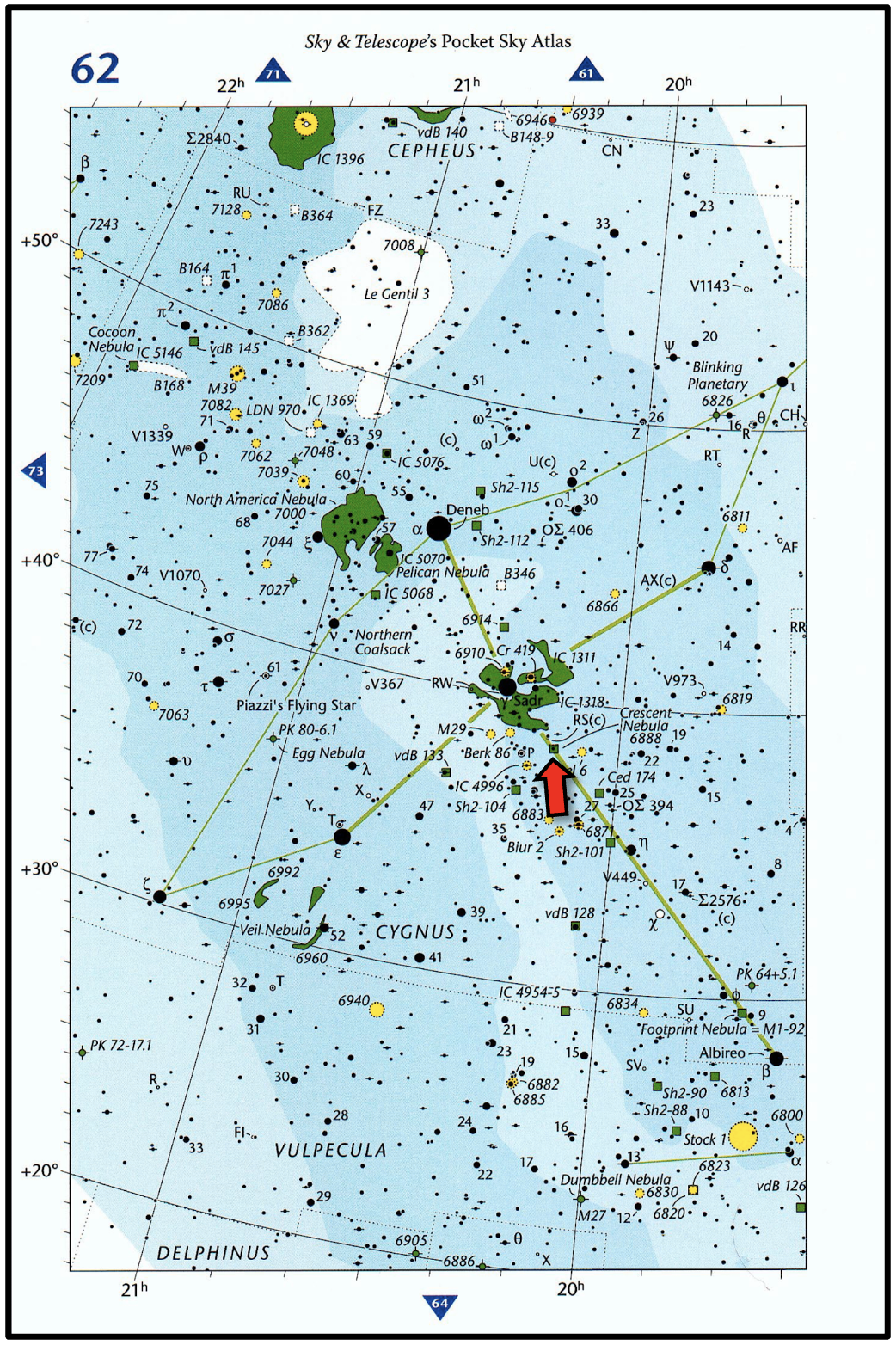
The Crescent Nebula lies in Cygnus, about 2.7° southwest of Sadr, drifting through the rich star fields of the summer/autumn Milky Way. Sky and Telescope's Pocket Sky Atlas – Roger W. Sinnott.
History
NGC 6888 was discovered by William Herschel in 1792 — the same astronomer behind Mu Cephei's "Garnet Star" description and the discoverer of Uranus. Herschel's early instruments could only resolve it as a faint, milky patch attached to a double star; it took much later photography to reveal the delicate, looping filament structure that gives the nebula its name.
It was later added to Stewart Sharpless's catalog of emission nebulae as Sh2-105, and to Patrick Moore's Caldwell Catalog as Caldwell 27 — a list specifically curated to complement Messier's catalog with bright non-Messier deep-sky targets for amateur observers.
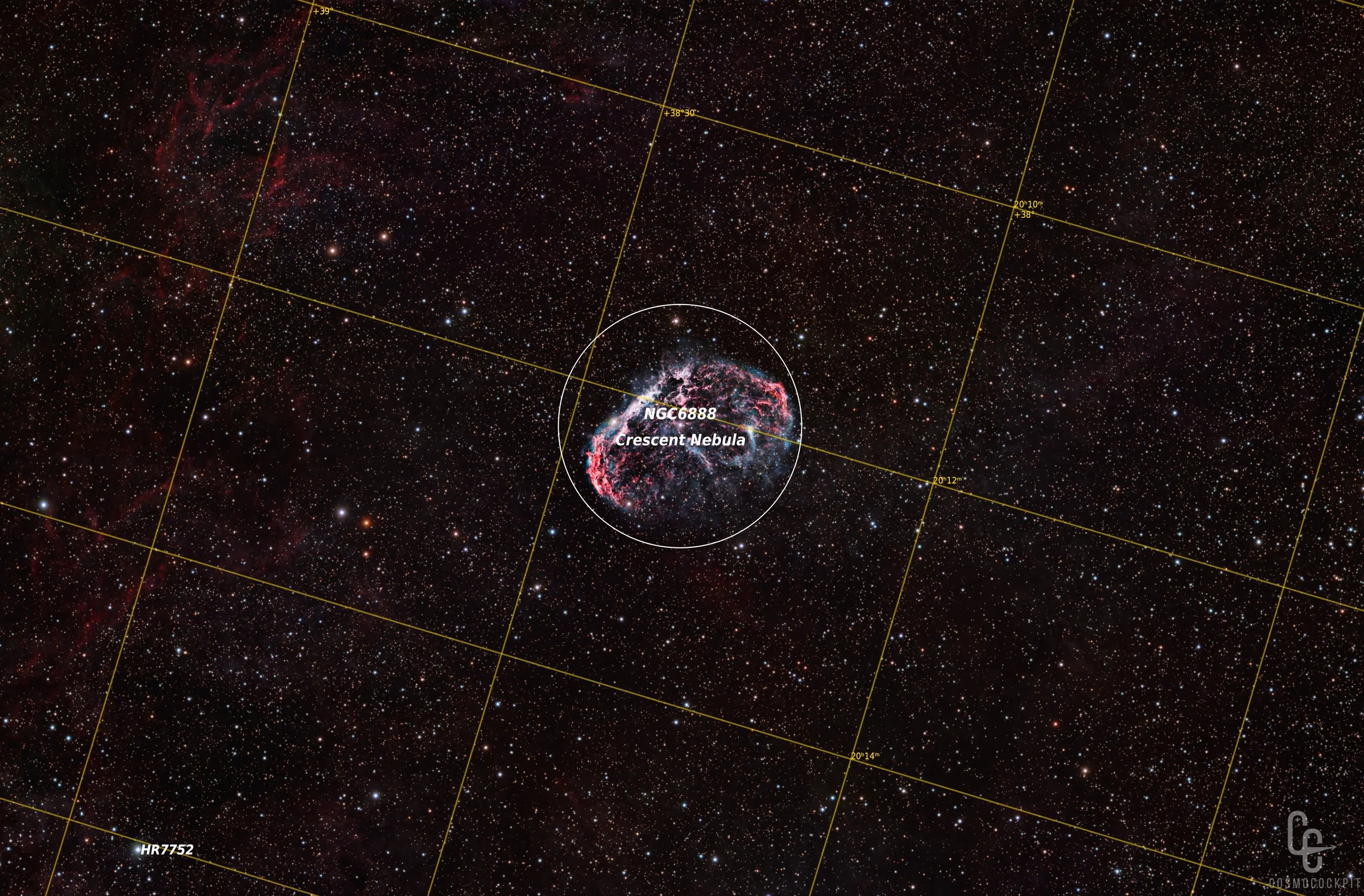
The Crescent Nebula, annotated and plate-solved in PixInsight.
Astrophysics
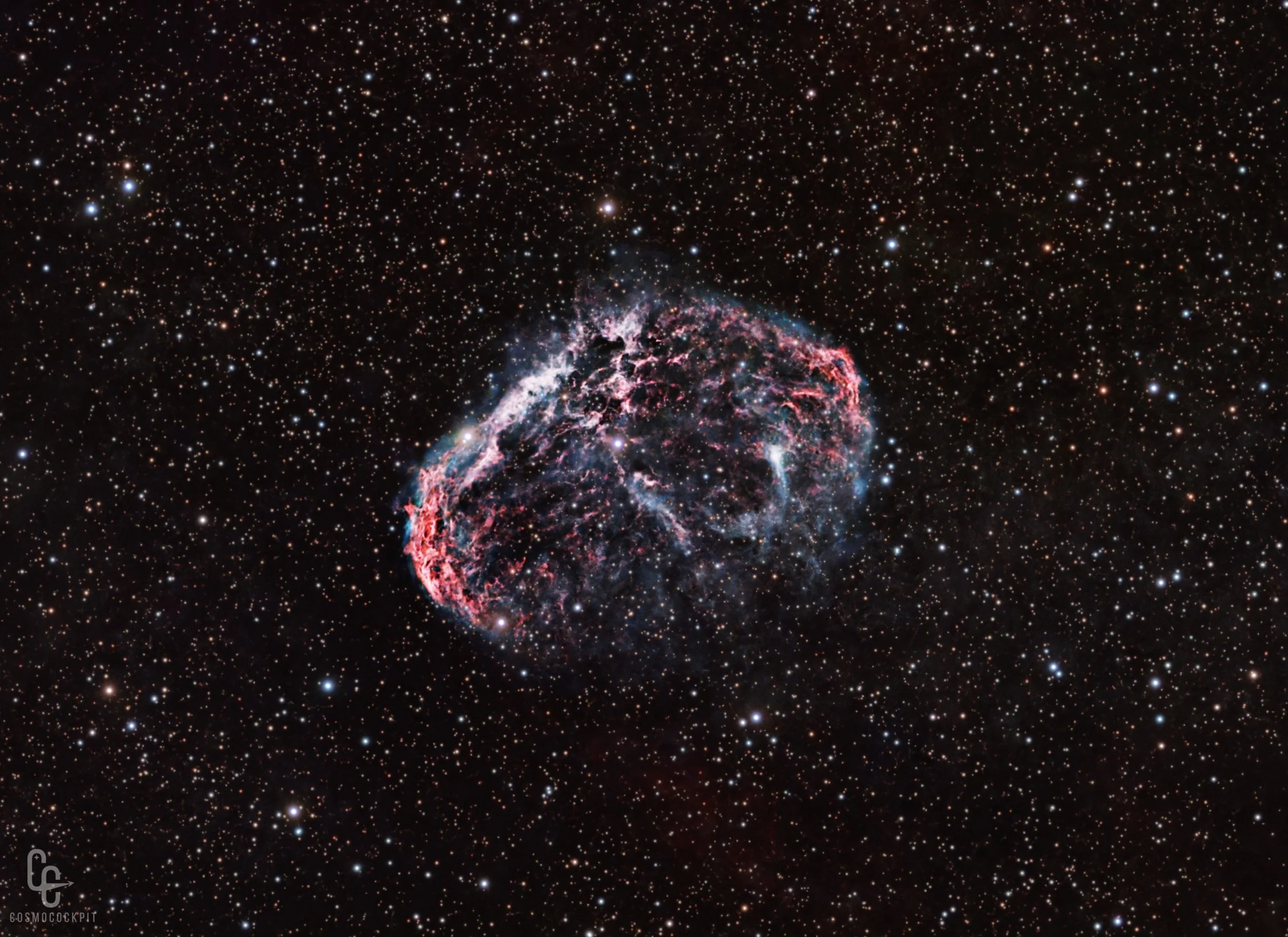
The Crescent Nebula owes its entire existence to the star at its center: WR 136 (also designated HD 192163), a Wolf-Rayet star — a rare, short-lived stage some massive stars pass through just before their lives end in a supernova.
A few hundred thousand years ago, WR 136 was a red giant, slowly shedding its outer layers into a slow-moving envelope of gas. As the star evolved further, it stripped away its remaining hydrogen envelope and exposed its hot, inner layers, which now blast out a much faster stellar wind — moving at several million miles per hour. That fast wind is now colliding with the slower material the star shed earlier, sweeping it up into the glowing shell we see today.
A shocked shell: the collision between the fast and slow winds produces two shock fronts — one plowing outward into the old slow wind, and one moving back inward into the fast wind itself. The inward-facing shock is energetic enough to heat the gas to X-ray-emitting temperatures, which is why the Crescent is also a target for X-ray observatories like the Chandra X-ray Observatory.
A star nearing its end: WR 136 is shedding mass at an extraordinary rate — roughly one solar mass every 10,000 years. That process can't continue indefinitely; astronomers expect the star to end its life in a supernova, possibly within the next few hundred thousand years — a blink of an eye on stellar timescales.
Rich in Hα and OIII, but light on SII: the shell's emission spectrum is dominated by hydrogen-alpha and doubly-ionized oxygen, making it a strong target for duo-narrowband Hα/OIII imaging.
What is a Wolf-Rayet star? Wolf-Rayet stars are massive, hot, highly evolved stars that have blown away most or all of their outer hydrogen envelope, exposing the fusion products underneath and driving an intense stellar wind. They're named after French astronomers Charles Wolf and Georges Rayet, who first identified the class at the Paris Observatory in 1867. Because they're rare, extremely luminous, and burn through their remaining fuel quickly, Wolf-Rayet stars are almost always seen shortly before their final collapse — WR 136 is a textbook example.
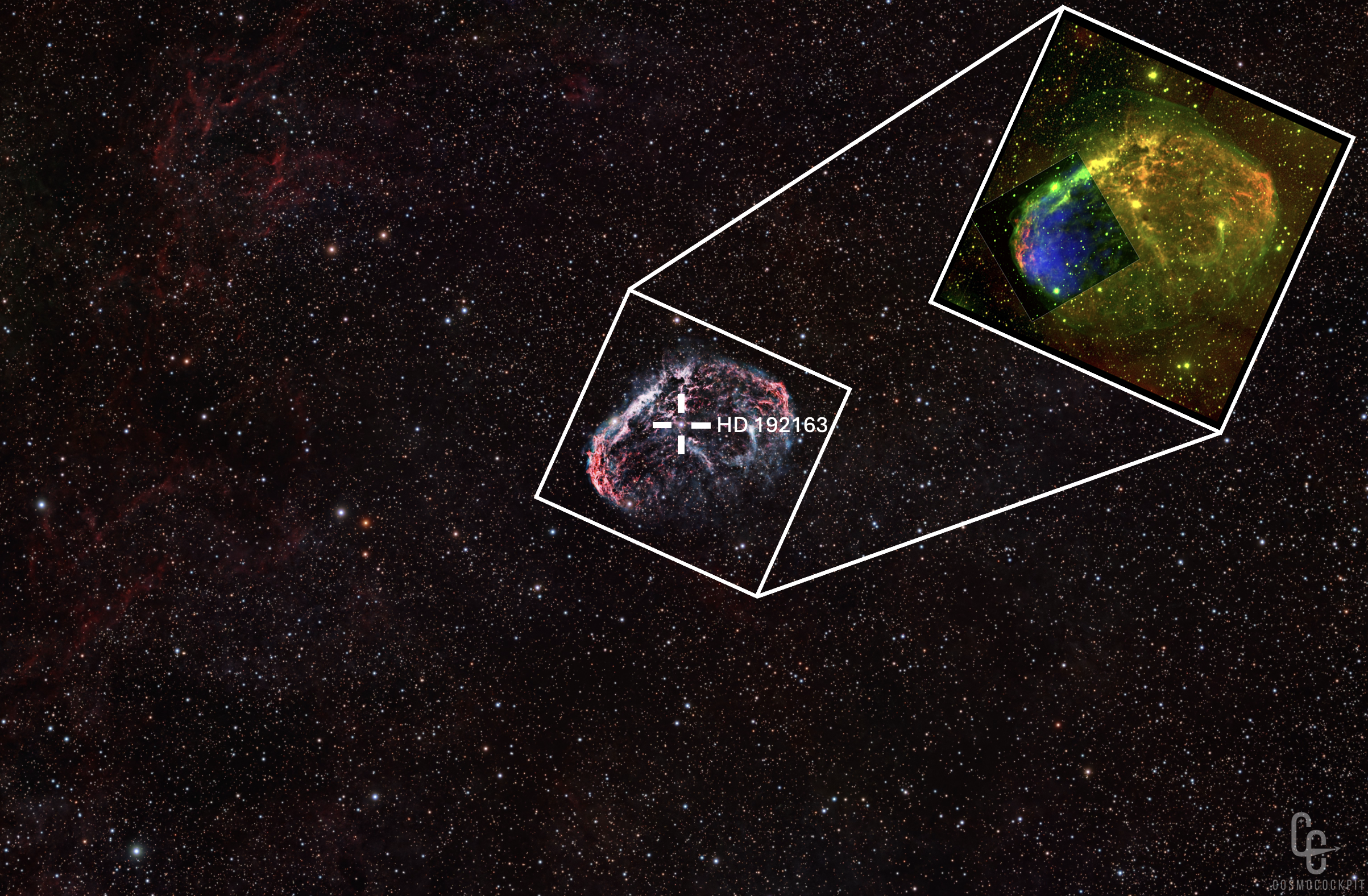
HD 192163 is a massive star in a late stage of life, shedding material through powerful winds that collide into a dense shell and create glowing X-ray and filamentary structures. Astronomers study this nebula to measure the shell’s properties and better understand how supernovae and their remnants form. Credit: NASA/UIUC/Y. Chu & R. Gruendl et al. Optical: SDSU/MLO/Y. Chu et al.
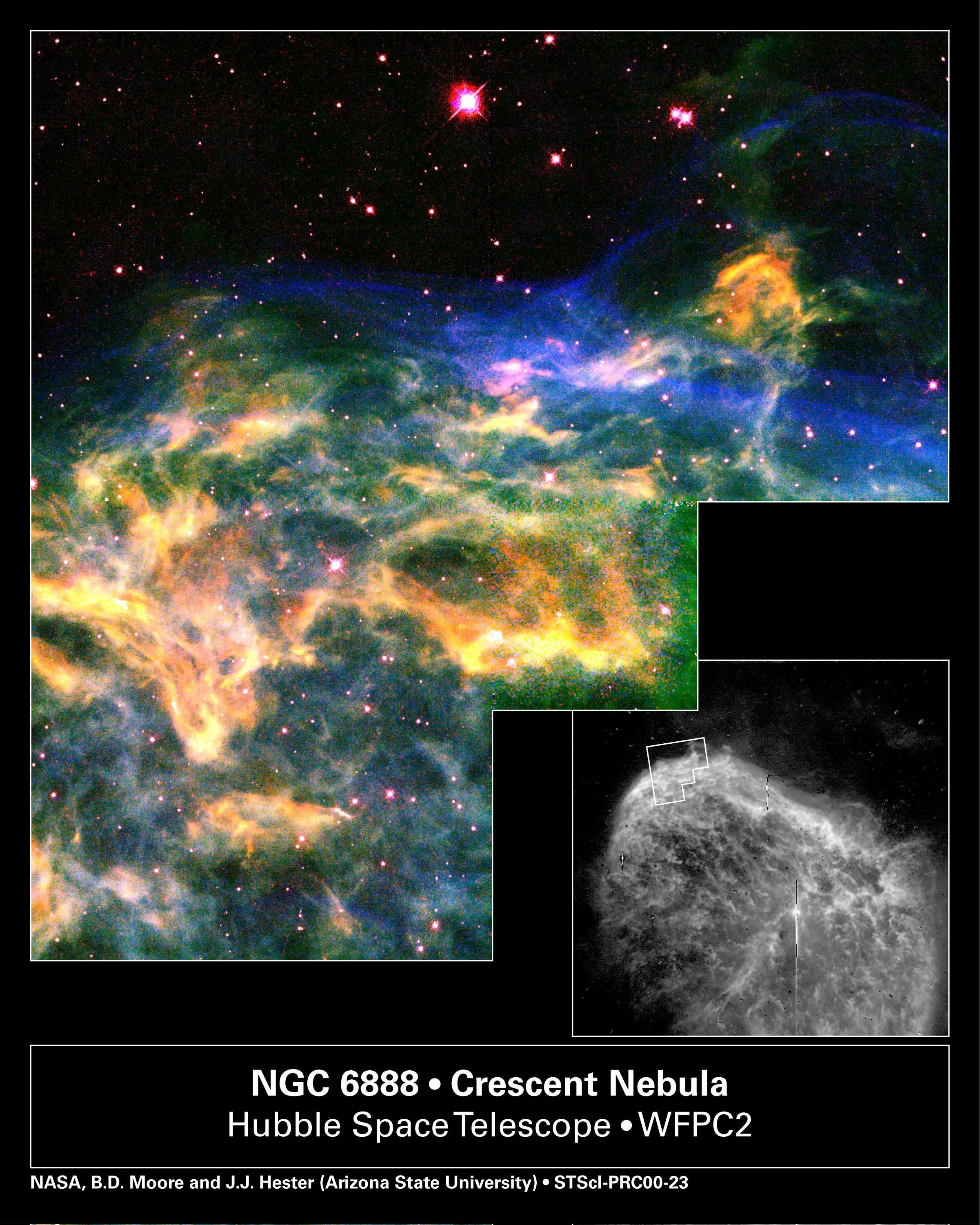
The shell of stellar material, dubbed the Crescent Nebula (NGC 6888), surrounds the 'hefty, ' aging star WR 136, an extremely rare and short-lived class of super-hot star called a Wolf-Rayet.Credit. Brian D. Moore, Jeff Hester, Paul Scowen, Reginald Dufour, and NASA/ESA.
Observation
The Crescent Nebula is best placed for observation during summer and early autumn, when Cygnus rides high overhead through the evening hours.
What you can see visually:
At magnitude +7.4, the Crescent sounds bright on paper, but its light is spread thin across an 18′ × 12′ patch of sky, giving it very low surface brightness.
A telescope of at least 8 inches of aperture, paired with a UHC or OIII filter, is generally needed to pick out any real nebulosity visually.
Under those conditions, the shell's looping, asymmetric shape is where the "Euro Sign" nickname comes from — though, like the Crescent itself, it takes a bit of imagination to see it that way.
As with most emission nebulae this faint, the Crescent is really a photographic target — visual observation only hints at what a camera can pull out of it.
Astrophotography Tips
The Crescent rewards a fairly different approach than a large, sprawling target like IC 1396 — it's small, concentrated, and well-matched to narrowband imaging, even on modest gear.
Medium focal lengths (500–800mm) frame the Crescent comfortably, with some working room around it, rather than requiring the ultra-wide fields that a target like IC 1396 demands.
An Hα + O III duo-narrowband filter is the natural first choice here — it isolates exactly the two emission lines the shell is strong in and cuts through urban skyglow effectively on an OSC camera. Given the nebula's weak SII signal, a dedicated SII filter pass generally isn't worth the extra integration time.
Blending in a broadband filter pass (even a relatively short one) restores natural star color on top of the narrowband data — useful since pure narrowband imaging alone tends to render stars with a flat, unnatural tint.
If you're imaging under a light-polluted sky with a light dome concentrated in one direction, timing the session around meridian transit keeps the target at its highest altitude and furthest from the horizon-hugging glow — the same principle that helps on any narrowband target from a compromised site.
Long integration still matters even though the Crescent is a relatively compact target — its outer, fainter filaments take real total exposure time to pull cleanly out of the noise, especially under Bortle 7+ skies.