Bubble Nebula (NGC 7635): A Stellar Wind Shell in Cassiopeia
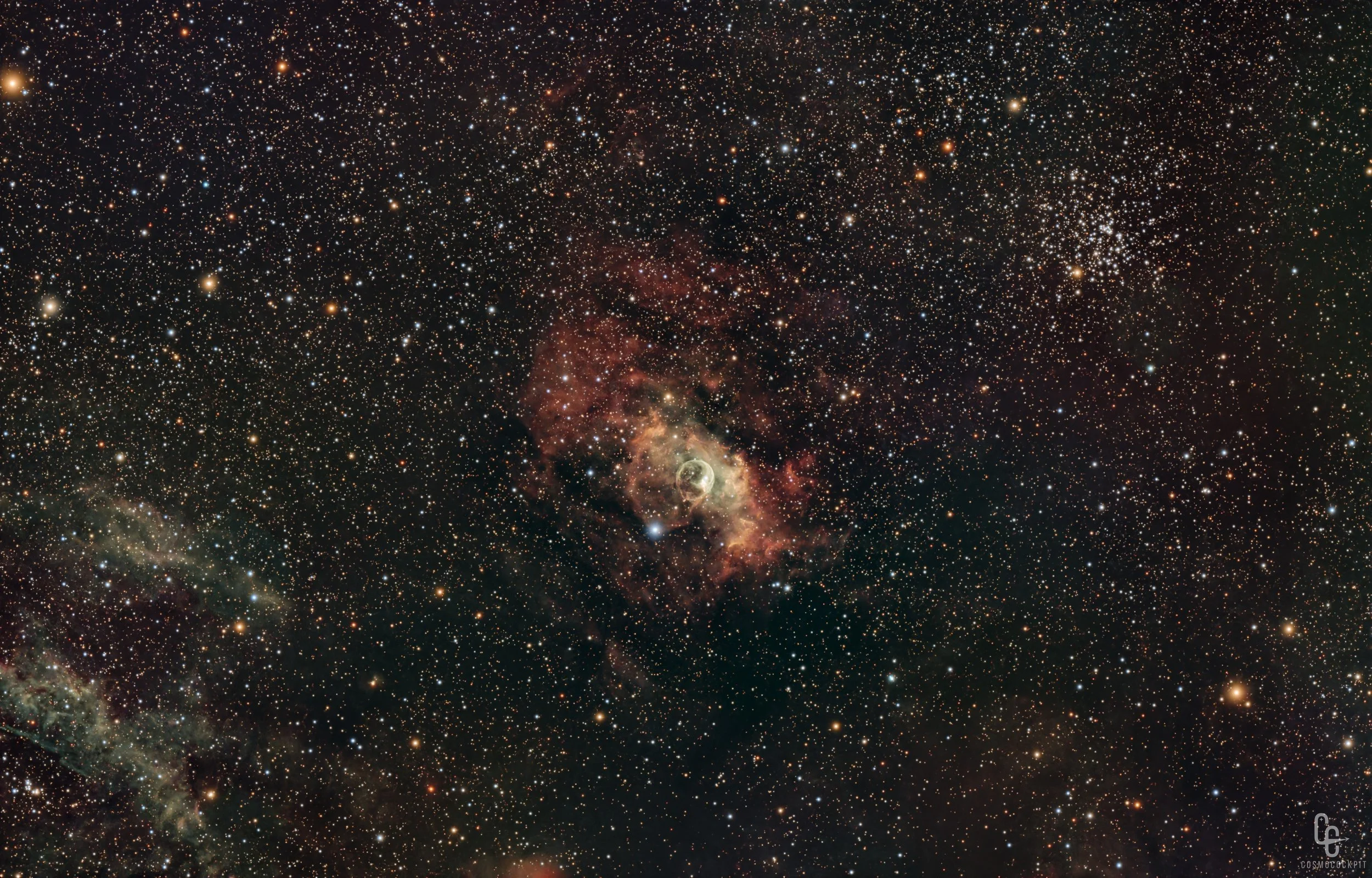
Bubble Nebula (NGC 7635) — 12h 30m total exposure (Askar 103 APO + 1.0x flattener, ZWO ASI 2600 MC). The ‘‘bubble’’ marks where the stellar wind encounters the surrounding interstellar medium.
The Bubble Nebula (NGC 7635) is a striking, near-perfect shell of glowing gas in the constellation Cassiopeia, carved out by the ferocious wind of a single massive star sitting just off-center within it. Modern Gaia-based measurements place it about 8,150 light-years away — though older catalogs and popular sources have quoted anywhere from 7,100 to 11,000 light-years. The visible shell spans 15′ × 8′ on the sky, corresponding to a physical radius of roughly 3 – 5 light-years. Also cataloged as Sharpless 162 and Caldwell 11, it sits a little under 1º from the open cluster Messier 52 — close enough that the two are a natural pair for both visual observers and imagers.
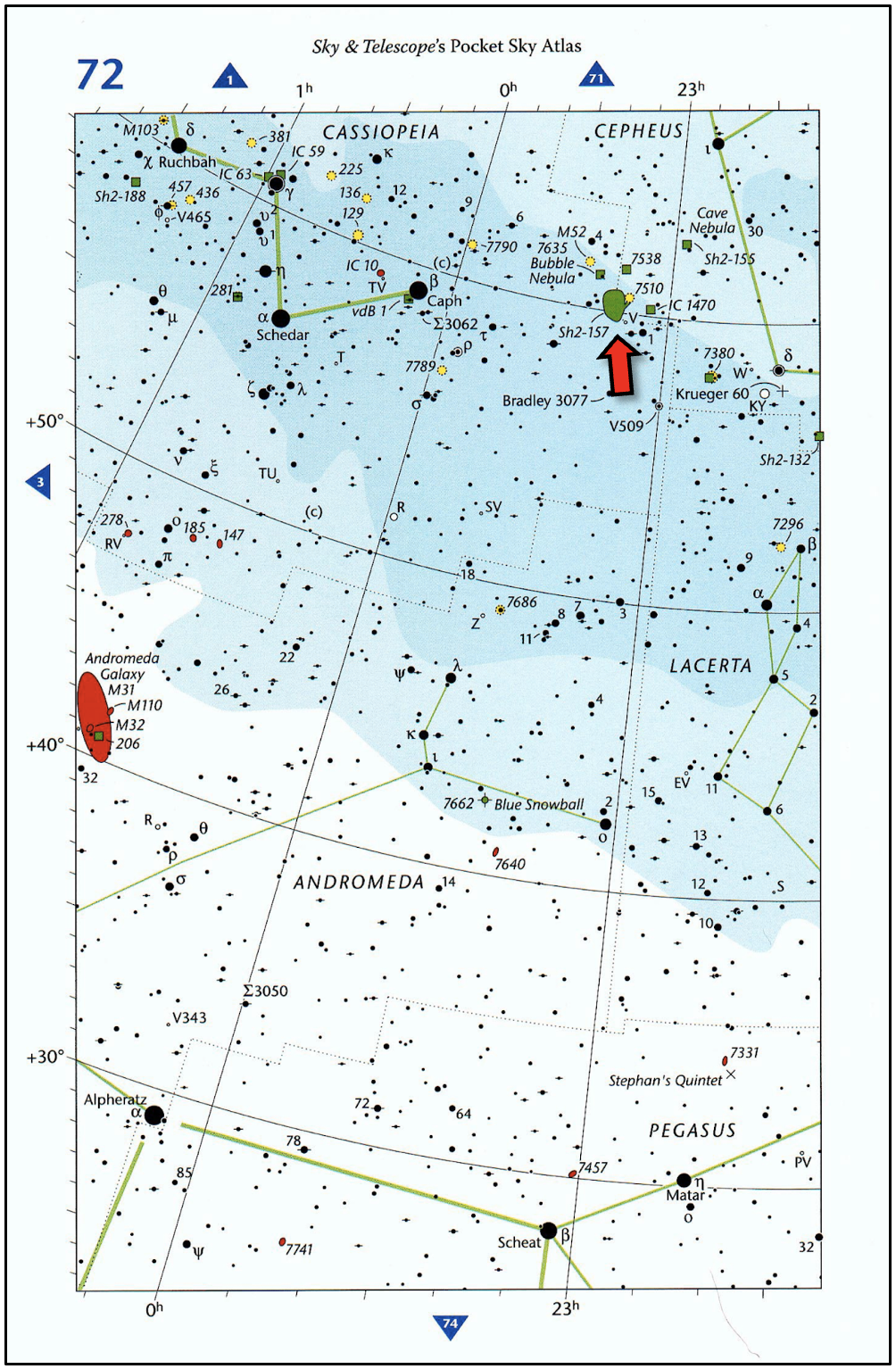
The Bubble Nebula lies in Cassiopeia, close to the open cluster M52, low in the northern sky. Sky and Telescope's Pocket Sky Atlas – Roger W. Sinnott.
History
The Bubble Nebula was discovered by William Herschel on 3 November 1787, who logged it in his own catalog as IV 52 and described it simply as "a star 9th magnitude with very faint nebulosity of small extent about it" — a modest note for what modern imaging reveals as a near-perfect glowing shell.
It later entered the New General Catalog as NGC 7635, Stewart Sharpless's catalog of emission nebulae as Sh2-162, and Patrick Moore's Caldwell Catalog as Caldwell 11. There's a nice historical footnote tied to its neighbor: when Charles Messier cataloged the nearby open cluster M52 in 1774, he described it as involved in nebulosity — almost certainly the glow of the Bubble Nebula bleeding into his view, more than a decade before Herschel picked out the Bubble itself as a distinct object.
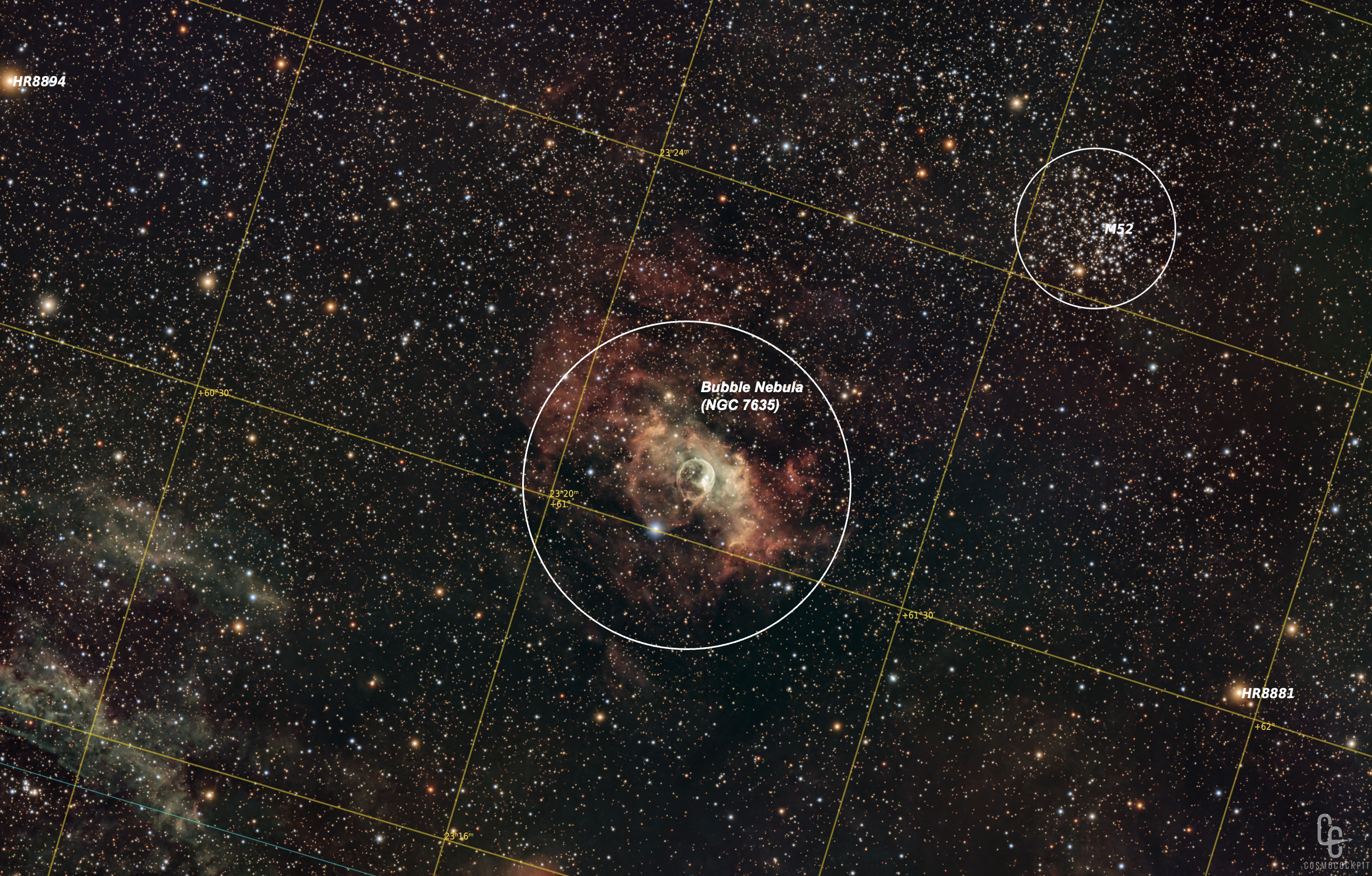
The Bubble Nebula, annotated and plate-solved in PixInsight.
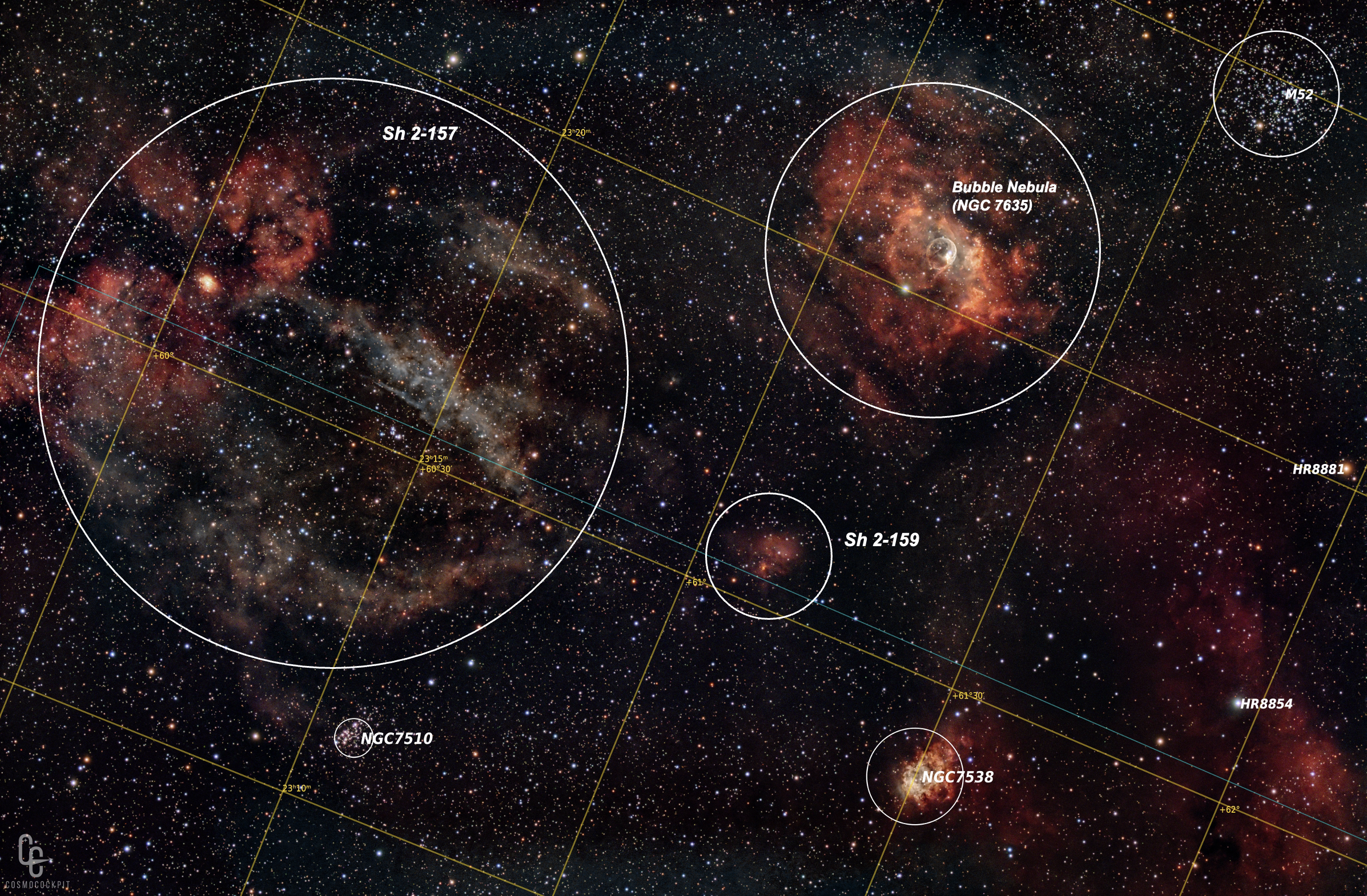
The Bubble Nebula and the surrounding structures. 5h 40m total exposure using the Askar 103 APO telescope coupled to a 0.8x flattener/reducer. Plate-solved and annotated in PixInsight.
Astrophysics
The Bubble owes its shape to a single star sitting near the edge of the shell rather than its center: BD+60°2522 (also cataloged SAO 20575), a massive O6.5 III giant with roughly 44 solar masses and an apparent magnitude of 8.7. Although older sources sometimes mislabel it a Wolf-Rayet star, current spectroscopy classifies it firmly as an O-type giant — still hot and massive enough to drive a wind clocked at roughly 2,000 km/s.
A wind-blown shell, with a complication: the textbook picture has that fast wind sweeping up surrounding gas into a thin, glowing shell. The nebula appears as a series of nested shells, and its bubble-like appearance likely comes from projection effects—different shells overlapping along our line of sight.
Rich in Hα, with a distinct OIII rim: the shell itself glows brightly at both Hα and OIII, with the OIII particularly concentrated right at the bubble's edge.
O-type giant, not Wolf-Rayet. O-type stars are the hottest, most massive class on the main sequence, burning through their fuel in only a few million years (a Wolf-Rayet star corresponds to a later, even more stripped-down evolutionary stelar stage). Both classes drive powerful winds, which is why either could plausibly carve a bubble like this one.
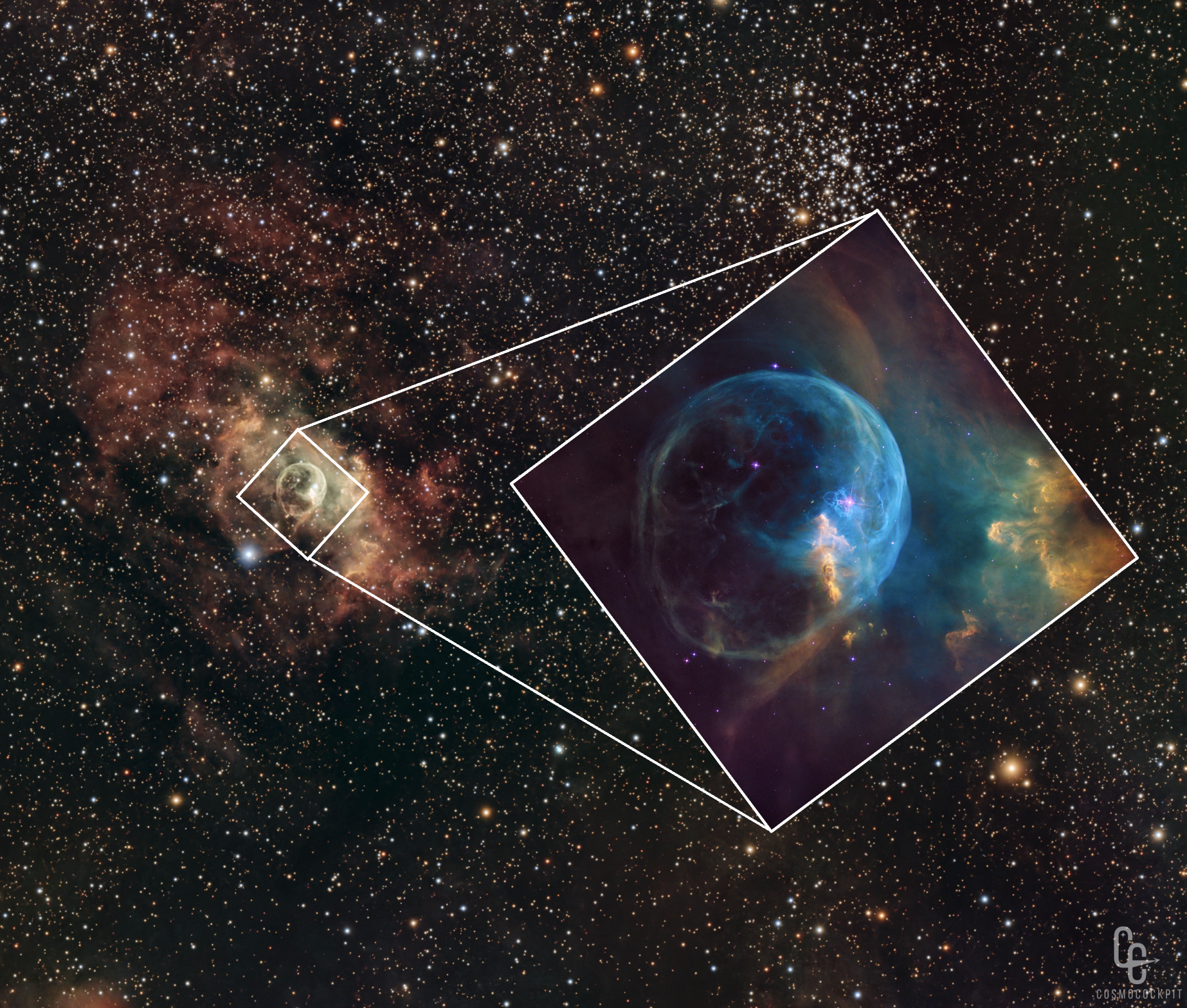
This NASA/ESA Hubble Space Telescope image, released to celebrate Hubble’s 26th year in orbit, captures in stunning clarity what looks like a gigantic cosmic soap bubble. The object, known as the Bubble Nebula, is in fact a cloud of gas and dust illuminated by the brilliant star within it. - Image credit: NASA, ESA, Hubble Heritage Team.
M52
M52 is another chance discovery by Charles Messier, made while he was following a comet. The French observer noted, on the 7th of September 1774: “Cluster of very small stars, which cannot be seen except in an achromatic refractor, mingled with nebulosity.”
After M11, M52 is one of the richest open clusters in the Messier list: The star density in the cluster’s center is about one star of 15th magnitude (or brighter) per square arcsecond or, in absolute terms, 1.5 stars per cubic light-year.
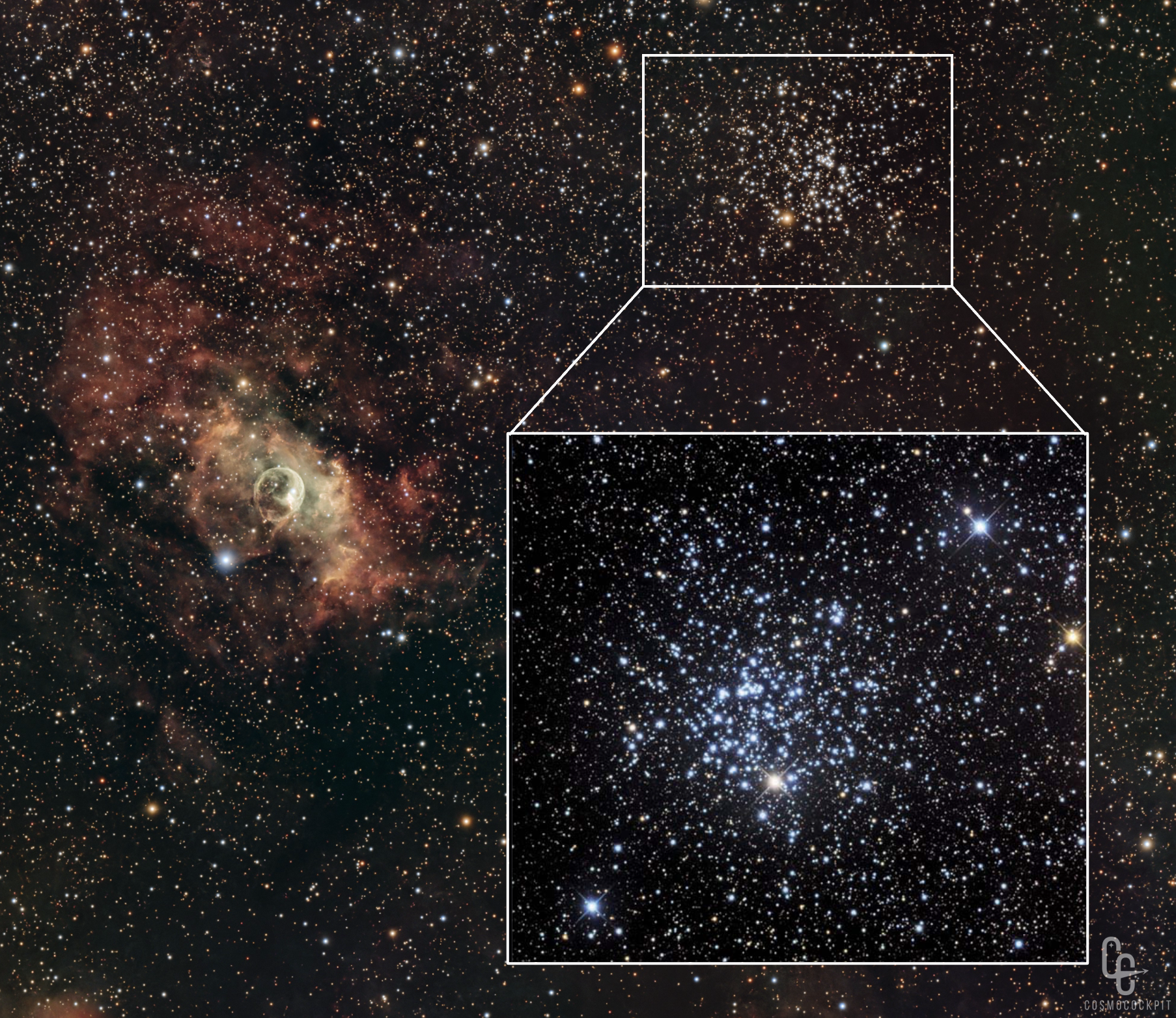
M52: A yellow giant is the brightest star of up to 6000 cluster members. Credit: Robert Gendler - Atlas of the Messier Objects, Highlights of the Deep Sky (Cambridge University Press).
Observation
The Bubble Nebula is best placed for observation in autumn, when Cassiopeia climbs high through the evening sky.
What you can see visually:
An 8–10 inch telescope with an OIII or UHC filter, and averted vision, is typically needed to glimpse any nebulosity at all.
The nearby open cluster M52 — roughly half a degree away — is a rewarding visual companion in the same field, bright enough to find easily and serving as a natural signpost to the fainter Bubble beside it.
As with most emission nebulae this faint, the Bubble is primarily a photographic target; a camera pulls out structure that the eye, even through a large aperture, mostly cannot.
Astrophotography Tips
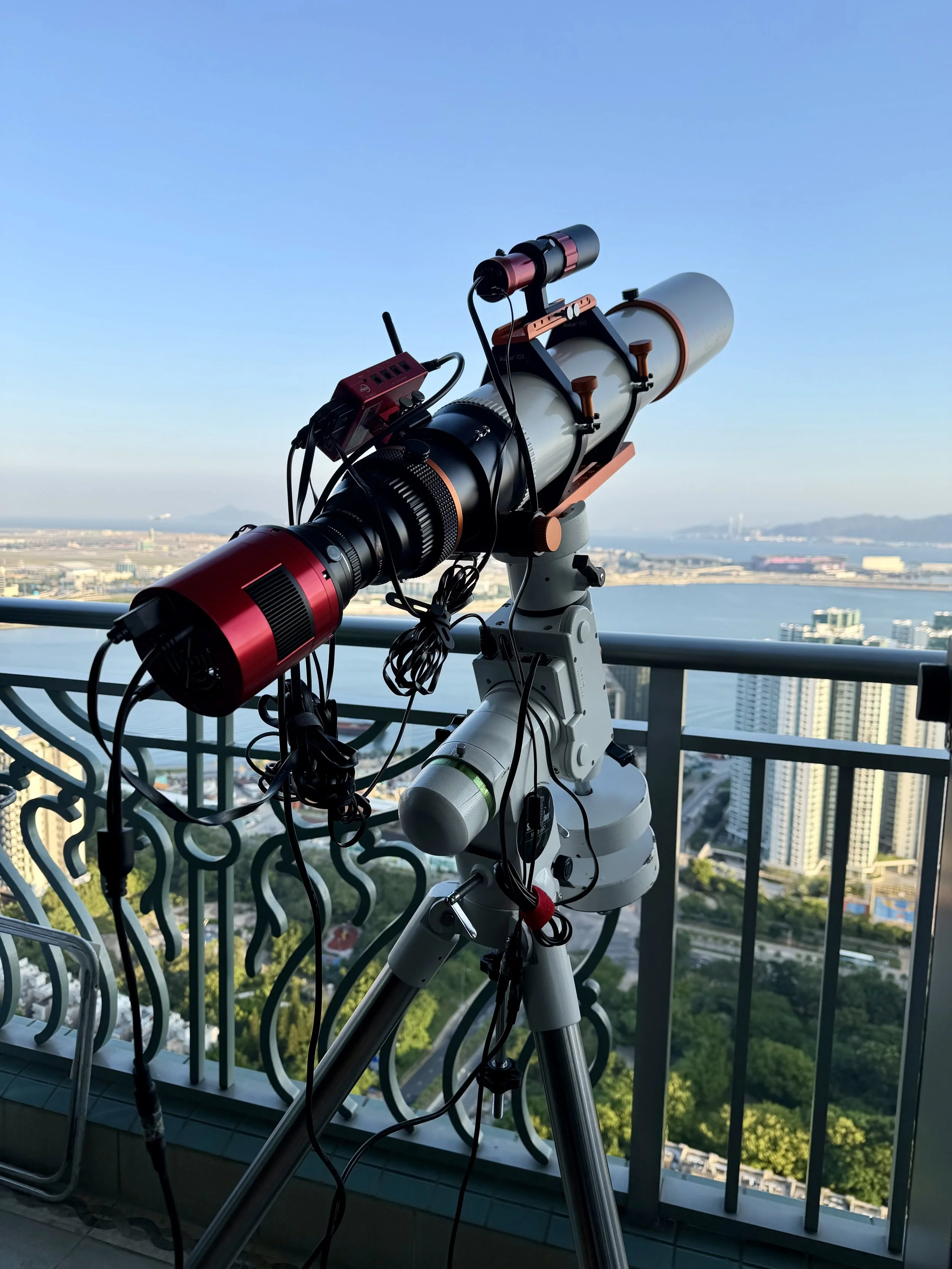
Telescope: Askar 103 APO; Main Camera: ZWO ASI 2600 MC; Mount: Sky-Watcher HEQ 5 Pro; Controller: ZWO ASIAIR.
The Bubble rewards a similar approach to other compact, Hα/OIII-dominated targets, with a couple of considerations specific to this one.
A close-up and a wide companion frame both have something to offer. The bubble itself is small enough to reward a tighter focal length, but the surrounding field — M52, and further out, the NGC 7538 star-forming region, the NGC 7510 cluster, and the Sh2-157 (Lobster Claw) nebulosity — is rich enough that a second, wider frame with a focal reducer captures a genuinely different, complementary picture of the same patch of sky.
A Hα + OIII duo-narrowband filter (Askar D1) carries most of the useful signal here. Given how weak the SII channel is across this target, a full SHO combination adds little; a D1-led HOO blend, supplemented by a shorter D2 pass for subtle color separation, uses imaging time more efficiently.
This is a northern target from a Tung Chung site — meaning it faces the Shenzhen light dome rather than the cleaner ocean-facing southern sky. The OIII/blue channel is the most vulnerable to contamination from modern LED street lighting, so it's worth checking OIII strength against expectations before trusting every bit of the blue signal as genuine nebula.
When narrowband integration time far outweighs a broadband filter pass (as it did here), blend the broadband master in through a star mask rather than across the whole frame — otherwise the broadband data's lower contrast and higher background noise can visibly soften the nebula structure the narrowband data already resolved cleanly.
Long total integration still pays off even on a relatively compact target like this — the bubble's fainter surrounding shell structure and the wider nebular complex around it both take real exposure time to separate cleanly from Bortle 7–8 sky noise.