Wizard Nebula (NGC 7380): A Stellar Nursery Casting Its Spell in Cepheus
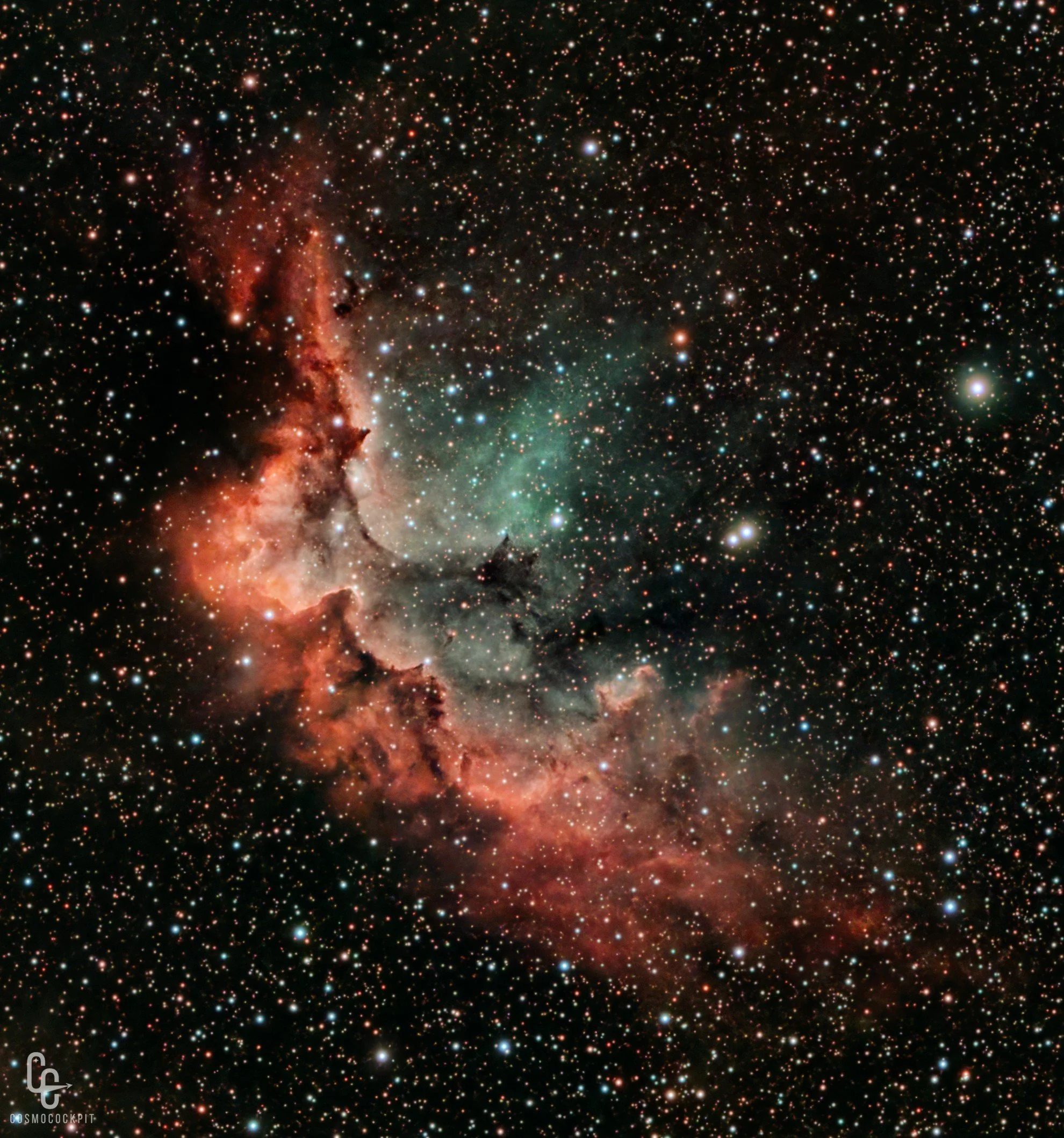
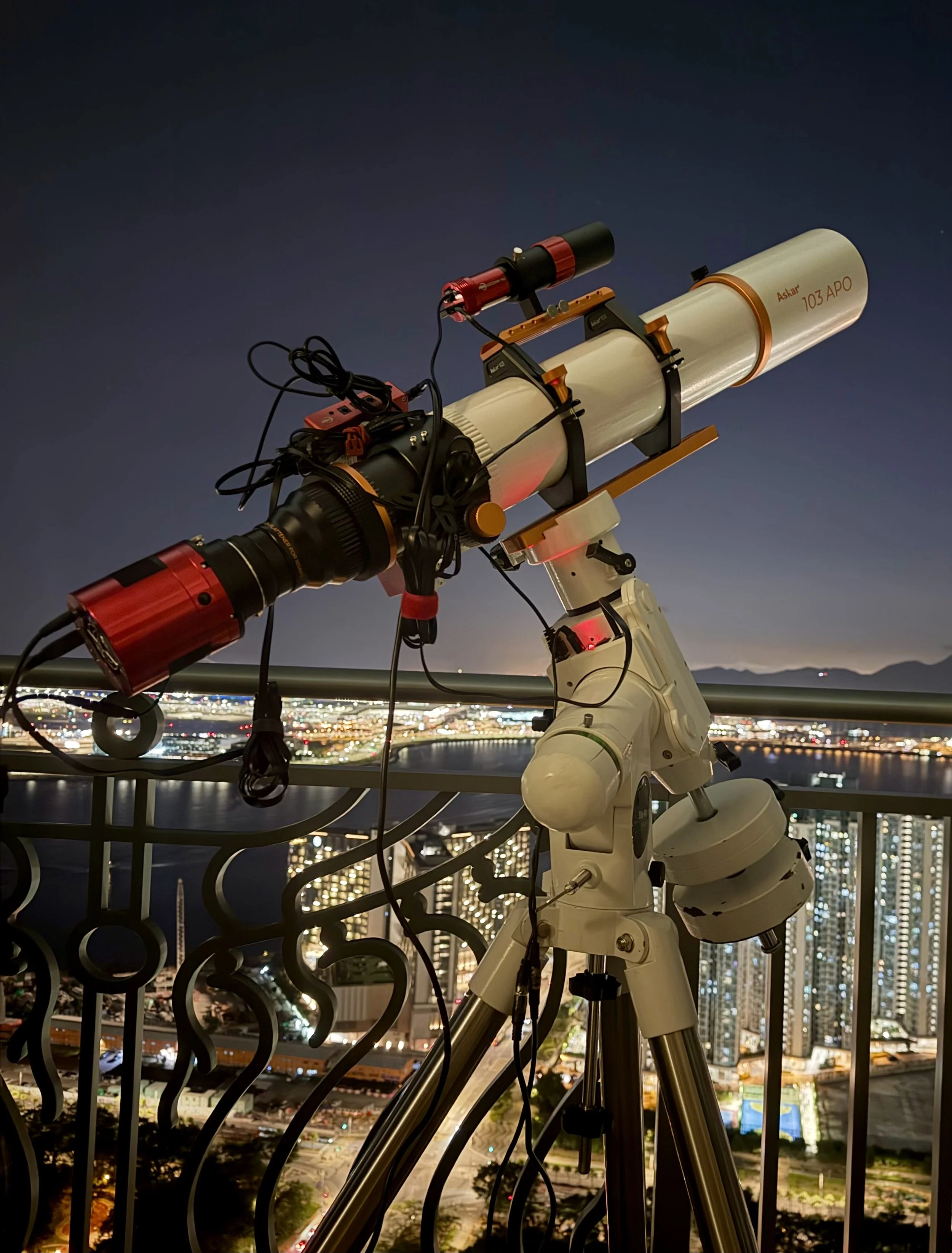
Wizard Nebula (NGC 7380 / Sh2-142) — 16h 00m total exposure (Askar 103 APO, ZWO ASI 2600 MC).
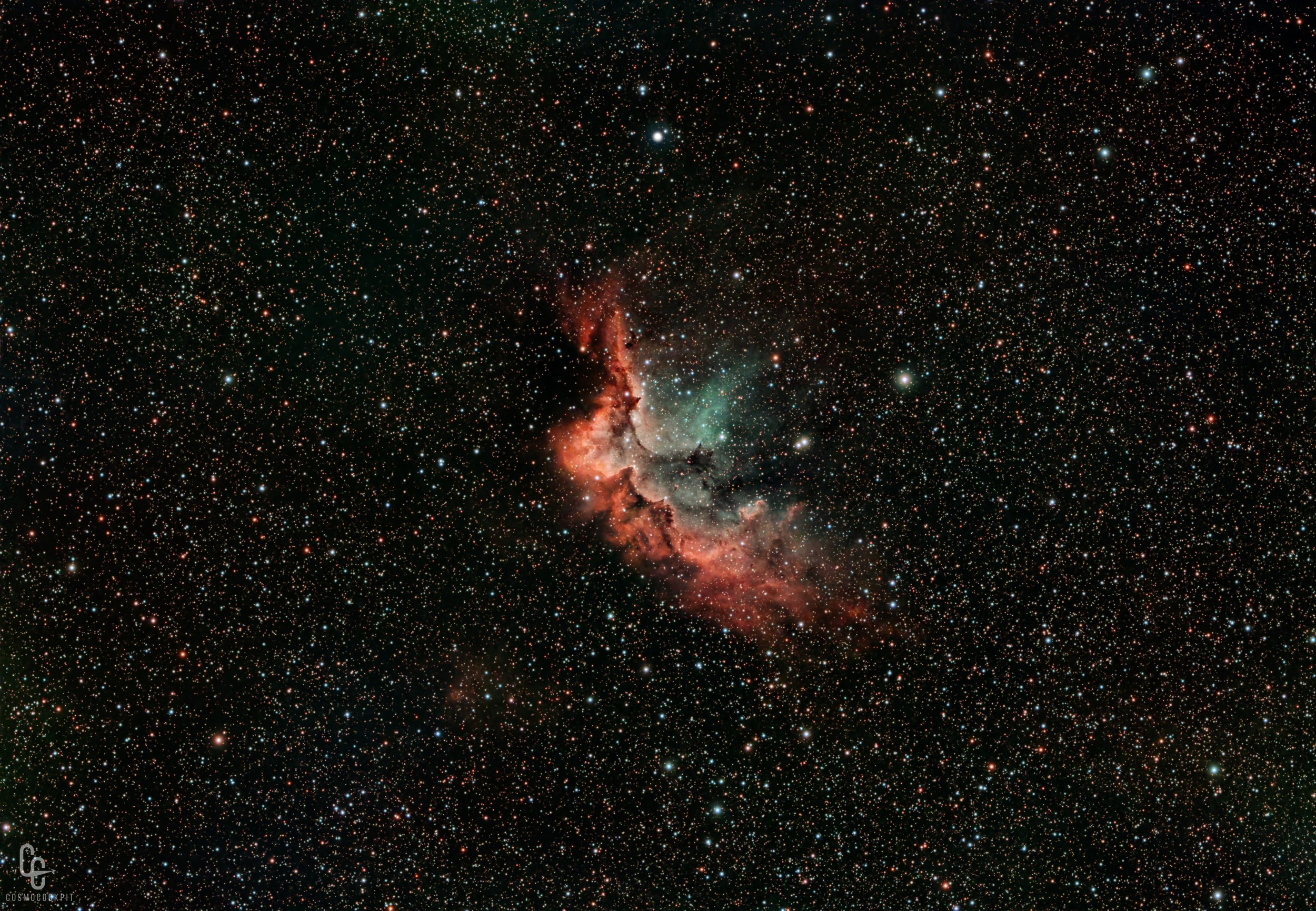
The Wizard Nebula is a cloud of glowing hydrogen in the constellation Cepheus, wrapped around the young open star cluster NGC 7380. Its ragged outline, with dark dust lanes cutting through bright, billowing gas, is often compared to a robed wizard bent over a cauldron, which gave it its nickname. Estimates of its distance vary more than for most targets we've imaged: a commonly quoted value is about 8,500 light-years, but published figures range from roughly 7,200 to 9,600 light-years. The cluster spans about 25′ on the sky, close to the apparent size of the full Moon, and the wider emission region, cataloged as Sharpless 142 (Sh2-142), extends further out. It lies in the Perseus Arm of the Milky Way, the next spiral arm out from our own.
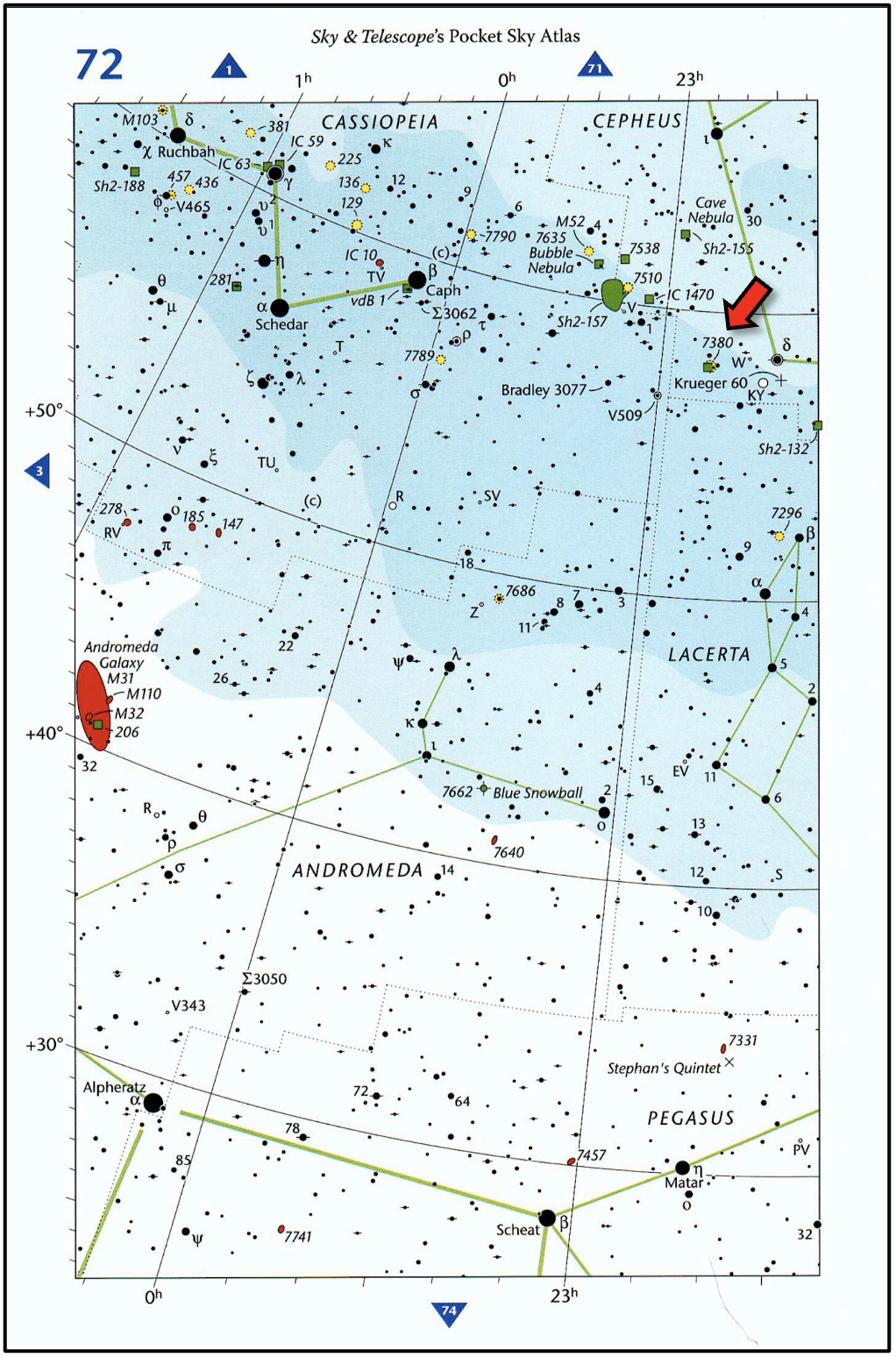
The Wizard Nebula lies in Cepheus, near the border with Cassiopeia, a few degrees from the Bubble Nebula (NGC 7635). From Hong Kong, it is a northern target, reaching about 54° altitude as it crosses the meridian. Sky and Telescope's Pocket Sky Atlas – Roger W. Sinnott.
History
Caroline Herschel discovered the cluster on 7 August 1787 using a small 4.2-inch reflector. Her brother William Herschel observed it a few months later, on 1 January 1788, with his much larger 18.7-inch telescope, and added it to his catalog as H VIII.77. It's a nice continuity with our earlier articles: William Herschel discovered the Bubble Nebula in the same year, and Herschel's Garnet Star sits beside IC 1396 in this same corner of the sky. This time, the discovery belongs to Caroline, one of the first women in history to be recognized for her astronomical discoveries.
Herschel also did not record the nebula itself. John Herschel's later description speaks only of "a fine, pretty rich, large cluster" with stars from 9th to 13th magnitude. The glowing gas only entered the catalogs in 1959, when Stewart Sharpless listed it as Sh2-142 in his survey of emission nebulae, based on photographic plates rather than an eyepiece.
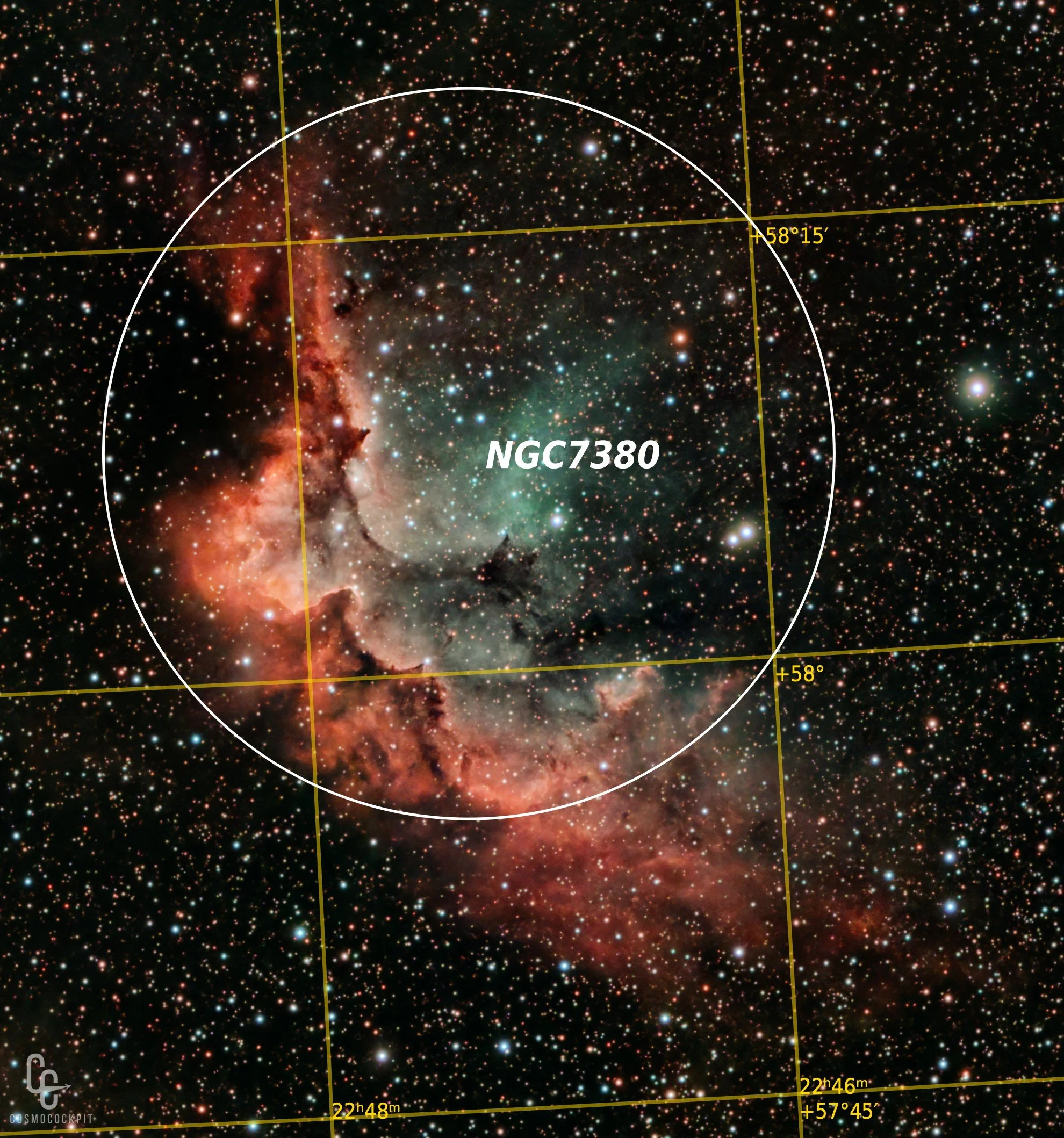
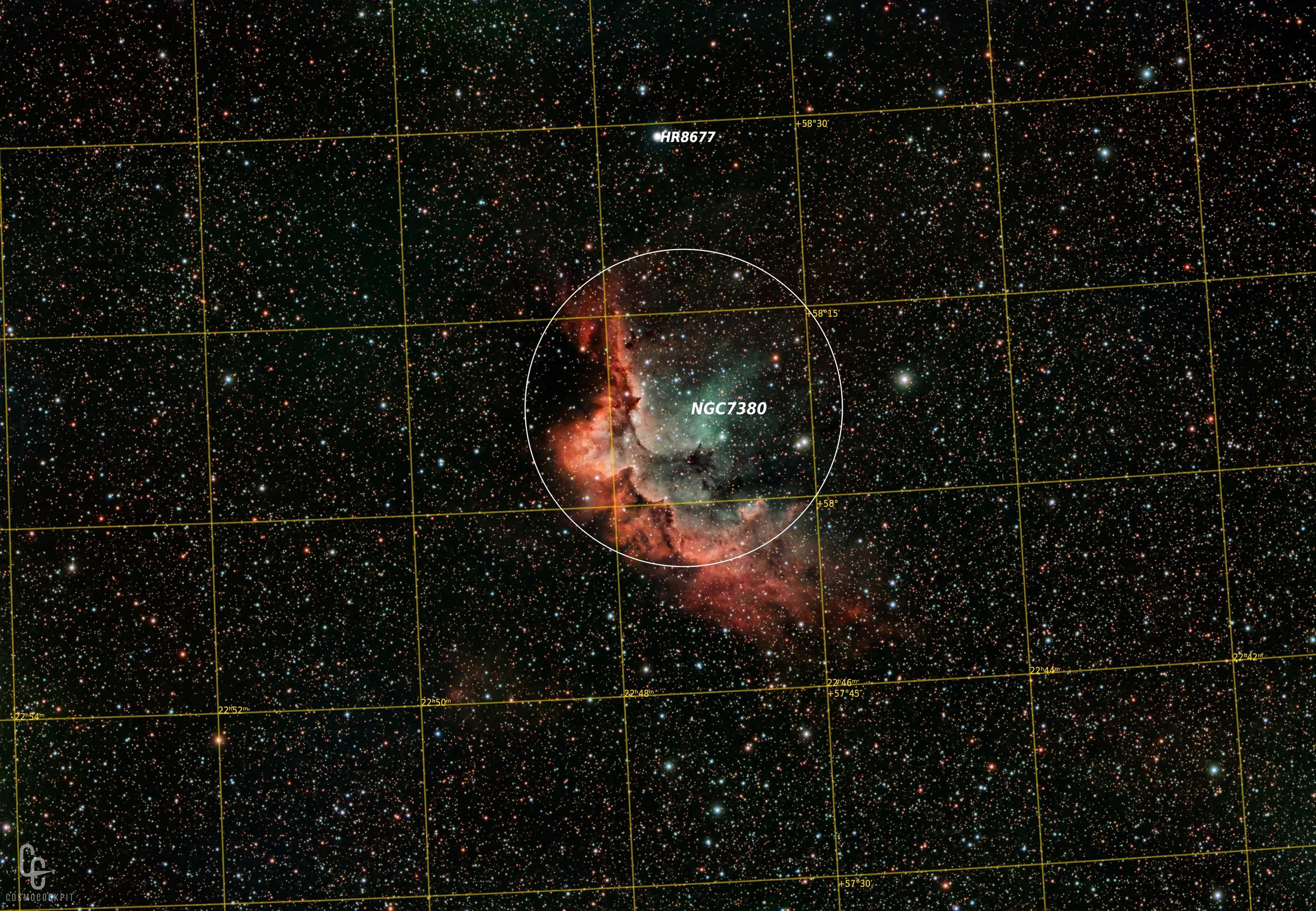
The Wizard Nebula, annotated and plate-solved in PixInsight.
Astrophysics
The Wizard is an H II region: a cloud of hydrogen ionized by the intense ultraviolet light of very hot, young stars. Here, the main engine is DH Cephei, a close binary at the heart of NGC 7380.
Two O-type stars in a 2-day orbit: DH Cephei is made of two massive stars, spectral types O5.5 V and O6 V, with estimated masses of roughly 38 and 34 solar masses. They orbit each other every 2.11 days, so close that tides stretch both stars into egg shapes. As the pair turns, we see a changing amount of their surface, so the system's brightness varies slightly even though the stars never eclipse each other (an ellipsoidal variable). Their powerful stellar winds collide between them and produce X-rays.
A very young cluster: age estimates for NGC 7380 range from about 4 to 12 million years, and DH Cephei itself is thought to be less than 2 million years old. Studies of the cluster have identified many pre-main-sequence stars (i.e., stars still contracting toward the point where they will start fusing hydrogen), confirming that star formation here is recent and still ongoing.
Carving and triggering: radiation and winds from the cluster are eroding the surrounding molecular cloud. The dark lanes and dense knots in our image are cold dust and gas still resisting that pressure. At the boundaries, compressing gas can trigger new star formation, so the cluster is both destroying and seeding its birth cloud.
Reading the colors: in our HSO rendition, Hα (hydrogen) is mapped to red, SII (sulfur) to green, and OIII (oxygen) to blue. The outer, orange-red regions are dominated by hydrogen and sulfur, while the teal glow in the interior is OIII. That pattern isn't just aesthetic: doubly ionized oxygen needs more energetic photons than hydrogen, so it shines mostly in the zone closest to the hottest stars; farther out, where the ultraviolet light has been weakened, lower-energy hydrogen and sulfur emissions take over.
What is an H II region? "H II" is astronomers' shorthand for ionized hydrogen: atoms that have lost their electron. Hot O-type stars emit enough ultraviolet light to strip electrons from the hydrogen around them. When an electron is recaptured, the atom releases light at specific wavelengths, the strongest of which is the deep-red Hα line at 656 nm. That's why emission nebulae like the Wizard, the Eagle and the Elephant's Trunk glow red in photographs.
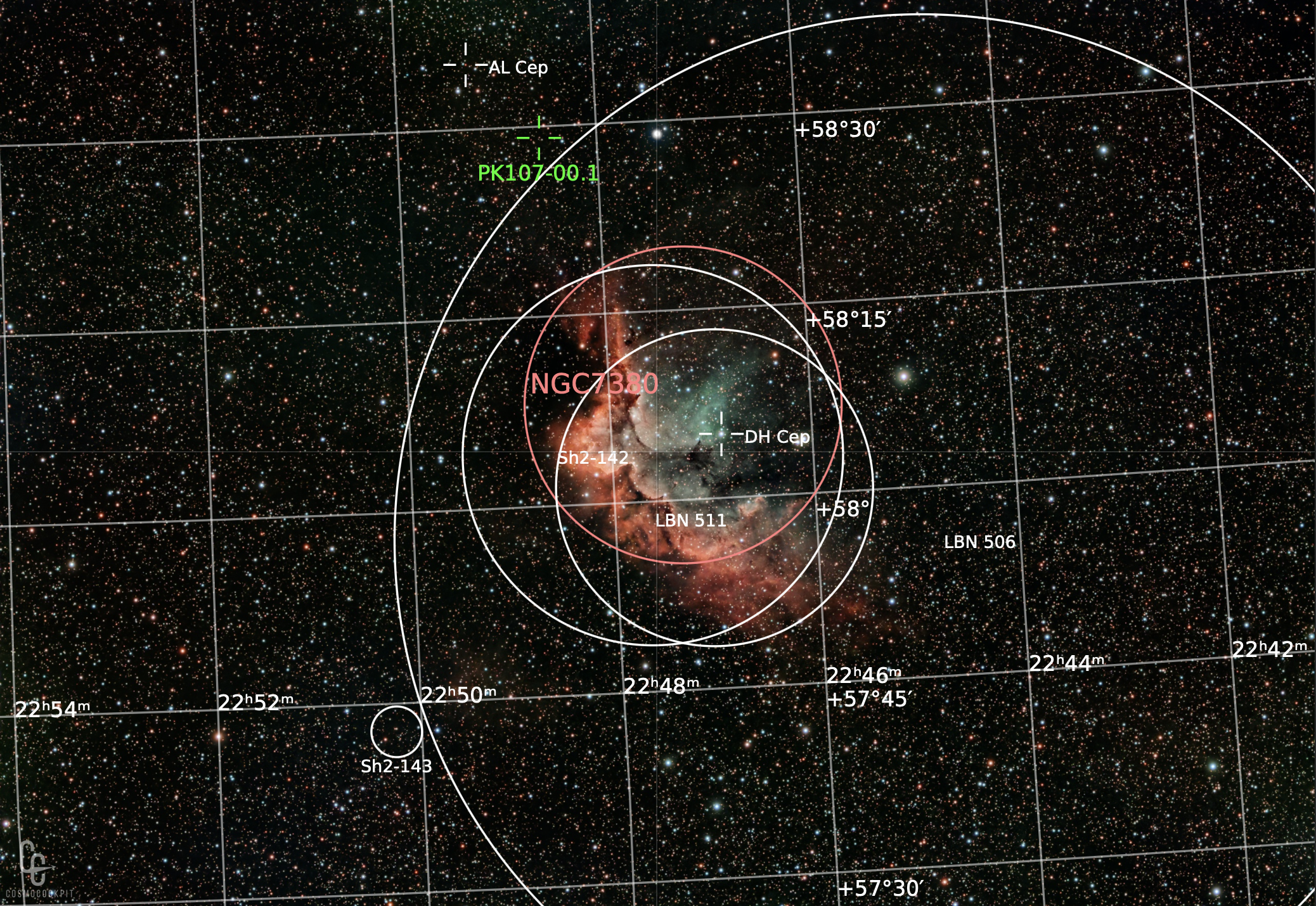
The Wizard Nebula and surrounding structures, as plate-solved and annotated by AstroBin. Note the Dh Cep at the center, a powerful double O-type star.
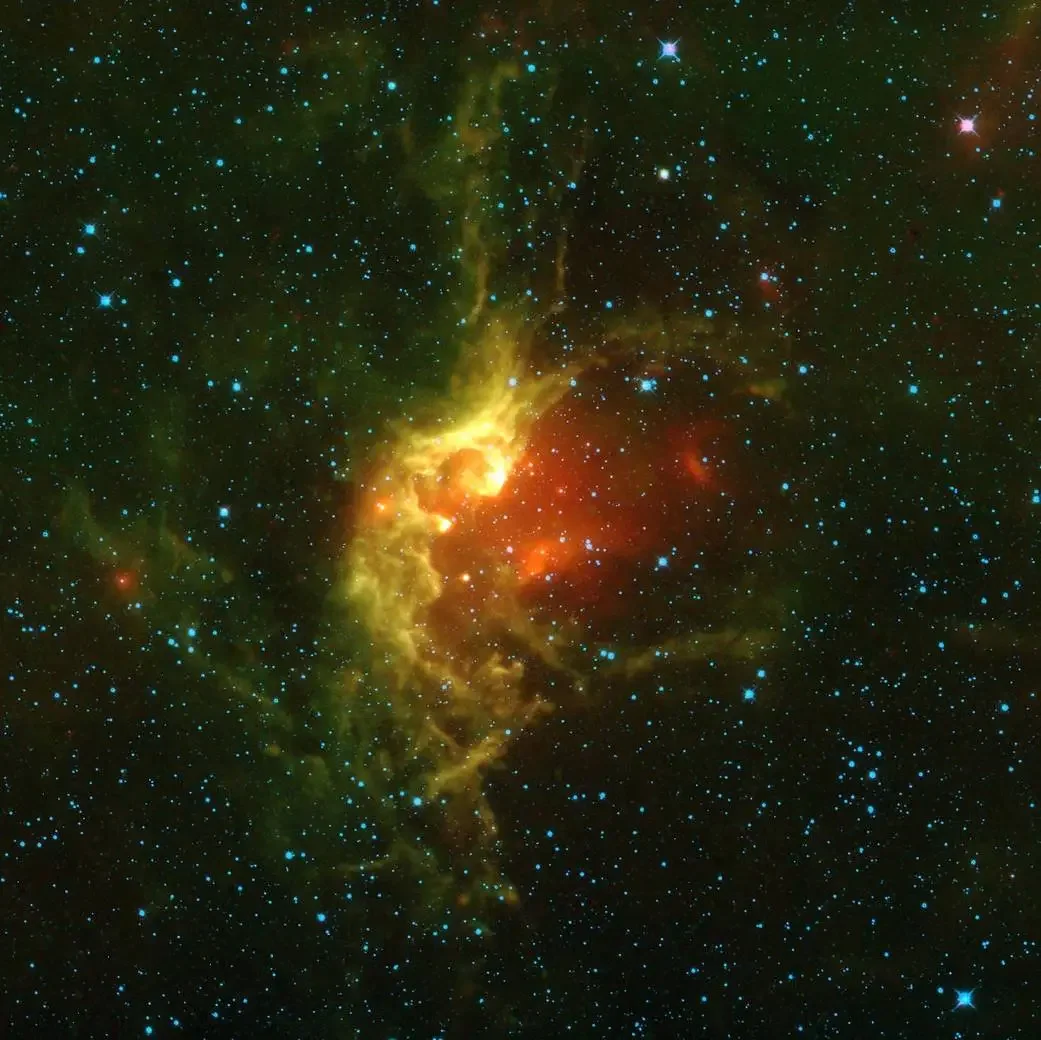
This image of the open star cluster NGC 7380 within the Wizard Nebula is a mosaic of images from the WISE Mission spanning an area on the sky of about 5 times the size of the full moon. WISE, the Wide-Field Infrared Survey Explorer Mission, scans the entire sky in infrared light, picking up the glow of hundreds of millions of objects and producing millions of images. The mission is designed to uncover objects never seen before, including the coolest stars. - Image Credit: NASA/JPL-Caltech/UCLA
Observation
The Wizard Nebula is best placed in the autumn evening sky. It reaches opposition in early September, crosses the meridian around midnight, and stays well placed through the end of the year.
What you can see visually:
At magnitude 7.2, the cluster NGC 7380 is an easy target for small telescopes, a scattering of stars spread across about a third of a degree.
The nebula itself is a different story: its surface brightness is low, and you need dark skies and a nebula filter (OIII or UHC) to glimpse it at all.
From light-polluted skies like Hong Kong's, it is essentially a photographic target. The camera reveals the shape, dust lanes, and colors the eye cannot.
Astrophotography Tips
Shoot around the meridian. At declination +58°, the Wizard never climbs very high from Hong Kong, and it faces north, towards the Shenzhen light dome. We centered each night's session on the meridian flip, 2–3 hours on each side, to keep the target as high as possible.
Watch the Moon, especially with OIII. The OIII line is much more sensitive to moonlight and LED light pollution than Hα. Collecting the Hα-dominated D1 and the broadband star frames on brighter nights, and saving the darkest nights for the D2 filter, makes the most of the available time.
Use the right weighting. With data collected over six nights at different altitudes and sky conditions, weighting subframes by quality (PSF Signal Weight in WBPP) lets the best frames count for more than the worst.
Merge narrowband data by integration time. We merged the two dual-narrowband masters early, right after LinearFit, weighting each by its share of the total exposure (0.55 for D1's 8 hours, 0.45 for D2's 6.5 hours). Keeping the data as a single image through denoising and stretching avoids the color blotching that can appear when you stretch weak channels separately.
Use broadband data for star color only. When narrowband time far outweighs broadband (here, about 10 to 1), blending the L-Pro master into the whole frame dilutes the nebula's contrast. Applying it through a star mask gives the stars natural color while leaving the nebula untouched.
Check star colors at the end. Narrowband processing can leave some bright stars with unnatural tints (we had one strongly cyan star). A small, soft-edged circular mask and a gentle saturation curve fix it without affecting the rest of the image.
Check your orientation with the plate-solve grid. The annotated image showed our first version was rotated 180° from the standard orientation. A quick rotation now displays it with north up and east to the left.