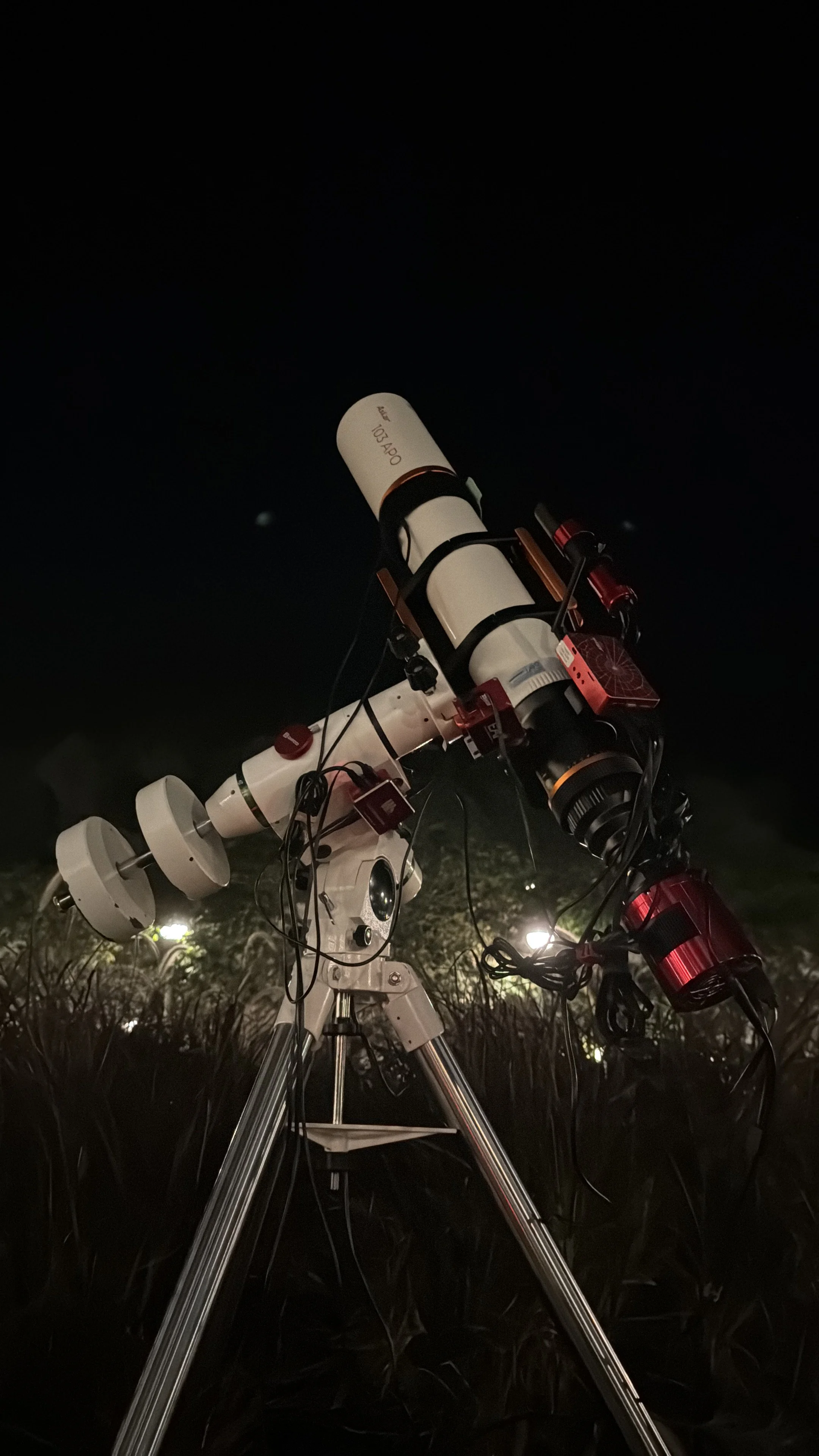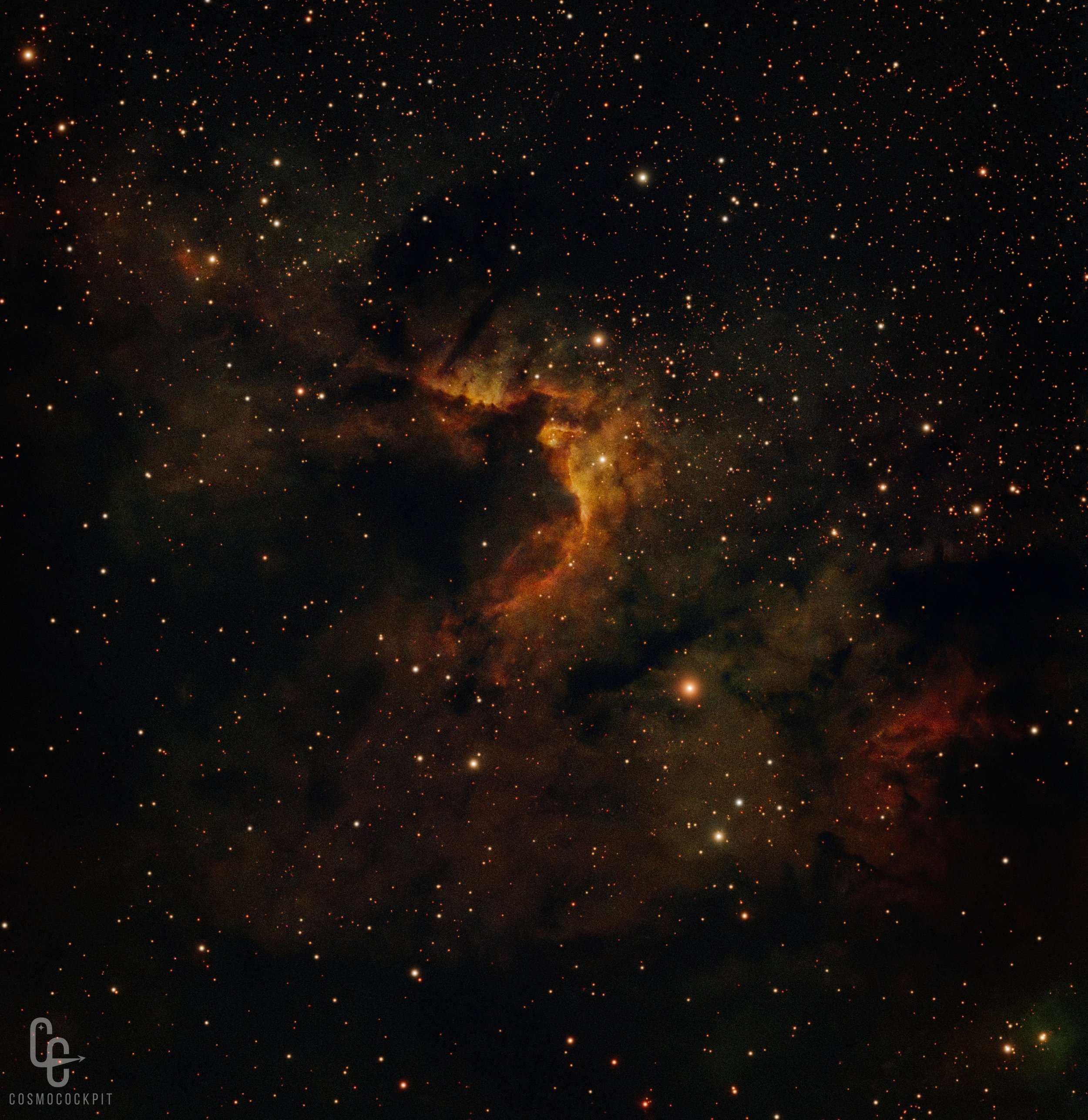
Cave Nebula (Sh2-155 / Caldwell 9) — 16h 10m total exposure (Askar 103 APO + 1.0x flattener, ZWO ASI 2600 MC).
The Cave Nebula is a glowing wall of hydrogen in the constellation Cepheus, pressed against the edge of a cold, dark molecular cloud. A bright, curving rim of ionized gas wraps around a pocket of dark dust, and in photographs, that shape looks like the mouth of a cave opening into the sky. It lies about 2,400 light-years away, much closer than the Wizard (about 8,500 light-years) or the Bubble (about 8,150 light-years) we imaged nearby in the same corner of the sky. The full emission region, cataloged as Sharpless 155 (Sh2-155), spans about 50′ × 30′ on the sky, and our 56′ × 58′ frame captures it whole, together with the dark clouds and a small reflection nebula around it.
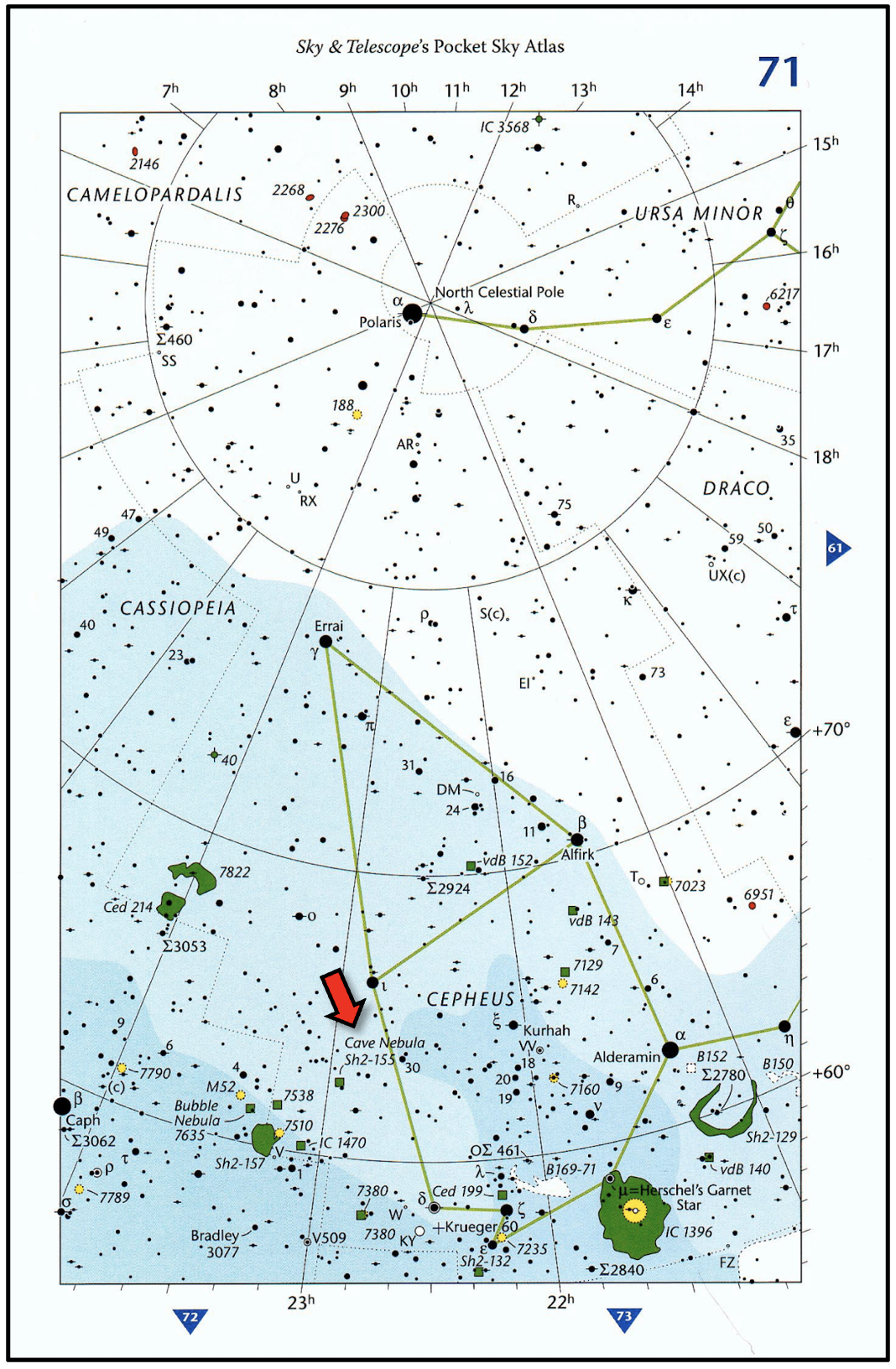
The Cave Nebula lies in eastern Cepheus, close to the border with Cassiopeia, in the same region as the Wizard Nebula (NGC 7380) and the Bubble Nebula (NGC 7635). From Hong Kong, it is a northern target, reaching about 50° altitude as it crosses the meridian. Sky and Telescope's Pocket Sky Atlas – Roger W. Sinnott.
History
Unlike the Wizard or the Bubble, the Cave Nebula has no Herschel discovery story: it is too faint and too spread out to have been noticed through the telescopes of the 18th and 19th centuries, and it never entered the NGC or IC catalogs. It first appeared in 1959, when Stewart Sharpless listed it as Sh2-155 in the second edition of his catalog of emission nebulae, compiled from photographic plates of the Palomar Sky Survey. It is also listed in Beverly Lynds' catalog of bright nebulae as LBN 529.
Its popular name came later. In 1995, Patrick Moore published the Caldwell Catalog, a list of 109 bright deep-sky objects that Charles Messier had left out, and included the nebula as Caldwell 9. Moore called it the "Cave Nebula" after the curved arc in photographs that resembles the entrance to a cave.
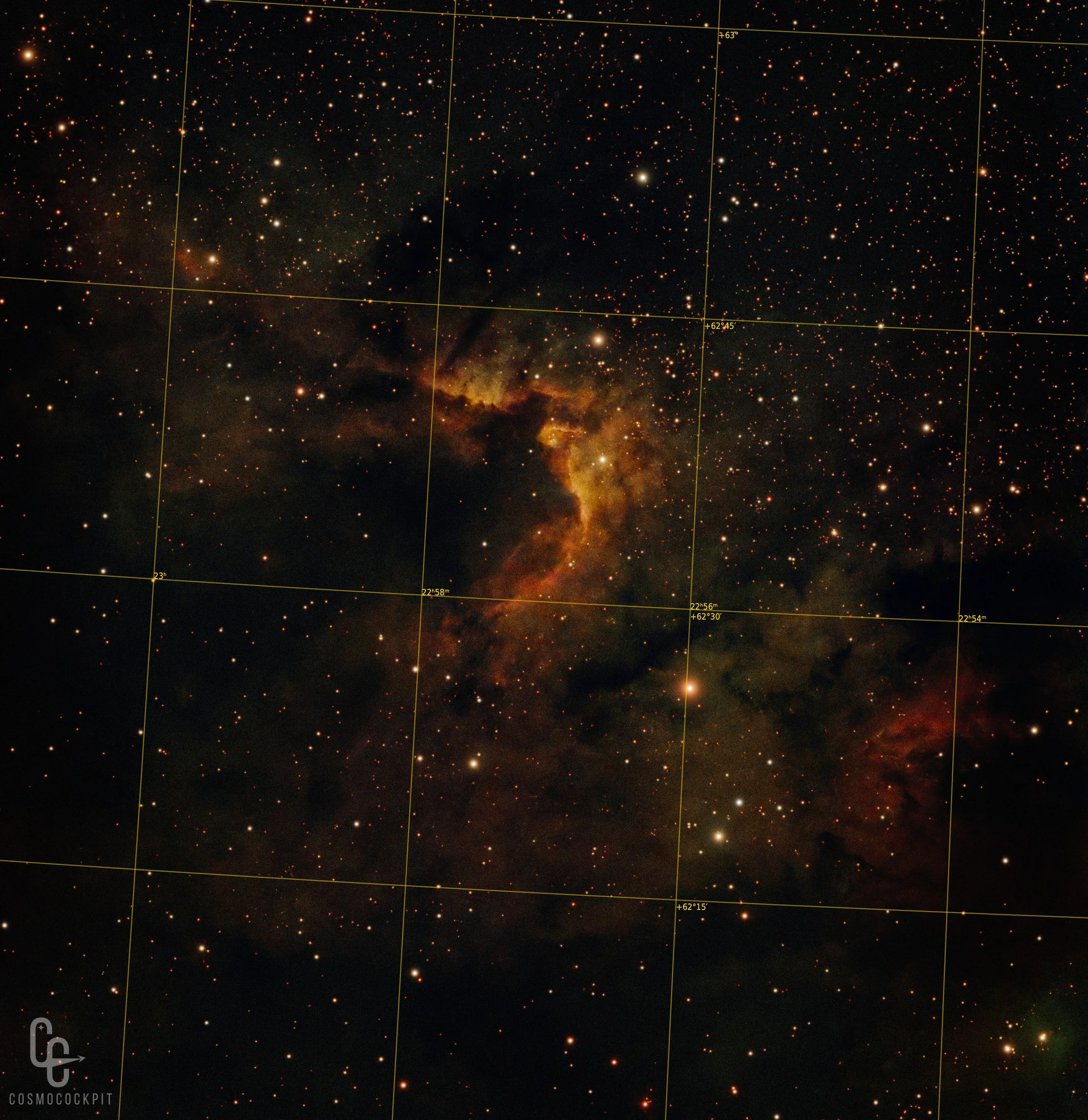
The Cave Nebula and its surroundings, annotated from the PixInsight plate solution.
Astrophysics
The Cave is an H II region: hydrogen gas ionized by the ultraviolet light of hot, young stars. What makes it special is where it sits: right on the boundary between that glowing gas and Cepheus B, a dense molecular cloud that is still forming stars.
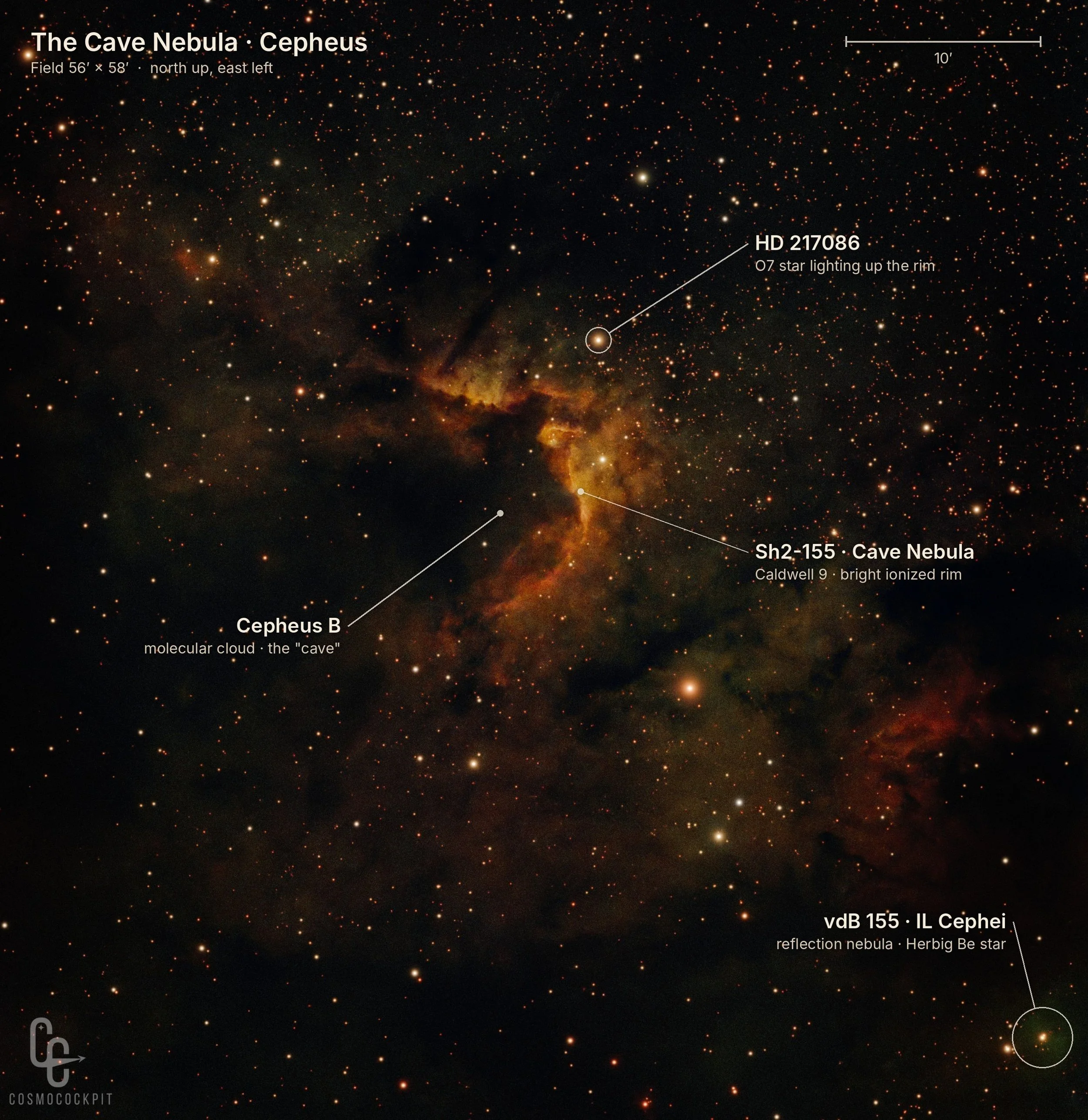
A single star does most of the work: the main source of ionizing light is HD 217086, a massive O7 star belonging to the Cepheus OB3 association, a loose group of young, hot stars. It sits outside the molecular cloud, and its radiation strikes the cloud's surface, ionizing it into the bright rim we see. The dark "cave" itself is part of Cepheus B: cold dust and gas that blocks the light from behind it.
Star formation caused by a star: The radiation from HD 217086 not only erodes the cloud. It also drives a compression wave into it, squeezing gas until it collapses into new stars. Astronomers call this radiation-driven implosion. In 2009, NASA's Chandra X-ray and Spitzer infrared telescopes found hundreds of very young stars in and around Cepheus B, arranged by age: about 1 million years old inside the cloud, 2–3 million years in an intermediate layer, and 3–5 million years further out. That is exactly the pattern expected if the ionization front has been moving into the cloud and triggering new generations of stars as it goes.
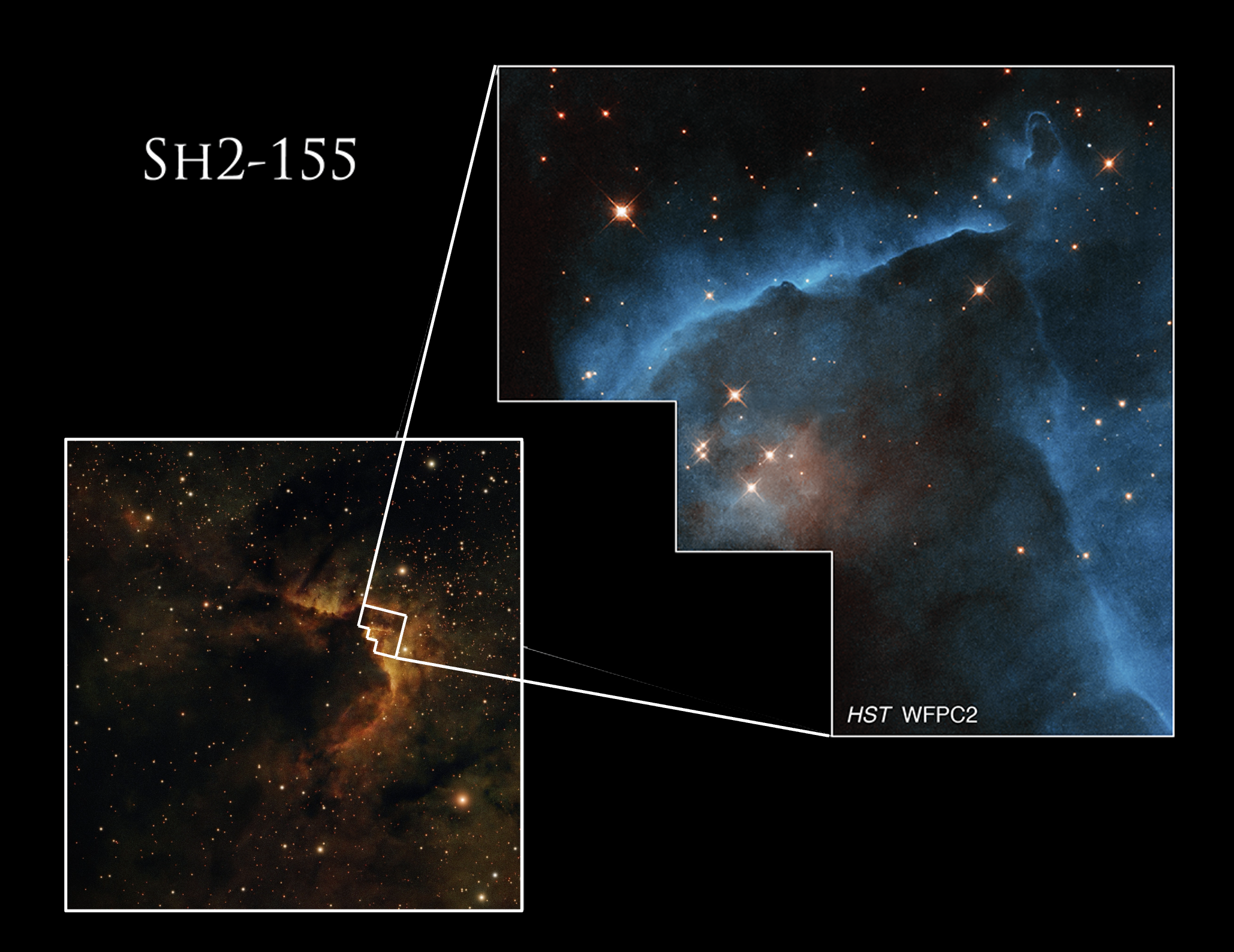
This image of Caldwell 9 (top right), captured by Hubble’s Wide Field and Planetary Camera 2, shows just a small portion of the nebula near the mouth of the cave. NASA, ESA, and K. Stapelfeldt (Jet Propulsion Laboratory); Processing: Gladys Kober (NASA/Catholic University of America)
Disks for future planets: the same study found that 70–80% of the youngest stars still have protoplanetary disks, the dust and gas from which planets form, compared to about 60% in the intermediate layer and only about 30% in the oldest. As stars age, and as the hot stars' radiation evaporates their surroundings, the disks disappear.
Reading the colors: in our HOO rendition, Hα (hydrogen) is mapped to red and OIII (oxygen) to green and blue. Most of the nebula glows in red and orange Hα. The golden tones along the brightest part of the rim, closest to HD 217086, are where some OIII mixes with the hydrogen, since doubly ionized oxygen needs the most energetic ultraviolet light. The dark lanes are dust in front of the nebula, blocking its light.
What is a molecular cloud? It's a cold (around −260 °C), dense cloud of gas and dust, made mostly of hydrogen molecules (H₂). Molecular clouds are where stars are born: when part of the cloud becomes dense enough, gravity takes over and it collapses into a new star. They are invisible in hydrogen-alpha light, so in our images they appear as dark shapes against the glowing gas or the background stars. The Cave Nebula is what happens at the surface of one of these clouds when a hot star nearby lights it up.
Observation
The Cave Nebula is best placed in the autumn evening sky. It reaches opposition in early September, when it crosses the meridian around midnight, and remains well placed through the end of the year.
What you can see visually:
The Cave is a very difficult visual target. Its light is spread over an area larger than the full Moon, so its surface brightness is very low.
Under truly dark skies, a medium-sized telescope with a nebula filter (UHC or Hβ) can show the brightest part of the rim and a hint of the dark "cave" beside it.
From light-polluted skies like Hong Kong's, it is a purely photographic target. The dust lanes, the outer clouds, and vdB 155 only appear after hours of exposure.
Astrophotography Tips
Spend your time on Hα. The Cave is overwhelmingly hydrogen, and its SII signal is very faint. Instead of splitting nights between the D1 and D2 filters, we put all our narrowband time into the Askar D1, collecting 88 ten-minute subframes (14h 40m) over four nights, and processed it as an HOO bicolor.
Shoot around the meridian. At declination +62°, the Cave climbs only to about 50° from Hong Kong, and it faces north, towards the Shenzhen light dome. We centered each night's session on the meridian flip, about 3 hours on each side.
Use broadband data for star color only. With narrowband time outweighing broadband by about 10 to 1, we added the L-Pro data through a star mask, giving the stars more natural color without diluting the nebula's contrast.
Protect the dust. On a target like this, the dark lanes are the subject. Automatic background tools look for the darkest areas of the image as "background", and on the Cave, those are often dust lanes, so we excluded them by hand. For noise reduction, we used NoiseXTerminator's frequency separation, reducing large-scale noise more gently than fine-grained, so the dust kept its natural texture.
Don't mistake a reflection nebula for a color cast. The greenish glow in the lower right corner looked like a processing problem at first. The plate solution showed it sits exactly on IL Cephei: it's vdB 155, real reflected starlight. Before neutralizing an odd color, check what's at those coordinates.
Keep one image scale. We kept the same 1.0x flattener for every session, so all the data were stacked and aligned without resampling.